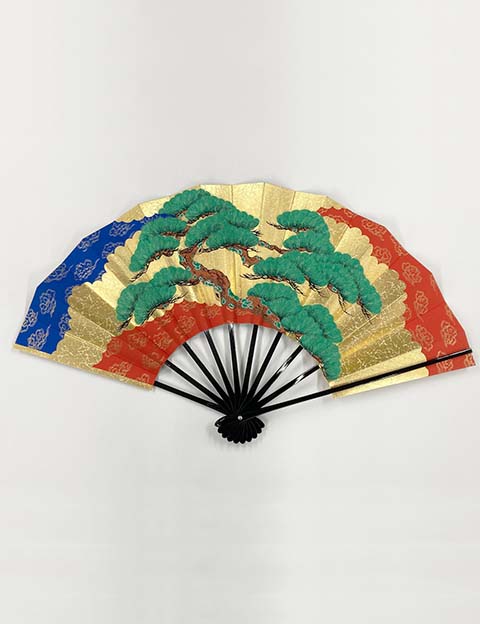
KYO Sensu (Folding Fans)

Kyoto Prefecture

The origins of the fan can be traced back to the early Heian period. It is believed that the fan originated from several thin, narrow wooden planks called "mokkan" that were joined together to form the shape of the fan we know today.
This fan is called a "hiougi" (cypress fan) because it is made by layering and binding thin cypress boards. Next, "kami-sen" (paper fans) made of bamboo and paper were created and exported to China around the 13th century. These then spread to Europe, where they became Western-style fans. The fans that took root in Europe were later re-imported to Japan, giving rise to the "kinusen" (silk fan).

  • Technology/techniques/raw materials

    Technology/techniques

    1. For flat fans, the following techniques or methods shall be used:
    (1) The woodworking process involves splitting the board lengthwise, followed by "side cutting" and "end sealing."
    (2) When decoration is to be applied, after applying white pigment and polishing, the decoration shall be done by foil stamping, dyeing, or painting. In this case, the painting shall be done by hand.


    2. For adhesive fans, the following techniques or methods shall be used:
    (1) The construction of the fan frame shall be as follows:
    (i) For fan ribs made of bamboo, after "single fan rib construction" or "multiple fan rib construction," they shall be dried and re-tightened.
    (b) In the case of fan ribs made of ivory or cow bone, they shall be made using a "single-rib construction."
    H. Polishing and "finishing."
    2. When decoration is to be applied, it shall be done by carving, dyeing, maki-e (gold lacquer), or lacquering.
    (2) When processing the base paper, it shall be done by "glued base processing" or "laminated base processing".
    (3) When processing the fabric, "processing" shall be performed.
    (4) When decorating the paper or fabric, the method shall be "gold stamping," "brushing," "gold leaf sprinkling," "gold dust sprinkling," "gold leaf application," or painting. In this case, the painting shall be done by hand, "printing on a woodblock," or "woodblock printing."
    (5) Folding shall be done by "plain folding," "die folding," or "board folding."
    (6) The finishing process shall be either "internal attachment" or "external attachment" for "paper fan finishes," and "attachment" for "silk fan finishes."
     

    raw materials

    1. For flat fans, the following raw materials shall be used.
    (1) The material shall be cypress, cedar, or sandalwood.
    (2) The foil shall be gold foil, silver foil, or tin foil.


    2. For adhesive fans, the following raw materials shall be used.
    (1) The material for the fan ribs shall be Madake bamboo, Hachiku bamboo, Moso bamboo, ivory, or cow bone.
    (2) The paper used for the base is Japanese paper, and the fabric is made of silk or cotton.
    (3) The foil shall be gold foil, silver foil, or tin foil.
    (4) The lacquer used must be natural lacquer.


  • Work scene

    KYO Sensu (Folding Fans) are divided into two types based on their materials and manufacturing methods: wooden fans and glued fans. Glued fans are further divided into paper fans and silk fans. The materials used for fans are bamboo and paper (or silk). It usually takes about a month to complete one fan.

    Step 1: Processing the fan ribs and cutting the stem.

    For KYO Sensu (Folding Fans) fans, the best material for the fan ribs is said to be bamboo from Tanba. The harvested bamboo is cut into cross-sections, with the nodes removed.

    Process 2: Split bamboo

    The steamed bamboo is cut into small pieces using a splitting knife and a hammer, while measuring the dimensions with a mold to match the width of the fan ribs.

    Step 3: Shedding

    The fruit is roughly cut to separate the white flesh inside from the outer peel. The peel is then thinned on both sides in a "finishing" step and left to dry for 24 hours.

    Step 4: Eye massage

    Holes are made in the thinly split fan ribs for the pivot, and dozens of them are threaded onto bamboo or iron skewers.

    Step 5: Spite

    The fan ribs, which have been roughly cut, are then shaped using a chisel and knife on a stand to create the desired fan frame form.

    Step 6: Whitening

    The fan ribs, which have been deliberately trimmed, are left outdoors in the sun to dry.

    工程7: 磨き

    Polish the dried fan ribs.

    Step 8: Must be used

    The pivot is passed through the drilled holes. After trimming the ends, the fan ribs are complete and sent for finishing.

    Process 9: Base paper processing

    In the "layered paper" technique, washi paper is glued to a core paper that is divided into two layers. The amount of glue is adjusted so that the core paper separates into two layers smoothly when the "spatula opening" is performed.
    The laminated washi paper is dried. The dried paper is cut into fan shapes and sent to wholesalers (fan makers) for decorative processing.

    Step 10: Decorative finishing and foil stamping

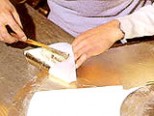
    When decorating with gold leaf, the gold leaf is pressed (applied) onto the fan-shaped paper base. The gold leaf is cut using a spatula on a deerskin surface and then scattered and applied to the fan surface, or pressed into a pattern. The "plain pressing" technique, in which extremely thin sheets of gold leaf are applied one by one to the entire surface of the fan, requires extreme skill and is unique to Kyoto.

    Step 11: Overglaze painting and woodblock printing

    The washi paper, which is pasted together in multiple layers and cut into a fan shape, is then decorated. Colors are matched with pigments, and the designs are hand-painted using brushes and other tools. In addition, stencil printing and Kyoto's unique "tsukiban" (printing method) are used to add embellishments before the paper is sent for folding.

    Process 12: Folding

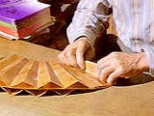
    The process involves separating the two layers of glued washi paper (called "herakuchiake"). The base paper is given a suitable amount of moisture, and a folding pattern corresponding to the number of ribs of the fan is placed on it and folded from the front.

    Step 13: Insertion

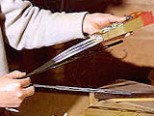
    Using a spatula to separate the bones, a thin bamboo stick called a "sashitake" is used to create a passage or cavity for inserting the central bones into the gap.

    Process 14: Man-kiri

    The unnecessary parts at the top and bottom of the paper are trimmed off, and then it is sent for finishing.

    Process 15: Finishing and intermediate application

    The hollows created by the center are blown into with the mouth (ground blowing), and glued ribs are inserted into the gaps, thus bonding the paper and the ribs together. The more ribs there are, the smaller the holes become, so this requires skill.

    Step 16: Parent

    The fan's outer ribs are heated while held in a vise, and a "tamekawa" (a type of adhesive) is applied to them, causing them to bend inward. Glue is then applied to the inside of the outer ribs, and they are attached to both ends of the paper to complete the fan. This "oya-tame" technique is what creates KYO Sensu (Folding Fans) that closes with a satisfying "snap."


  • Close-up

    The creation of profound beauty born from refined handiwork.

    Born in Kyoto, the fan is a representative symbol of Japanese culture. KYO Sensu (Folding Fans), which bring elegance and tranquility to people's hearts, developed as cypress fans during the Heian period as a symbol of aristocratic society. In addition to winter fans and summer fans (cypress fans and bat-shaped fans), fans have been made for use in incense ceremony, tea ceremony, and dance since the Muromachi period.


    Visiting a workshop to appreciate the beauty of bamboo and paper sculptures.

    The production process for KYO Sensu (Folding Fans) is highly specialized, with each stage—from fan frame processing and paper processing to decoration, folding, and finishing—being handled by expert craftsmen. In this report, we focused on the fundamental materials of the fans: bamboo and paper, and visited workshops that handle fan frame production and decoration.

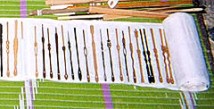
    The fan ribs of silk fans come in various shapes. I've kept all the ones I've made so far, rolled up and preserved. It's a collection that's almost like a small illustrated encyclopedia.

    Living in the context of the Showa era

    Katsuaki Takishita, a fan frame maker, is one of the few craftsmen who makes fan frames for both paper and silk fans. While the term "fan frame" is used broadly, this process usually divides craftsmen into those specializing in "paper fans" and those specializing in "silk fans." The reason he began making two types of fan frames, an unusual feat, was a comment from his master: "From now on, it might be difficult to survive if you only make paper fans, so I'll teach you how to make silk fan frames." In the turmoil following the end of World War II in 1950, Takishita, then 18 years old, left his hometown of Toyama for Kyoto, hoping to acquire a trade. Among the many professions available, he was drawn to the work of making fan frames. At that time, craftsmanship was hereditary, and the children of fan frame makers would begin apprenticeships at around the age of 12. After several years of unpaid apprenticeship, they would perform a year of service as a token of gratitude. That was the era. Takishita, 18 years old when he began his apprenticeship, already had hardening hands, and even with his master's instruction, he couldn't handle the tools as skillfully as he wanted. He lived and trained at his master's house. He had neither the luxury nor the money to go out and have fun on his days off. He would watch his younger senior apprentices go out to have fun while he tirelessly continued to grip his tools. That was his apprenticeship. In the 1950s, air conditioners began to appear. The work of making fan frames for summer fans plummeted, and many of his fellow craftsmen went out of business. His master told him, "It's your life, so I can't tell you to stay in this industry. You can decide what you want to do." He was shocked. "Looking back now, I think it must have been harder for my master than for me when he said that to me. He had to let go of an apprentice he had nurtured with such care." For two or three days, he agonized over it more than he had ever before. "But my apprenticeship had been so hard that I couldn't quit then." He decided to continue, thinking that it wouldn't be too late to quit after seeing how things went for another two or three years.

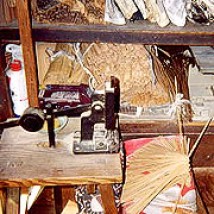
    Tools for drilling holes. I've worked with Mr. Takishita on these. A collection of well-worn tools.

    Doing work that makes people happy

    When she first came to Kyoto at the age of 18, she saw a fan shaped like a bat. She thought, "I wish I could make a fan like that someday." Last year, Takishita exhibited that fan, which "was the catalyst for her entering this world," at an art exhibition. "I felt a deep sense of emotion when I realized that I was now able to make one myself." The fan's ribs are essential to the fan's practicality, including how it is held, opened, and closed. As a craftsman, she concluded, "For the rest of my life, I want to make at least one good thing, at least one thing I can be satisfied with. I want to make something that will make people happy and say, 'This is a good fan.'"

    "Kawahori" (Bat) - made by Mr. Takishita. He was so drawn to this fan that he became a fan frame maker. "Fans cannot be made by one person alone. I am happy that I have been able to make them with the cooperation of everyone," he says.

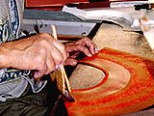
    Overglaze painting, where vibrant colors are applied to the base paper.

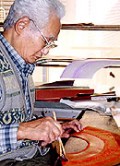
    "For the Tokyo Olympics, we finished tens of thousands of fans. The paper was so heavy that we couldn't even keep it in our upstairs workshop because it was said the ceiling would collapse," says Kazutoyo Kagawa, a painter specializing in the overglaze painting of dance fans. He and his wife, who specializes in gold leaf application, have been painting overglaze paintings side-by-side at their desks. Every year, when the theme for the Imperial New Year's Poetry Reading is decided, the heads of each school of tea ceremony consult with him about the fans for the "Beginning of the Dance." He creates several samples of the design based on the theme, taking into account the preferences of the heads of the schools. The hardest part is matching the colors. Even if they specify, "I want the colors of this old fan," it is extremely difficult to reproduce the aged colors with new pigments because the pigments used in overglaze painting change color drastically over time. Usually, he layers three to four colors to create the desired shade, but for some cases, this process alone can take half a day. "I have a funny story," says Kagawa. "There was a time when they specified the color as 'the blue depicted on a Peace (cigarette) pack.' No matter how many times he brought the color in, they would say, 'That's not it.'" However, the "blue of the Peace cigarette" and the "blue of the fan" in his hand looked identical. After much thought, he brought out a pack of cigarettes and said, "To my eyes, this blue and the blue of the Peace cigarette are the same." It turned out that the printed colors of the "blue of the Peace cigarette" that they each had were actually different. Mr. Kagawa remains particular about colors. Even when he goes to department stores, he says, "I can't help but look at the 'color trends' in kimonos, Western clothes, and accessories." "Because I started this because I love it." He has been in this field for 50 years. Blurring, haze. From the tip of the brush of this 73-year-old active artist, beautiful flowing lines are drawn on dance fans of various schools, mainly the Nishikawa school.

    • Kagawa's workspace is lined with brushes of various widths, thicknesses, and lengths, including multi-tip brushes and single-tip brushes.

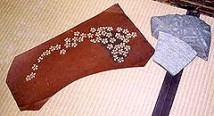
    • A stencil featuring a cherry blossom pattern, perfect for spring. Sometimes, he would use a blade instead of a paintbrush to create his own stencils. On the right is a woodblock print of a fan made as a summer gift for a major company. The varying pressure applied to the print creates a unique, slightly faded look. The warmth of handmade craftsmanship is a hallmark of woodblock printing.

    Craftsman Profile

    Katsuaki Takishita

    Born on January 20, 1934.
    KYO Sensu (Folding Fans) fan master
    Traditional craftsman
    Kyoto City Traditional Industry Technology Meritorious Service Award
    He currently serves as a director of the Kyoto Fan and Uchiwa Manufacturers' Cooperative Association.

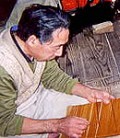
    Traditional techniques inherited from his master. Mr. Takishita "applies pressure" to the bone that has been massaged.

    Kazutoyo Kagawa

    Born on January 1, 1928 (Showa 3).
    KYO Sensu (Folding Fans) fan illustrator.
    Kyoto City Traditional Industry Technology Meritorious Service Award
    Chairman of KYO Sensu (Folding Fans) Traditional Craftsmen's Association
    Vice Chairman of the Kyoto Fan and Uchiwa Manufacturers' Cooperative Association

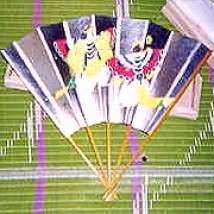
    A vibrant red background is adorned with a golden mist. In addition to dance fans, Ms. Kagawa has also painted overglaze designs on summer fans and tea ceremony fans. When she holds a brush, she becomes a completely different person, her eyes intense and focused.

    Anecdotes

    A landscape with a fan

    A townscape with fans
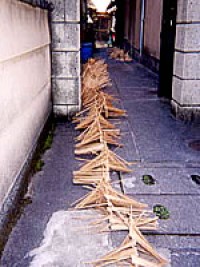
    Iwagami Street, once known as "Honeyamachi" (Bone Town), was home to fan frame makers. The sounds of hammering and shaping bamboo echoed day and night. On sunny days, the sight of fan frames being dried in the neighborhood was famous and even featured on tour buses. Craftsmen competed to secure the closest possible drying spot to their workshops. The distinctive scent of bamboo soaked in water, wafting through the streets, was also a characteristic feature of the area. Capturing emotions in a fan.
    A fan is a portable work of art. Why not record your fresh feelings on a fan at important turning points in your life? When you take the first step in something for the first time, remember that "beginner's spirit" at that moment. It can be words or a picture. Transfer your own resolve and thoughts onto the fan's surface. When you feel like giving up, when you're feeling down and can't stop looking at the ground, or when you set a new goal, a single word written on the fan might just show you the way forward.

    There are also workshops where you can try painting designs onto fans. It would be a wonderful way to capture the season and your feelings at that moment as a memento of your visit to Kyoto.

    • Although their numbers have decreased, you can still see the sight of fan frames being dried on sunny days.


overview

Craft item name KYO Sensu (Folding Fans)
Reading Kyosensu
Classification of crafts Other crafts
Main Products Cooling fan, ceremonial fan, performing arts fan, decorative fan
Main manufacturing area Kyoto City, Uji City, Kameoka City, Nantan City
Designated date October 14, 1977

contact address

■ Production area association

Kyoto Fan and Uchiwa Manufacturers Cooperative Association
606-8343
9-1 Okazaki Seishoji-cho, Sakyo-ku, Kyoto City, Kyoto Prefecture
KYO Office
TEL: 075-761-3572
FAX: 075-761-3573

http://www.sensu-uchiwa.or.jp/

Features

These small craft items, born from meticulous handiwork using carefully selected materials such as bamboo and paper, possess not only superficial beauty but also a variety of "beauty" inherent in practical objects, such as their texture and character.

How to make it

In the case of a typical paper fan, the fan surface (senmen) is decorated with gold leaf, gold dust, or overglaze painting, and folds are made using a folding mold according to the number of ribs. Then, gaps are made in the base paper for the ribs to pass through, glue is applied, and the central ribs are inserted. Finally, the ribs at both ends, called the outer ribs, are glued in place.

top