KYO Uchiwa (Fans)

Kyoto Prefecture

The origins of KYO Uchiwa (Fans) can be traced back to the Nanboku-cho period. It is said that Korean fans, brought to western Japan by Japanese pirates known as Wako, who raided the coastal areas of China (then called Ming) and Korea, were introduced to Fukakusa, a villa area of Kyoto nobility, via Kishu and Yamato.
The unique structure of KYO Uchiwa (Fans), where the handle is attached separately rather than being integrated with the central frame, became established during the Edo period. This is believed to have originated with "Gosho Uchiwa" (court fans), which were painted by artists of the Tosa and Kano schools who created artwork for the imperial court. Soon after, they spread to be used by common people as well, establishing the foundation for today's KYO Uchiwa (Fans).

  • Technology/techniques/raw materials

    Technology/techniques

    1. "Fan frame processing" shall be carried out using the following techniques or methods:
    (1) After making cuts in the split bamboo, perform the "mashing" and "shredding" by hand.
    (2) After air-drying, remove the whiskers.

    2. When decorating the paper, the methods used may be "gold stamping," "splashing with gold leaf," "hand carving," "torn paper collage," "gluing," "dyeing," or painting. In this case, the painting must be done by hand, "printing on a woodblock," or "woodblock printing."

    3. After the temporary covering is done, the "back covering" should be done.

    4. After "trimming the beard" and "matching," use the prayer spatula to "remind the hair."

    5. After making a deposit, perform "revolving" and "removing" the stakes.

    6. Insert a handle. In this case, the handle should be made of wood wax with a polished finish or lacquered.
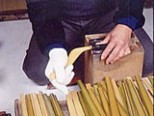
     

    raw materials

    1. The material for the fan frame shall be Madake, Hachiku, or Moso bamboo.

    2. The base paper shall be Japanese paper (washi).

    3. The foil shall be gold leaf or silver leaf.

    4. The material of the handle shall be wood, bamboo, ivory, or cow bone.

    5 漆は、天然漆とすること。

  • Work scene

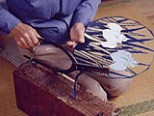
    The production of KYO Uchiwa (Fans) involves processing the fan frame, decorating the fan paper, applying a backing, and finishing the process.

    Step 1: Processing the fan frame - Cutting the body

    For KYO Uchiwa (Fans) fans, the frame is said to be made from Tanba bamboo. The harvested bamboo is cut into rings, with the nodes removed.

    Step 2: Split bamboo

    Using a mold to measure the width of the fan's ribs, the paper is carefully split into small pieces using a splitting knife and a hammer.

    Step 3: Width adjustment

    We'll even out the width of the roughly shaped fan ribs.

    Step 4: Thickness matching

    We will now standardize the thickness of the fan ribs, which have been cut to the same width.

    Step 5: Chop

    Make a notch at the top of the inner bone.

    Step 6: Kneading

    The top end of the bamboo is notched and then split by kneading it alternately from side to side along the bamboo fibers.

    Step 7: Hegi

    The fan frame is trimmed, and the fan is complete. It will then be sent for backing processing.

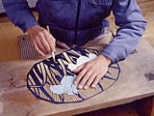
    Step 8: Decorating the fan paper

    We apply decorations such as hand-painting, woodblock printing, dyeing, paper cutting, and collage to fan paper.

    Step 9: Backing process

    Glue thin bamboo strips to a thin piece of paper. The cross-section of the bamboo is rectangular, so glue it to the shorter side.

    Step 10: Lining

    On the back of the temporarily attached surface, attach the paper that will be used for the back of the fan.

    Step 11: Turning over

    Once the paper on the back of the fan and the frame are completely glued together, peel off the paper that was temporarily attached to the front.

    Process 12: Finishing process - Alignment

    Attach the paper to the front of the fan.

    Step 13: Finishing touches

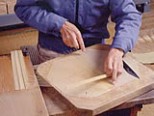
    After the fan paper is attached to both sides of the thin bamboo, a squeegee is used to create grooves along the edges of the fan's frame. This requires meticulousness, as the phrase "to make a point" suggests. This is what creates the unique style KYO Uchiwa (Fans).

    Step 14: Base plate mounting

    Attach a piece of cloth or thick paper to the part where the handle will be inserted (the center).

    Step 15: Turning around

    Once the material has been reinforced, it is cut into the shape of a fan and then molded.

    Step 16: Edge trimming

    After cutting it into a specific shape, cover the edges with thin paper. Then, add a pattern to complete it.


  • Close-up

    KYO Uchiwa (Fans) with elegant designs that evoke a sense of refined elegance.

    The history of Japanese fans is long, dating back to the Nara and Asuka periods. Traditional KYO Uchiwa (Fans) are elegant and refined, befitting the thousand-year-old capital, and cherish a taste of refined taste. Their charm is underpinned by exquisite craftsmanship and elegant beauty.


    Born in Aiwa

    "From the time I can remember, 'uchiwa' (Japanese fans) have been a part of my life." Tomoyuki Aiba, president of Aiba, is both a 'uchiwa craftsman' and a 'business owner.' Founded in the Genroku era, Aiba has a 300-year history, and he was born as the tenth heir. Didn't he feel any pressure because of that? "My father, who had a strong craftsman's spirit, never told me to take over the business. Looking back now, I think he raised me very well." Instead, "I was told a lot by the people around me, things like, 'When I grow up, I'm counting on you to open the uchiwa shop.'" So, "I naturally thought that taking over the business was 'just how things were supposed to be.'" After graduating from university, he got a job at a credit union. He didn't immediately take over the family business. Why? "When you're pushed to your limits, you start to see the priorities of the problems you're facing, and what's most important right now." He always had the idea of eventually taking over the family business in mind. That's why he thought, "If I get a job at a bank, I can absorb information about finance and management. Especially at a credit union that's closely connected to the local community, I can see how the local economy works from the inside. (At such a young age, fresh out of university) I can meet and talk directly with company presidents face-to-face," something he thought wouldn't be possible at other companies. He was only 22 years old. It was a decision he made with the intention of eventually being involved in management.

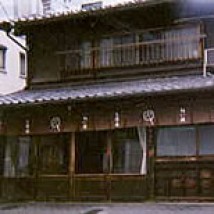
    The Aiba family business was founded in 1689 (Genroku 2). Initially, they employed many artists and also published books on woodblock prints. It was under the seventh generation that they became a specialty fan shop.

    Entering the workplace as a "craftsman"

    After working for four years, he left the credit union to join the family business. It was his start as a "craftsman." He stepped into the workshop he had frequented since childhood, this time as a "craftsman." "When I actually started, it was really from scratch. Watching and doing it yourself are completely different things. In terms of motivation, I think it was higher than others." What was difficult was that "no matter how much I wanted to learn, the senior craftsmen wouldn't open their knowledge base." When he asked "how do you do it?", all he was told was "I'm doing it (right in front of you)." It was like that from A to Z. "I tried it myself, failed many times, and when I brought it to them saying, 'I want to do it this way, but I just can't,' they would say, 'I thought so. I thought from the beginning that it wouldn't work that way.'" It was only then that he was given the wisdom (technique) of "how to do it." But "now that I can make a 'uchiwa' fan from scratch, I think that even though it seemed like a roundabout way, it was important." If you don't thoroughly explain things you "don't understand" before teaching them, it won't become part of your craft as a craftsman. How deeply can one deepen their "dedication" and "understanding" of their work and skills? That is a matter of life and death for a "craftsman." There is a right time to teach even a single thing. "I only understood that after I became a teacher myself," he said with a laugh.

    As the tenth generation, I am working hard to create, perfect, and establish the "transparent fan" design.

    Craftwork inherently possesses the richness of being custom-made.

    Aiba is strongly associated with traditional KYO Uchiwa (Fans) as works of art and craft, as well as creative openwork fans. They have supplied highly decorative KYO Uchiwa (Fans) to renowned department stores, corporations, restaurants, and inns. However, their philosophy is that "crafts are something you have made, not something you buy." Therefore, they believe it's perfectly fine to receive orders for fans that "suit the tatami room in my house."
    "I once made a fan for my grandmother's rehabilitation," she said. The fan was made by her family for their grandmother who had suffered a stroke. To fulfill the family's wish that the fan would help her with her rehabilitation exercises, which still had some difficulty with her hands, without making her feel discouraged, they spent a lot of time discussing the design. They created a practical, small fan that could be placed by the bedside.
    There is a story behind every piece of craftsmanship. It includes the thoughts and feelings of the person who commissioned it, and the skill of the craftsman who received the order, taking that background into account. "If we can have a thorough and detailed discussion, I would like to continue to accept custom orders from individuals," he said. "I want to emulate the speed, precision, and agility of my predecessors, including my father, both as a craftsman and as a business owner."

    Beautifully handcrafted "KYO Uchiwa (Fans)" adorned an entire wall in the reception room.

    Craftsman Profile

    Satoshi Aiba

    Born on August 23, 1960.
    He succeeded to the name of the 10th generation Aiba Chobei.
    Received the Minister of International Trade and Industry Award (1998)

    Aiba President Tomoyuki Aiba (10th generation Aiba Chobei)

    Anecdotes

    KYO Uchiwa (Fans) add a touch of color to any space.

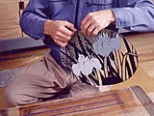
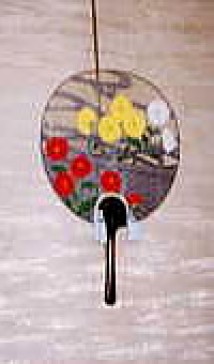
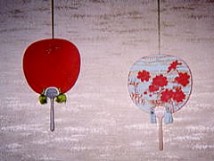
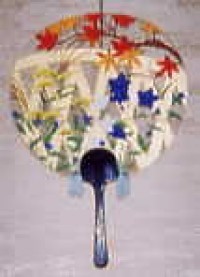
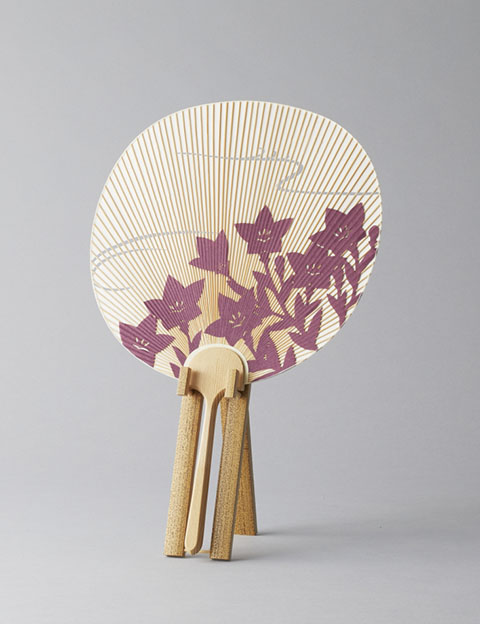
    The moment a vibrant "KYO Uchiwa (Fans)" is hung on the wall, a cheerful atmosphere fills the room. While some fans are highly practical, beautifully decorative fans are also made. They feature exquisite depictions ranging from those inspired by the four seasons of Kyoto to those based on themes from The Tale of Genji and Greek mythology. The highly decorative "openwork fans" possess a light, delicate elegance that paintings lack.

    • "KYO Uchiwa (Fans)" evoke the vibrant four seasons of Kyoto. Seasonal flowers are depicted on delicate, openwork fans.


overview

Craft item name KYO Uchiwa (Fans)
Reading Today's fan
Classification of crafts Other crafts
Main Products fan
Main manufacturing area Kyoto City, Nantan City
Designated date October 14, 1977

contact address

■ Production area association

Kyoto Fan and Uchiwa Manufacturers Cooperative Association
606-8343
9-1 Okazaki Seishoji-cho, Sakyo-ku, Kyoto City, Kyoto Prefecture
KYO Office
TEL: 075-761-3572
FAX: 075-761-3573

http://www.sensu-uchiwa.or.jp/

Features

KYO Uchiwa (Fans), nurtured by a rich climate, culture, and history, continue to be imbued with new design sensibilities through the skill and dedication of their artisans. More than just tools for keeping cool, they delight our eyes as exquisite works of art and craft, adding elegance and richness to our lives.

How to make it

KYO Uchiwa (Fans) are made by arranging thin, split bamboo ribs, each individually notched and split, radially on the top end of a high-quality split bamboo. A cover decorated with gold leaf, hand carving, hand-painting, or woodblock printing is then attached, grooves are made along both sides of the ribs with a bamboo spatula, and the fan is cut into various shapes. Thin paper is wrapped around the edges, and the handle is inserted to complete the fan.

Please see here for information on traditional craftspeople.

Japanese traditional craftsman
top