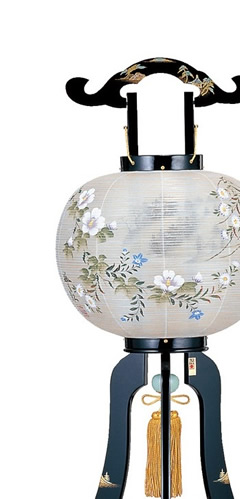
YAME Chochin (Lanterns)

Fukuoka Prefecture

The origins of YAME Chochin (Lanterns) are said to date back to the early 19th century, when simple, unadorned lanterns called "bachochin" were created.
In the mid-19th century, innovative designs revolutionized paper lanterns. By the end of the 19th century, paper lanterns had become a major product among locally produced industrial goods.

  • Technology/techniques/raw materials

    Technology/techniques

    1. When processing the paper base, "sizing" and "base color application" should be performed. However, for white paper, "base color application" may not be performed.

    2. When decorating paper or silk, the decoration must be done by "painting." In this case, the "painting" must be done by hand.

    3. When processing the lantern shade, the following methods shall be used: "mold assembly," "bamboo strip winding," "adhesion," "seam cutting," and "die cutting." However, if "silk adhesion" is used, the following methods shall be used: "mold assembly," "bamboo strip winding," "silk adhesion," "seam cutting," "sizing," and "die cutting."

    4. When processing the wood, the process involves "wood preparation" and "painting."
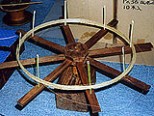
     

    raw materials

    1. The base paper shall be Japanese paper (washi), and the silk shall be silk fabric.

    2. The frame of the lantern shall be made of Madake bamboo or Moso bamboo.

    3. The wood used shall be magnolia, cypress, pine, or a material of equivalent quality.


  • Work scene

    The manufacturing process for YAME Chochin (Lanterns) is broadly divided into six stages: making the lantern shade, painting, preparing the wood, applying lacquer, creating the maki-e (gold lacquer) decoration, and finishing. Each of these stages is an independent industry.

    Wooden components such as the handboard and finials, as well as the lampshade, tassels, and metal fittings, are all manufactured in parallel. The completed parts are then gathered at a lantern shop that manages the entire production process and assembled into the final product.

    Production of the lantern

    Step 1: Preparing the bamboo strips

    YAME Chochin (Lanterns) are made by spirally winding a single frame to create the lantern's shape. Therefore, a long frame is first made from bamboo strips. These strips are approximately 0.4 mm in diameter and 4.5 meters long. Typically, 12 to 25 of these are joined together to form a single long frame.
    Making bamboo strips is a job that requires advanced skills and expertise, and is carried out by specialized craftsmen.
    The method of shaping using a single bamboo strip is called "ichijo rasen" (single spiral), and it was devised in Yame during the Edo period.

    Step 2: Assembling the wooden mold

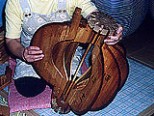
    First, we assemble a wooden mold that will serve as the prototype for the lantern. The mold should be the same size and shape as the lantern we intend to make. We then wrap bamboo strips around this mold to create the shape of the lantern.
    The wooden mold consists of boards called "wings" and discs for securing the wings. Each mold requires 8 to 16 wings. Grooves are carved into the edges of the wings to secure the bamboo sticks.

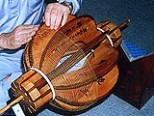
    Step 3: Wrapping the bamboo strips

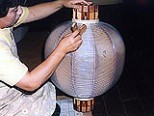
    Rings are fitted to the top and bottom of the wooden mold. One end of the bamboo strip is secured to the upper ring, and the strip is wound spirally along the grooves of the wings, finishing with the lower ring. Winding the strips at narrow intervals without any tangles requires skill.
    Once the bamboo strips are wrapped, threads are attached to control the expansion and contraction of the lantern and prevent damage to the paper. The threads are laid along the top of the bamboo strips, passed from the upper tension ring to the lower tension ring, and both ends are secured to the upper and lower tension rings. Care must be taken to ensure that the threads are not at an angle. These threads are called hanging threads. The number of hanging threads varies depending on the size of the lantern.

    Step 4: Applying the base silk

    First, apply silk from the top and bottom rings up to about 4-5 bones away to reinforce the opening.
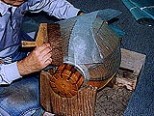
    Next, the space between the threads that are stretched vertically is considered one section, and sumi paste is applied to the bamboo strips in that section with a brush, and the base silk is then attached.
    The base silk is stretched taut with a little slack, and any raised areas are gently pressed down with a brush.
    The base silk is stretched out at one-ken intervals so that once the previously stretched silk has dried, the adjacent silk can be stretched out.

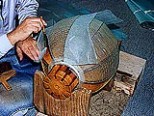
    Step 5: Cutting the seams of the base silk.

    One piece of base silk is used per bay. The width of the overlapping seams between adjacent pieces of base silk is only about 1 millimeter. Each time a piece of base silk is hung, the excess silk is trimmed along the hanging threads with a razor blade. Maintaining this narrow and consistent width requires skill.

    Step 6: Dough preparation

    Once the base silk has been stretched and the seams have been trimmed, the surface of the lantern shade is treated to prevent the pigments from bleeding during painting and to give the surface a glossy finish.
    The processing involves using a solution called "dosa," which is a mixture of animal glue and alum dissolved in water.
    By applying "dosa" evenly to the surface of the lantern shade with a brush, the fine irregularities on the paper surface are filled in, making it smooth. This process is called "dosa application."

    Step 7: Cutting out the shapes

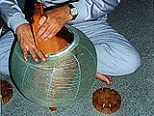
    The attached firebox is then dried. After drying, the wooden mold is disassembled inside the firebox and the feathers are removed.
    The lantern shade, after being removed from the mold, is folded by pinching the bamboo strips together to create creases, and then passed on to the lantern maker for the painting process.

    Step 8: Painting

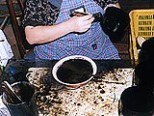
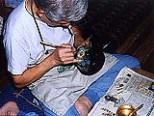
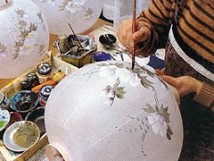
    The painting is done by specialized craftsmen called painters. The painters do not make any preliminary sketches and paint directly onto the lampshade with a brush.
    The painted lantern shades are then handed over to the lantern maker.

    画像をクリックすると動画が再生されます

    Production of the rim and handboard

    Step 1: Wood preparation

    Thin boards are bent to create the rings. The upper ring is called a "musou-rin," which is made by gluing two boards together. Because of its double-layered structure, the joint between the firebox and the ring can be hidden when the firebox is finished.
    Cut out the handboard from a thick board using a sewing machine saw. Sand the cut handboard to make the surface smooth.
    Wooden components such as lintels and handboards are called "kiji," and craftsmen who specialize in this work are called "kijishi."
    The finished wooden base is then passed on to the lantern maker for the lacquering process.

    Step 2: Lacquering

    The lacquering process is carried out by specialized craftsmen called lacquerers. To achieve a refined finish, the lacquer is applied in two coats. After the lacquering is complete, the wooden base is passed on to the maki-e artist via a lantern maker.

    工程3: 蒔絵

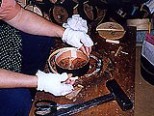
    Makie is a technique where an underpainting is drawn with lacquer, and once the lacquer has dried to the right degree, gold, silver, or colored powders are sprinkled on to create the design. The timing for sprinkling the gold powder is judged by observing the dryness of the lacquer, and this requires considerable skill.
    In addition to maki-e (gold lacquer) decoration, some pieces are decorated with raden (mother-of-pearl inlay), which involves attaching lustrous seashells.
    Makie and raden are applied by specialized craftsmen called makie artists.
    The decorated wooden base is then handed over to the lantern maker.

    The finishing touches are done at the lantern shop. The lantern shop has painted lampshades and decorated wooden bases, as well as tassels and metal fittings, each handcrafted by specialized artisans.
    Attach the ferrule to the lampshade, attach eyelets or other metal fittings to the ferrule, thread the string through and attach the handle plate. Finally, attach the tassel to complete the lantern.


  • Close-up

    The heartwarming, powerful warmth of people and pottery.

    Yame City, Fukuoka Prefecture. In the city center, traditional storehouses still line the streets, conveying the atmosphere of the Edo, Meiji, Taisho, and early Showa periods to the present day. Along with tea shops, miso shops, and Japanese confectionery shops that evoke a sense of nostalgia, there are also many Buddhist altar shops and lantern shops, a scene unique to Yame, a city famous for its lanterns. We spoke with Yasuo Imamura, the owner of a lantern manufacturer and an expert on Yame's lantern making.
     

    From summer lanterns to Bon lanterns

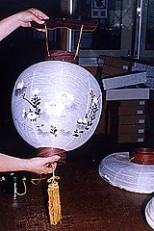
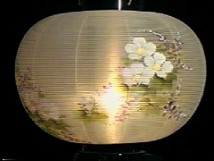
    The paintings of hibiscus flowers and autumn grasses, peacocks and landscapes, rendered with exquisite brushwork, are the hallmark of YAME Chochin (Lanterns). Thin Japanese paper or silk is used for the lanterns, and the light shines through the refined paintings. Their refreshing appearance was so popular that during the Edo period, they adorned the eaves of verandas throughout the country as lanterns that brought coolness on summer nights.
    Yame has always been a production area for bamboo and paper. Using these materials, lantern making began in the Edo period. For 180 years since then, lanterns have been continuously made in Yame. Since the Meiji era, the main product has been Bon lanterns, and the production volume is currently the highest in Japan, making it truly a lantern capital.

    Lanterns and Buddhist altars

    Yame is a production center for both paper lanterns and Buddhist altars. Like paper lanterns, YAMEFUKUSHIMA Butsudan (Household Buddhist Altars) are designated as a national traditional craft.
    "Lanterns, like Buddhist altars, are manufactured through a highly specialized division of labor. We, the manufacturers, act as a bridge between processes that take place in different locations, and ultimately gather all the parts and assemble them to create the finished product," Imamura explains.
    Both lanterns and Buddhist altars are made using a division of labor, which allows the techniques of each process to be refined. Even just looking at the fire shade that covers the light, there are artisans who wind the bamboo frame and cover it with Japanese paper or silk, and painters who apply the designs. Other parts, such as the wooden base for the rim that secures the top and bottom of the fire shade, the legs and handles, the lacquering, and the maki-e decoration, are all done by specialized craftsmen. YAME Chochin (Lanterns) are created through the accumulation of the skills of these many skilled craftsmen. Many of the processes, such as woodworking, lacquering, and maki-e, are influenced by the techniques used for Buddhist altars.
    Just as Bon lanterns are placed close to the Buddhist altar, the craftsmanship seems to be intertwined with the altar itself.

    The art of hand-drawn art

    Among the many processes involved in making YAME Chochin (Lanterns), the painting process is what truly distinguishes them. YAME Chochin (Lanterns) are painted by hand; no preliminary sketches are made. The artist paints directly with paint, following the composition in their mind. However, there is a guideline for the placement of the design. This guideline is the lines of thread that connect the spirally wound frame of the lantern's frame vertically. By deciding where to paint what along these lines, the overall balance of the design is maintained.
    YAME Chochin (Lanterns) do not have designs drawn on paper. Instead, they use photographs of lanterns made by senior craftsmen or other samples as models, depicting the designs in three dimensions. When deciding on a new design, the ideas are drawn onto the actual lantern. The manufacturer and the artist meet and discuss the design, drawing it onto a white lantern multiple times, until the final design is decided.
    "The defining characteristic of YAME Chochin (Lanterns) is undoubtedly their hand-painted designs, so I hope the artisans who paint them will continue to pass on that tradition," says Imamura.

    Bon lanterns to express feelings for the deceased

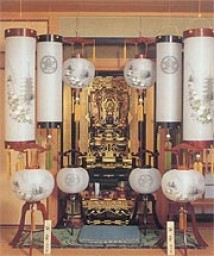
    The delicately painted Bon lanterns are etched in people's memories as a mystical symbol of summer. Bon lanterns are gifts given by siblings or close friends of the deceased to families observing their first Obon festival as a form of remembrance. It is said that Bon lanterns tell the story of the deceased's relationships during their lifetime, and it is not uncommon to see dozens of lanterns lined up in front of the Buddhist altar. Precisely because they are gifts, the most beautiful lanterns are sought after. However, no matter how beautiful they are, Bon lanterns are only displayed for a few days out of the year. Even though they are only displayed for a few days, they embody the feelings people have for the deceased. To give form to these feelings, artisans in Yame continue to make Bon lanterns day after day throughout the year.
    Recently, such gifts are often given in cash, and it has become more common for the bereaved family to buy the lanterns themselves.
    "These days, fewer and fewer families have a Buddhist altar, but I hope that at least during Obon, the whole family will gather in front of the altar to pay respects to their ancestors, and that children will also have that feeling. Lanterns are part of that custom," Imamura said thoughtfully.

    Anecdotes

    Interacting with lanterns

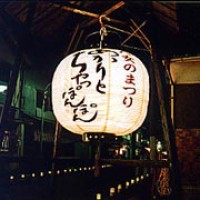
    In Yame City, an event called "Akari to Chapponpon" is held every year for several days around the autumnal equinox in September. "Chapponpon" refers to the traditional performing art "Yame Fukushima Lantern Dolls," which is designated as an Important Intangible Folk Cultural Property. The event is held in honor of the "light" of these lantern dolls, the "light" of YAME Chochin (Lanterns) lanterns, and the "light" of illuminated chrysanthemums (Note 1), which originated in Yame. During the event, a lantern festival, an lantern parade, a local products festival, and a townhouse festival are also held, allowing visitors to experience Yame's traditional culture and industries.
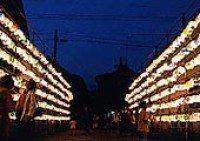
    One of the highlights is the lantern parade. Between 1,700 and 1,800 lanterns adorned with pictures line the streets, brilliantly illuminating the autumn night. The pictures on each lantern were diligently drawn by elementary school students in the city as their summer vacation homework.
    In addition to this, Yame also offers lantern painting as a class activity at prefectural high schools. As a lantern producing region, they are trying to create as many opportunities as possible for children, who will be the future leaders, to interact with lanterns and cultivate successors.

    (Note 1) Chrysanthemums that have been artificially lit in a greenhouse to control their flowering period.


overview

Craft item name YAME Chochin (Lanterns)
Reading Stop lanterns
Classification of crafts Other crafts
Main Products Bon lanterns, festival lanterns, votive lanterns, decorative lanterns
Main manufacturing area Yame City, Yanagawa City, Chikugo City, Hirokawa Town (Yame District), Kurume City, Miyama City
Designated date July 3, 2001

contact address

■ Production area association

YAME Chochin (Lanterns) Cooperative
834-0063
425-22-2 Honmura, Yame City, Fukuoka Prefecture
Inside the Yame Chamber of Commerce and Industry
TEL: 0943-22-5161
FAX: 0943-22-5164

Features

YAME Chochin (Lanterns) gained fame as cooling lanterns by redesigning the bamboo frame into a single spiral structure, replacing the thick cardboard with thin Yame handmade paper, allowing the interior to be seen through, and featuring colorful paintings of landscapes, plants, flowers, and birds. Both traditional, simple lanterns and modern Bon lanterns are made using techniques and methods cultivated in the soil of Yame, and Yame boasts the highest production volume in Japan for these elegant and atmospheric lanterns, with products shipped widely throughout Japan and overseas.

How to make it

First, the lantern's mold is assembled, and bamboo strips are wound spirally along the grooves carved into the mold. Next, glue is applied to the bamboo strips, and the base paper (silk) is attached, with the overlapping parts of the paper (silk) being trimmed. Once the lantern is dry, the mold is removed, and landscapes, plants, flowers, and birds are hand-painted onto the lampshade with a brush. After applying lacquer and fitting the lampshade into the top and bottom rings and legs decorated with maki-e (gold lacquer) designs, accessories are attached to complete the lantern.

Please see here for information on traditional craftspeople.

Japanese traditional craftsman
top