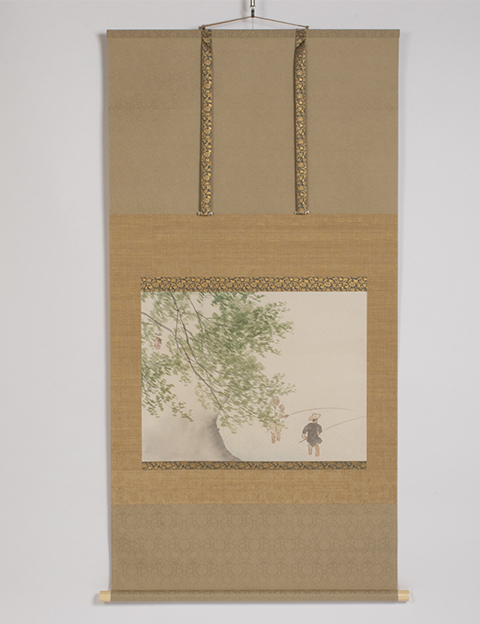
Edo-style mounting

Tokyo

The history of mounting and framing dates back to the Nara period, but Edo-style mounting and framing began in the early 17th century when the shogunate was established in Edo, and mounting and framing artisans employed by daimyo (feudal lords) and temples and shrines settled in Edo.
Edo Hyogu, which developed from the samurai culture of Edo, is characterized by its understated and light designs that also possess a touch of luxury and splendor. Furthermore, it is a robust product that can withstand the dry climate of Tokyo.

  • Technology/techniques/raw materials

    Technology/techniques

    1. For hanging scrolls and hand-rolled scrolls, the following techniques or methods shall be used:
    (1) The paper and the fabric backing shall be done by first applying "skin backing" and then "additional backing".
    (2) Make "cut and splice" the edges of the paper.
    (3) Use a brush to perform the "upper back" and then "back" after drying.

    2. For folding screens, framed pictures, sliding doors, and partitions, the following techniques or methods shall be used:
    (1) The underlayment shall be made by "bone binding," "flat pasting," "raincloth pasting," "raincloth holding," "round weaving," and "bag pasting."
    (2) The hinges of the folding screen shall be attached using the "wing-type" method.
    (3) The final upholstery shall be done by "overlaying".

    3. When attaching to a wall, the following techniques or methods shall be used:
    (1) The underlayment shall be made by "flat covering around the edges/flat covering throughout", "bag covering", and "clean covering".
    (2) The final upholstery shall be done by "overlaying".


    raw materials
    1. The paper used must be Japanese paper (washi).
    2. The fabric shall be silk, cotton, kudzu cloth, banana fiber cloth, or a woven fabric of equivalent material.
    3. The adhesive shall be wheat starch paste or an equivalent material.

overview

Craft item name Edo-style mounting
Reading Edo Hyogu
Classification of crafts Other crafts
Main Products Hanging scrolls, rolled scrolls, sliding doors, folding screens, framed pictures, partitions, wall hangings
Main manufacturing area Ota Ward, Koto Ward, Taito Ward, and others; Saitama Prefecture: Saitama City, Kawagoe City, and others; Chiba Prefecture: Urayasu City; Kanagawa Prefecture: Kamakura City
Designated date November 16, 2020

contact address

■ Production area association

KYO Hyogu (Art Mountings) and Interior Decorators
110-0015
Room 402, Dai-2 Higashi Building, 4-10-14 Higashi-Ueno, Taito-ku, Tokyo
Tel: 03-5826-1773 Fax: 03-5826-1774

https://tokyo-hyougu.jp/

Please see here for information on traditional craftspeople.
Japanese traditional craftsman
top