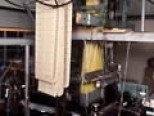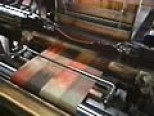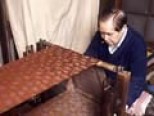
Technology/techniques
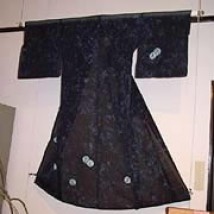
1. In the case of Omeshi weaving, the fabric shall be a crinkled fabric woven using the following techniques or methods.
(1) The fabric shall be plain weave, twill weave, satin weave, or a variation thereof, and shall be pre-dyed or pre-processed.
(2) The threads used for the Omeshi silk should be twisted first, and then bracken starch or other plant-based starches should be manually incorporated into the twisted threads.
(3) For twisting the silk threads of the Omeshi silk, use the Hachijo-shiki twisting machine.
(4) The wrinkles should be formed by "hot water massage".
(5) The density of the warp threads shall be 100 or more per centimeter.
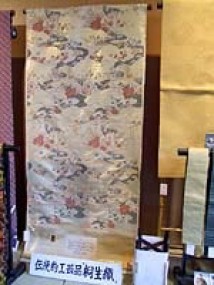
2. In the case of weft brocade, the patterned fabric shall be woven using the following techniques or methods:
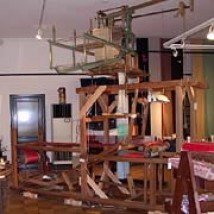
(1) The fabric shall be a plain weave variation, twill weave, satin weave, or a variation thereof, using a "Jacquard loom" with pre-dyed or pre-processed yarn.
(2) For weaving, a hand-thrown shuttle, a pull shuttle, or eight or more shuttles, six or more heddles, or a pull device shall be used.
(3) The crest shall be represented by the weft thread. In this case, if weaving is done using "eight or more shuttles", the crest shall be "embroidered".
3. In the case of warp brocade, the patterned fabric shall be woven using the following techniques or methods:
(1) The fabric shall be a pre-dyed plain weave or twill weave using a "Jacquard loom".
(2) The warp threads shall consist of three or more colors, and after being drawn from two or more spools and made into a group, they shall be manually pulled into each reed.
(3) Adjusting the position of the "Twill Bamboo" and weaving while manually adjusting the tension of the warp threads to be uniform.
(4) The weft threads shall be woven in alternatingly with "shadow threads" and "ground weft threads." In this case, the density of the weft threads shall be 40 or more per centimeter.
(5) The crest shall be represented by the warp threads.
4. In the case of openwork weaves, the patterned fabric shall be woven using the following techniques or methods:
(1) The fabric shall be a double weave using a "Jacquard loom" with pre-dyed or pre-processed yarn.
(2) Weaving shall be done by double weaving using warp threads of two or more colors and weft threads of two or more colors so that the front and back of the fabric can be reversed.
(3) To have a "stitched crest" applied.
(4) The warp thread density shall be 120 threads or more per centimeter, and the weft thread density shall be 40 threads or more per centimeter.
5. In the case of warp-woven fabrics, the patterned fabric shall be woven using the following techniques or methods:
(1) The fabric shall be pre-dyed or pre-processed and woven in a warp layer using a "Jacquard loom".
(2) The warp threads shall consist of two or more colors, drawn from two or more spools to form a group, and then manually pulled into each reed. The warp thread density shall be 150 threads or more per centimeter.
(3) Adjusting the position of the "Twill Bamboo" and weaving while manually adjusting the tension of the warp threads to be uniform.
(4) The crest shall be either "floating" or "floating" and "picture weft".
6. In the case of warp ikat weaving, the woven fabric shall be made using the following techniques or methods:
(1) The fabric shall be pre-dyed or pre-processed and woven using a "Jacquard loom".
(2) The dyeing method for the warp threads shall be by "hand tying," "board clamping," or "stencil dyeing."
(3) The crest shall be either a "picture weft" or an "embroidered crest".
7. In the case of gauze weave, it shall be a gauze fabric woven using the following techniques or methods:
(1) The fabric shall be pre-dyed or pre-processed gauze woven using a "jacquard loom".
(2) For weaving, a hand-thrown shuttle, a pull shuttle, a pattern shaker, or a modified reed shall be used.