HONBA KIHACHIJYO (Textiles)

Tokyo

Long ago, Motoori Norinaga wrote, "The name of the island Hachijo probably comes from the Hachijo silk."
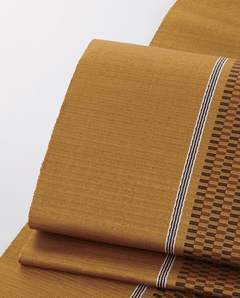
Regarding Kihachijo silk, which is said to be the origin of the island's name, there are records of silk being offered as tribute since the Muromachi period, and from the mid-Edo period onward, stylish vertical stripes and checkered patterns that are still in vogue today began to be woven.

  • Technology/techniques/raw materials

    Technology/techniques

    1. Weaving shall be carried out using the following techniques or methods:
    (1) The fabric shall be pre-dyed plain weave or twill weave.
    (2) A hand-thrown shuttle is used to insert the weft threads.


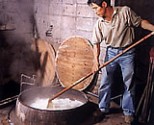
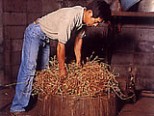
    2. Dyeing shall be done by hand immersion dyeing. In this case, the dye shall be a plant-based dye made from knotweed, machilus, or chinquapin, and the mordant shall be wood ash or mud.
     

    raw materials

    The threads used shall be raw silk, spun silk, floss silk, or silk threads of equivalent quality.

  • Work scene

    The most distinctive feature of Kihachijo silk is undoubtedly its dyeing process. Only plants native to Hachijo Island are used to dye the threads yellow, brown, and black. These threads are then meticulously hand-woven on a high loom. The patterns are traditional stripes and checks. Combining elegance and sophistication, Kihachijo silk has been loved by women across generations.

    Process 1: Scouring

    The raw silk, packed in a bag, is placed in boiling water containing sodium carbonate and simmered over low heat for about three hours before being rinsed with water. This scouring process removes the gelatinous substance from the raw silk, resulting in a supple and lustrous thread.

    Step 2: Dyeing

    ● Yellow dye (Dried Kobunagusa (Kariyasu, a plant on the island) is used as a dye.)

    Step 3: Folding

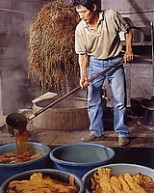
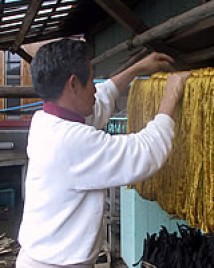
    The liquid extracted by boiling plants is called "fushi," and the process of dyeing by soaking the yarn in this liquid is called "fushizuke." Bundles of kariyasu are placed in a pot and boiled. Two or three ladlefuls of the hot "fushi" are taken from the pot and placed in a dyeing tub. Each skein of yarn is soaked in the liquid and left overnight to dry in the sun the next day. Next, each skein of yarn is lightly twisted and arranged in the dyeing tub. The hot "fushi" is poured evenly over the yarn to ensure it is thoroughly soaked, and it is left to soak overnight. The next morning, the yarn is removed from the tub, squeezed well, and hung on a pole outdoors to dry until evening. Once completely dry, the yarn is soaked in a freshly made "fushi." This dyeing and drying process is repeated about 20 times.

    Step 4: Adding scum

    The supernatant liquid obtained by dissolving ash in water is called "aku," and the ash produced by burning camellia and sakaki branches is used for "aku-tsuke." The ash is placed in a jar filled with water, and any debris is removed to allow the ash to settle. After about a week, the supernatant liquid can be used. A small amount of aku is scooped into a basin, and a small amount of aku is poured onto each skein of yarn that has been "fushi-tsuke" (prepared using the knotting technique), and the yarn is rubbed 50 to 60 times. This causes the "fushi" (knots) that have already permeated the yarn to react with the metal ions in the aku, resulting in a vivid yellow color. After "aku-tsuke" is complete, the yarn is left to rest for a while, then squeezed tightly and dried in the sun.

    画像をクリックすると動画が再生されます

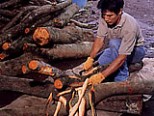
    ● Birch dye (The raw bark of the Japanese crabapple tree (known as "Madami" in Okinawa) is peeled off and used as a dye.)

    Step 5: Folding

    First, boil the bark of the fir tree in a bamboo basket. Take two or three ladlefuls of the hot liquid from the pot into a dyeing tub, soak each skein of yarn in it, leave it overnight, and then dry it in the sun the next day. Repeat this dyeing and drying process about 30 times. Next, lightly twist each skein of yarn and arrange them in the dyeing tub, pour the hot liquid evenly over them to ensure thorough soaking, and leave them to soak overnight. The next morning, wring out the yarn thoroughly after removing it from the tub, hang it on a pole outdoors, and let it dry until evening. Once completely dry, soak the yarn in a newly prepared liquid. Repeat this dyeing and drying process about 15 times.

    Step 6: Adding scum

    For the "dyeing" process in birch dyeing, ash from various trees is used. The method is the same as for yellow dyeing.

    ●Black dyeing (The dried bark of the Japanese chinquapin tree (known as "Shii" in Japan) is used as a dye.)

    Step 7: Folding

    The "fushizuke" method for black dyeing is exactly the same as for birch dyeing. By repeating the dyeing and drying process 30 to 50 times, a lustrous black color is achieved.

    Step 8: Applying mud

    The mud-soaking process for black dyeing is equivalent to the "staining" process used for yellow and birch dyeing. Mud rich in iron, with a bluish-green substance floating on the surface, is collected from natural swamps on the island, filtered through a sieve, and placed in a bucket. The yarn is dyed by exposing each skein to the mud. After soaking the yarn in the mud for about three hours, it is pulled out, washed to remove the mud in flowing stream water, and then dried.

    画像をクリックすると動画が再生されます

    Step 9: Weaving

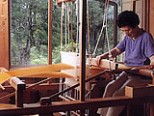
    The pattern is decided and the fabric is starched, the warp threads are prepared, and then the fabric is woven on a loom. There are two main weaving methods: plain weave (the most basic type, in which the warp and weft threads cross every other thread) and twill weave (in which the weave points are arranged in a continuous diagonal pattern; also called diagonal weave).


  • Close-up

    Yellow, brown, and black. The lustrous colors of Kihachijo silk are a gift from nature.

    Vibrant yellow, deep reddish-brown, lustrous black. The captivating colors of Kihachijo silk are dyed using plants native to the island. The experience and skill of artisans, ingrained in the island's unique climate and weather, breathe life into these creations. Once the dyeing is complete, it's the women's turn. On the loom, they weave each bolt of cloth with meticulous care and dedication. On this fertile island, people and plants live in the same cycle.


    The yellow Hachijo silk woven by the island women has supported the island.

    Located about 290 kilometers south of Tokyo, Hachijojima, one of the Izu Islands, is a gourd-shaped island floating in the Kuroshio Current. Once known as a place where "even birds wouldn't pass" and where many political prisoners were exiled, it's now surprisingly close, just an hour's flight away. Upon arriving on the island, I was greeted by a baptism of rain and wind. The lush green of the mountains was visible in the distance.
    It is uncertain when the weaving of Kihachijo silk began. However, there are already records in Muromachi period documents mentioning that silk fabrics from Hachijo Island were presented as tribute. Later, during the Edo period, Kihachijo silk became a favorite of the Shogun's family. Then, during the Bunka-Bunsei era (1804-1830), when townspeople culture flourished, it became widely worn by ordinary people as well. Even in modern times, sericulture was thriving until before World War II. Since ancient times, the women of the island have silently cared for silkworms, wove cloth, and supported the island's economy.

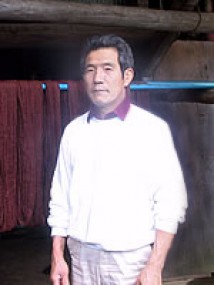
    Akihito Isezaki checks the color development of the Kijōhachijō fabric.

    The more you wash it, the more its color and luster increases.

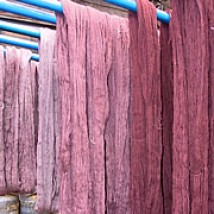
    Currently, there are three dyers specializing in Kijōhachijō silk, located in the Kashitate and Nakanogō districts. We visited Akihito Isezaki in Kashitate, which is close to Otchogahama beach. In the courtyard, raw silk dyed in vibrant yellow and subdued birch tones was drying.
    "During the day, we sun-dry them, and at night we boil them. We repeat this 20 to 40 times, and the color gradually deepens. Every single day is crucial."
    The secret to why Kijōhachijō becomes more vibrant with each wash lies here. Gently bring the thread to your nose. The scent of natural dyes is soothing to the nostrils, making you want to smell it again and again.
    "I was actually planning to strip birch bark today, but... it's a job that's really dependent on the weather. On days when it rains and we can't work, we spend time with our colleagues."

    Birch dyeing. Through repeated saturation and drying, the dark brown color gradually deepens.

    I can't sleep without the sound of tango weaving.

    Isezaki is the fourth generation to take over the dyeing business, counting from his great-grandfather, and he inherited the business at the age of 27.
    "Since I was a child, the sound of weaving tango (in the Kashidate dialect, meaning weaving bolts of cloth) has been like a lullaby, and I can't sleep if it's too quiet at night."
    Isezaki is the fourth of seven siblings; all of her brothers except for her have left the island. She herself went to Tokyo when she was 20, but she felt that it was merely a place to visit and not a place to live, so she returned to the island after three months. Since then, she has been energetically working in livestock farming and horticulture while acquiring dyeing techniques.
    It's often said that dyers depend on their weavers. Currently, the average age of weavers is 70. That's half the number from the last 30 years. The women of the island are hard workers, and Ms. Isezaki's eldest sister, who is over 70, is still actively weaving.
    "As long as my sister is weaving, I won't stop dyeing either."
    My 24-year-old son is off the island. But I can't ask him to take over the business.

    "I hate the phrase 'I'm tired.' Even if the work is tough, you have to approach it with a positive attitude."

    The color of Kijōhachijō is a "transfer" of the life of plants.

    "Aki-ani is always on the move. One moment he's in the mountains, the next he's at the beach, and by night he's nowhere to be found," say friends who admire Isezaki.
    His lifestyle is semi-self-sufficient. He sometimes joins his fisherman friend on his boat to help with flying fish fishing. Whether it's dyeing, fishing, or farming, he always wants to act positively while dreaming big.
    "As a living being on this planet, as a human being, as a man, I want to live my life to the fullest and with the utmost honesty."
    Perhaps when you immerse yourself in abundant nature, you realize that you are not living alone, but rather that you are sustained by the interconnectedness of all things.
    What is the most rewarding aspect of working as a dyer? — "Encounters," he answered immediately. Encounters with good friends, encounters with the plants that become dyes, and encounters with the colors that appear in the threads. The yellow, brown, and black colors of Kijōhachijō are a "transfer" of the life of the plants into the threads. Dyeing may be that ritual. Humans are only able to partake in a small share of the blessings of heaven.
    I can't help but feel that the true charm of Kijōhachijō lies precisely in that.

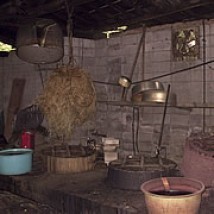
    • This is Mr. Isezaki's workplace. The Kijōhachijō silk fabric, which becomes more lustrous with each wash, is produced here.

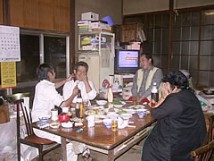
    • Dyeing work is affected by the weather. Today, unfortunately, it's raining, so my colleagues have gathered for lunch. Flying fish that Mr. Isezaki himself prepared are also on the table.

    Craftsman Profile

    Akihito Isezaki

    Born in 1942.
    "My parents gave me a lot of wealth. They gave me a healthy birth and taught me the art of dyeing." He is a man of great integrity.

    Anecdotes

    Wait, you can't understand each other's languages even though you're on the same island?

    Hachijojima Island is broadly divided into five settlements: Mine, Ogago, Kashidate, Nakanogo, and Sueyoshi. Between Ogago and Kashidate lies a long, gently sloping hill. The islanders refer to this as the boundary between the upper and lower parts of the hill: the Kashidate/Nakanogo area is called Sakagami (upper slope), and the Ogago/Mine area is called Sakashita (lower slope). Sakashita is quite lively, with the airport, town hall, and a bar district (aptly named Oyafuko-dori, meaning "unfilial street"). On the other hand, even within Sakagami, Kashidate and Nakanogo have slightly different atmospheres. It is said that in the past, people from neighboring settlements did not visit each other and could not understand each other's languages (!), but different languages can lead to different temperaments. In Sakagami, Kashidate is the only settlement without a fishing port. The earnest, simple, and hardworking people of Kashidate had their minds drawn not to the vast ocean, but to the mountains. For them, all that mattered was having mulberry trees there. The fact that there are currently three dyers specializing in Kijō-hachijō (yellow silk) concentrated in Sakagami (two in Kashidate and one in Nakanogō) may be related to this area.


overview

Craft item name HONBA KIHACHIJYO (Textiles)
Reading Honbaki Hachijo
Classification of crafts fabric
Main Products Kimono fabric, obi
Main manufacturing area Hachijo-jima, Hachijo-machi
Designated date October 14, 1977

contact address

■ Production area association

Kihachijo Textile Cooperative
100-1621
346-1 Kashidate, Hachijo-machi, Hachijo-jima, Tokyo
TEL: 049-967-0516
FAX: 049-967-0516

Features

HONBA KIHACHIJYO (Textiles) silk fabric comes in three colors: yellow, brown, and black. Its subdued hues give it an elegant appearance.

How to make it

All dyes used are natural plant-based dyes that grow naturally on the island. After dyeing the yarn dozens of times with a decoction of natural dyes, the yarn is then soaked in a solution made from the ashes of burnt camellia and sakaki trees for yellow and brown colors, and in water filtered from iron-rich swamp mud for black colors. The dyed raw silk is then warped and woven on a traditional loom using a hand-thrown shuttle, paying attention to every detail.

Please see here for information on traditional craftspeople.

Japanese traditional craftsman
top