TOKAMACHI AKASHI Chijimi (Crepe Textiles)

Niigata Prefecture

Towards the end of the 19th century, samples of summer fabrics from Nishijin in Kyoto were brought back and applied to the existing weaving technique called Tokamachi Sukiya to conduct research and development of new products.
Since then, research into the techniques of highly twisted weft threads and finishing methods has been diligently pursued. By improving upon the twisted openwork twill already being woven in Tokamachi, they succeeded in creating a prototype of a new type of fabric called "openwork crepe" using highly twisted yarn for the weft. This was named "Akashi Chijimi" and put onto the market around the middle of the Meiji era.

  • Technology/techniques/raw materials

    Technology/techniques

    1. In the case of ikat weaving, the fabric shall be a crinkled fabric woven using the following techniques or methods:
    (1) The fabric shall be plain weave with pre-dyed yarn.
    (2) Kasuri thread shall be used for warp and weft threads or as weft threads.
    (3) The ikat pattern of the ikat thread is matched by hand and woven into the fabric.
    (4) The dyeing method for the ikat thread shall be by hand-tying or rubbing.


    2. Striped, checked, and solid-colored fabrics shall be crinkled fabrics woven using the following techniques or methods: pre-dyed plain weave, twill weave, satin weave, or variations thereof.


    3. For the weft yarn used in textured fabrics, "Akashi weft" yarn shall be used. The yarn used for "Akashi weft" shall be pre-twisted using a "Hatcho-style twisting machine," and then hand-twisted with cloth starch, bracken starch, or other plant-based sizing agents.


    4. The wrinkles should be formed by "hot water massage".
     

    raw materials

    The thread used shall be raw silk, spun silk, or silk thread of equivalent quality.

  • Work scene

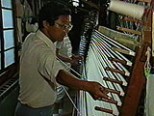
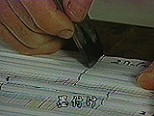
    The process of making TOKAMACHI AKASHI Chijimi (Crepe Textiles) is complex, but broadly speaking, it involves dyeing the warp and weft threads with ikat patterns, weaving, and finishing. Raw silk and spun silk are used, and first, ikat patterns are applied to the threads. A ruler is made beforehand, and the threads are marked with ink along the ruler. Dye is then rubbed into the threads using a spatula called a "rubbing spatula." The weft threads are strongly twisted to create the unique crepe (wavy wrinkles) characteristic of chijimi fabric. The resulting threads are then set on the loom, and weaving can finally begin. Even then, the fabric is carefully woven while checking the position of the warp and weft ikat patterns. Finally, a unique chijimi process called "yumomi" is performed to bring out the crepe.

    Step 1: Design (creating ikat patterns and making rulers)

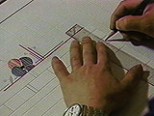
    Based on the original design or sample, the pattern placement is determined on graph paper to create the ikat pattern, and the exact location of the threads where the ikat will be applied is precisely set. Then, based on that pattern, the warp ikat and weft ikat are separated, and a ruler is created.

    Step 2: Twisting the yarn

    Raw silk and sujito (also called sujito, a thick thread with many streaks; it is taken from a tamamayu, a cocoon made by two silkworms) are combined on a spinning machine and twisted on a twisting machine to achieve the required thickness and strength. The main method used is komayori (a type of twisted silk).

    画像をクリックすると動画が再生されます

    Process 3: Hand-stretching

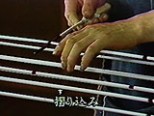
    On a repetitive machine, the threads wound onto bobbins or frames are manually stretched to the specified number and length for each type of warp and weft ikat weaving, according to the design specifications.

    Step 4: Marking and shaping

    The warp and weft ikat threads are stretched on a stretching stand, and the marks on the selvage (the part that indicates the width of the fabric) at both ends of the ikat ruler are aligned, and ink marks are made in the position of the ikat pattern. Then, the ink-marked parts of the warp and weft threads are tightly tied with cotton thread or elastic. This prevents the color from being absorbed into these areas. If the tying is not done tightly, the color may be lost even in the tied areas, or the color may become uneven.

    Step 5: Rubbing and dyeing

    Using a rubbing spatula, the dye is thoroughly rubbed into the areas that have been marked with ink. Once the color has been rubbed in, the thread is tied into a skein and dyed repeatedly by rubbing it together with the ground thread (the part that will not be dyed). After that, the color is stabilized with steam at about 100 degrees Celsius.

    Step 6: Starching and top twisting

    This process is essential for creating the unique texture of Akashi fabric. The starched weft threads are strongly twisted using an eight-spinning machine. This thread is called Akashi weft, and it is this thread that creates the distinctive crinkled texture of Akashi crepe fabric.

    Step 7: Preparation for weaving, weaving

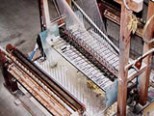
    The process differs depending on whether you're using warp or weft threads. For warp threads, the kinks are removed and the threads are loosened before being wound onto a reel while checking the pattern. This requires careful work as the threads must be wound according to the design. Then, each thread is passed through the heddle of the loom, and two threads at a time are passed through the reed. The standard number of threads is around 1200. The weft threads are also removed and loosened in the same way as the warp threads before being wound onto a reel frame, placed on a small reeling stand, and finally wound onto bobbins for weaving. The weaving is finally ready, and you can start weaving. The weft threads pass back and forth between the heddle and reed of the loom, and the fabric is woven. For ikat patterns, the selvage marked during the ikat-making process is used to precisely match the pattern, and the fabric is woven without a single thread being misaligned.

    画像をクリックすると動画が再生されます

    工程8: 仕上げ

    Finally, the fabric is thoroughly kneaded by hand in hot water to create a crinkled texture. Lastly, it is inspected for stains and weaving irregularities.


  • Close-up

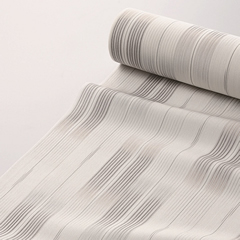
    Akashi Chijimi: A translucent fabric like a cicada's wing.

    TOKAMACHI AKASHI Chijimi (Crepe Textiles) is a textile with a refreshing texture. Because of the long winters and snowbound conditions, weaving has taken root in this region. The techniques used create a unique texture unlike any other.


    The world created through weaving

    TOKAMACHI AKASHI Chijimi (Crepe Textiles) uses weft threads called Akashi Yoko to create a crinkled texture. Its unique texture and cool colors have earned it a reputation as a high-quality summer kimono fabric since the Meiji era. This time, we spoke with Shigehisa Abe, a certified traditional craftsman, about Akashi Chijimi.

    Akashi Chijimi fabric with a refreshing texture

    TOKAMACHI AKASHI Chijimi (Crepe Textiles) which took the world by storm.

    Originally, Echigo produced a high-quality fabric called Echigo Jofu, which featured tightly twisted weft threads. It all began when Einosuke Suzaki, a crepe wholesaler in Kashiwazaki, witnessed this technique. He believed that Akashi Chijimi, which was being researched in Nishijin, Kyoto, would be better suited to weaving in Tokamachi, and he showed a sample to Zenjiro Sato of Tokamachi. After further research, around 1889-1890, Akashi Chijimi was ready to be sold on the market. Since then, Akashi Chijimi has been immensely popular. Initially, it was considered too sheer, so it was mainly popular in the geisha world. The fact that it was sung about in the "Popular Summer Clothing Songs" published as a newspaper supplement in 1901, with the lyrics "Geisha of Shin-Yanagibashi, wearing patterned Jofu and navy Akashi Chijimi...", suggests that its sheerness was appealing to professionals such as geishas. Since then, the product's quality has been continuously improved through a tireless pursuit of excellence, and it has gradually become widely popular. However, its extremely thin, almost transparent nature remains unchanged, to the point that "it's said to be too cool now that there are so many air-conditioned places."

    When I wear a kimono, I feel like my body is rejuvenated.

    Akashi Chijimi fabric is made by twisting the weft threads tightly to create a unique yarn called Akashi Yoko. The fabric woven with this yarn as the weft is then finished by being kneaded by hand in hot water. This "hot water kneading" process creates the crepe (wavy wrinkles) on the fabric. "Most people probably just see it as wrinkles," says Takahashi, but this crepe is the most distinctive feature of Chijimi. It is because of this crepe that the fabric feels smooth and doesn't stick to the skin. Conversely, because of the crepe, "complex patterns cannot be made," says Takahashi. However, even without complex patterns, the ikat technique is incorporated, and delicate patterns are woven into the fabric. Above all, the "transparent fabric like a cicada's wing" is breathtaking to behold. Akashi Chijimi absorbs sweat and is breathable, making it the perfect fabric for kimono to wear in Japan's humid summers.

    You need to use good quality yarn for summer clothes.

    According to Mr. Abe, "For summer fabrics, if you don't use particularly good thread, you'll end up with uneven weaving." He also added that even if you use good thread, "if the tension of the threads is different, it will become uneven, and if even one thread breaks, you have to remove only the broken part and then put the threads back in the correct order." Just these words alone give you an idea of how careful the work is. It takes about 10 days for a weaver to weave just one bolt of fabric. "It's not that it's leisurely, but you can't make good fabric otherwise." Each of the painstaking tasks, packed into a long period of time, is what completes this TOKAMACHI AKASHI Chijimi (Crepe Textiles).


    The crepe fabric made at Mr. Abe's place

    I want to keep going no matter what happens.

    "It makes me happy when I see someone wearing a kimono I made. It feels like meeting a family member. There are hardly any two kimonos that are the same, so you can recognize them right away," Ms. Abe said with a smile. She said she can't help but strike up a conversation with anyone wearing a kimono she made. Ms. Abe said she is happy when customers she speaks to tell her, "It's comfortable to wear, and I love it." When asked about the future, her eyes were serious despite her calm demeanor, and she said, "I can't produce large quantities, I won't imitate others, and I want to make something that is both good and affordable." You can see the desire to create something that is unique to "TOKAMACHI AKASHI Chijimi (Crepe Textiles)," something unlike anything else. She also said, "I want to make something that is neat and tidy and in line with the times. Patterns that give a cool feeling," and there seemed to be a strong sense of determination that she still has a long way to go.

    Craftsman Profile

    Shigehisa Abe

    Born in 1929 (Showa 4).
    He initially became a teacher, but at the age of 18, he started helping his father and entered this field.

    Anecdotes

    Tokamachi Textile Seasonal Events - Tokamachi Folk Songs -

    The Tokamachi Folk Song begins with the lyrics, "There are many famous products of Echigo, but Akashi Chijimi has a snow-like texture; once you wear it, you won't want to let it go, isn't it just Tokamachi? Isn't it just Tokamachi? Isn't it just Tokamachi?..." This folk song, sung every year at the Tokamachi Snow Festival, became a commercial around 1945, making the name of Tokamachi textiles known to the world. The music was composed by Shinpei Nakayama, known for composing children's songs such as "Shabon Dama" (Soap Bubbles). It is said that a melody composed for this Tokamachi Folk Song, but not actually used in the Tokamachi Komachi performance, was the basis for the Tokyo Ondo, and that it may have been the original song for Hibari Misora's "Sado Jowa" (Sado Love Story). In fact, this folk song has deep connections to many famous songs. This charming folk song is completely different from recent hit songs, and if you listen to it once, the scenery of Tokamachi described in the lyrics will surely come to mind.

    • Akashi Chijimi Poster


overview

Craft item name TOKAMACHI AKASHI Chijimi (Crepe Textiles)
Reading Tokamachi Akashi Chijimi
Classification of crafts fabric
Main Products Kimono fabric
Main manufacturing area Tokamachi City
Designated date November 1, 1982

contact address

■ Production area association

Tokamachi Textile Industry Cooperative
948-0003
6-1-71-26 Honcho, Tokamachi City, Niigata Prefecture
Cross 10, 4th floor
TEL: 025-757-9111
FAX: 025-757-9116

https://www.tokamachi-orikumi.or.jp/

Features

Before the war, it was immensely popular as the quintessential elegant summer kimono with a unique sense of coolness. Although production gradually decreased after the war, its manufacturing techniques have been passed down as a tradition unique to Tokamachi, and it continues to enjoy strong support to this day.

How to make it

The method of creating patterns is the same as for TOKAMACHI Kasuri (Ikat). The fundamental difference lies in the yarn twisting method. For Akashi Chijimi, the weft yarn is first twisted about 300 times per meter as a preliminary twist, and then wound into skeins of right-handed and left-handed single-twist yarn. Then, the raw silk is soft-dyed to the specified color, and a plant-based paste containing 30-40% of the weight of the yarn in the skeins is evenly absorbed by hand-pasting it. Finally, this is twisted about 3,000-3,500 times per meter using an eight-spindle twisting machine.

Please see here for information on traditional craftspeople.

Japanese traditional craftsman
top