MIYAKO Jofu (Ramie Textiles)

Okinawa Prefecture

400 years ago, a ship carrying tribute from the Ryukyu Kingdom was caught in a typhoon and was about to sink when a man from Miyako Island, who happened to be on board, bravely jumped into the sea, repaired the damaged parts of the ship, and saved the lives of all the crew members.
The King of Ryukyu praised this achievement and appointed the man as a Buddhist priest. His wife rejoiced and lovingly wove cloth to present to the king. This is said to be the origin of MIYAKO Jofu (Ramie Textiles)).

  • Technology/techniques/raw materials

    Technology/techniques

    1. The fabric must be a kasuri textile woven using one of the following techniques or methods.
    (1) The fabric shall be plain weave with pre-dyed yarn.
    (2) A hand-thrown shuttle is used to insert the weft threads.

    2. The dyeing method for ikat yarn shall be by "weaving tie" or "hand-tying." In this case, the dye shall be a plant-based dye made from indigo or a similar material.
     

    raw materials

    The yarn to be used should be hand-spun hemp yarn.

  • Work scene

    MIYAKO Jofu (Ramie Textiles) is made by hand-spinning yarn, dyeing it with indigo, and then weaving it. The process has traditionally been carried out through a division of labor. It is completed through the hands of many people, from cultivating ramie and spinning the ramie to tightening the loom, indigo dyeing, weaving, and pounding the yarn. The division of labor has the advantage that each person can pursue their specialized skills more deeply and improve the quality. Because the ikat patterns are so fine, it takes three months to weave one bolt of fabric for a kimono.

    Step 1: Extracting fibers from ramie.

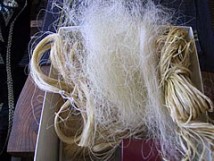
    The raw material for the thread is ramie (called "boo" in the Miyako dialect), a plant belonging to the nettle family. Because it is susceptible to wind, it is cultivated in backyards or similar areas. Compost is used, and no chemical fertilizers are used. After about 40 days, when the plants exceed 150 centimeters in height, they are cut down at the base. Four or five harvests can be obtained per year. Those harvested in early summer are of the highest quality and are called "Urizunbu." After cutting, the leaves are removed and the outer layer of the stem is peeled off. Abalone shells are used to scrape off parts other than the fibers. The fibers are washed with water and then air-dried in the shade.

    Step 2: Spinning the ramie

    Both the warp and weft threads are spun by hand. The fibers taken from ramie are finely torn with fingernails. The warp threads are torn to a very fine thickness, about the thickness of a strand of hair. They are twisted together without tying knots to form a single thread. Next, they are twisted on a spinning wheel. Two warp threads are twisted together to form one thread. There is only one weft thread. It takes more than three months for one person to spin enough yarn for one bolt of cloth.

    Step 3: Design and Kasuri dyeing

    First, draw a cross pattern on graph paper. After warping the threads to the same length for one bolt of fabric, apply starch to prevent the ikat pattern from shifting during the ikat dyeing process. Once dry, tie off the parts you want to remain white with cotton thread. Because the ikat pattern is so fine, use a tying machine to tie it off. The tied threads form a mat-like structure, which is called an ikat mat. Finally, remove the starch to ensure even dyeing.

    工程4: 染色

    We use Ryukyu indigo cultivated in Izumi on Okinawa Island. Put the muddy indigo into a plastic container, add caustic soda, awamori (Okinawan rice liquor), and brown sugar, and stir. After 1-2 weeks, it will ferment and flower-like bubbles will appear. Dip the ikat mat and plain, undyed yarn into the solution. Remove them and let them air out to dye. After dyeing once, wring out the yarn and dry it in the sun for 4-5 hours. Repeat this process about 20 times until a sufficiently dark color is achieved.

    Step 5: Temporary reed threading

    After dyeing is complete, the threads used to tie the ikat fabric are removed, and the fabric is washed and dried. The threads are then threaded one by one through the temporary reed according to the design.

    工程6: 製織

    After neatly winding the thread that has passed through the temporary reed, you thread it through the heddle and then through the reed to begin weaving. You gradually weave, correcting any misalignment of the warp threads with a needle as you go. Even a skilled weaver can only weave about 20 centimeters a day.

    Step 7: pounding the cloth with a cloth block

    The woven cloth is washed and air-dried. Both sides are glued with potato starch and folded into a small size. It is placed on a stand made of Akagi wood and beaten with a 4-kilogram wooden mallet made of Isunoki wood. The beating continues evenly for about 3 hours. This process results in a smooth and lustrous cloth.


  • Close-up

    A supple summer kimono created through the ultimate in handcraftsmanship.

    MIYAKO Jofu (Ramie Textiles) woven with hand-spun yarn, is considered one of Japan's four major types of high-quality fabrics. As a top-of-the-line summer kimono and a rare item, it is the object of desire for kimono enthusiasts. We spoke with Kiyoko Taira, who has been weaving this fabric for over 30 years.


    Weaving by joining together ikat patterns that are only 1 millimeter in size.

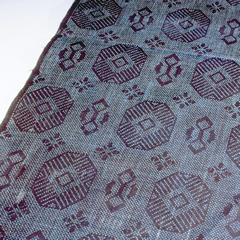
    As I ran my fingers over it, it felt incredibly smooth, unlike what I'd expect from linen. The deep MIYAKO Jofu (Ramie Textiles), made using finely hand-spun threads and finished with a "kinuta-uchi" (fulling) technique. The secret to its refined quality also lay in its intricate ikat patterns. While other Okinawan textiles often create patterns with lines, MIYAKO Jofu (Ramie Textiles) uses a pointillist technique. Countless small white crosses (cross ikat) are woven in, making the navy blue pattern stand out. Moreover, it's a total ikat pattern, characterized by the repeated application of patterns such as flowers, tortoiseshells, and coins across the entire fabric.
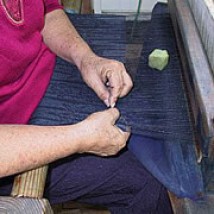
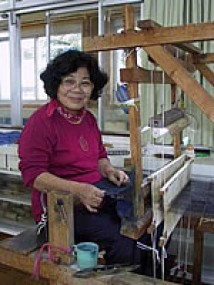
    I was shown how Kiyoko Taira weaves. The rhythm is different from ordinary weaving. After weaving for a while with a tapping sound, she stops and bends over the fabric. When I leaned in to look, I saw that she was picking up each thread with a needle to correct the misalignment of the white ikat pattern.
    The indigo-dyed threads have tiny white areas, about 1 millimeter in size. When the white areas of the warp and weft threads are crossed, a cross shape is formed. Patterns are created using these cross shapes, but as weaving progresses, misalignments inevitably occur, requiring occasional corrections. It is an incredibly meticulous and painstaking process.

    Kiyoko Taira says she wants to preserve the Jofu fabric for generations to come.

    When a girl was born, people were happy.

    Most people can only weave a few centimeters a day, and even skilled weavers can only manage about 20 centimeters. It takes three months to weave one bolt of fabric. The threads are thin and easily broken, so extra care is needed when picking them up with a needle.
    "When I first started, my eyes would get so tired, and tears would stream down my face uncontrollably before I went to sleep at night," says Taira, who began weaving in her late twenties. Her mother also did dyeing and weaving, and everyone in the neighborhood did it, so it felt like a natural progression.
    MIYAKO Jofu (Ramie Textiles) was once one of the island's three major industries, alongside sugarcane and dried bonito. The birth of a girl who would become a weaver was a cause for celebration, and girls with nimble fingers were allowed to concentrate on weaving without being made to help with meal preparation or laundry. It was said that if there were two or three girls, a fine house with red tile roofs could be built. Currently, the annual production is about 30 bolts, but during its peak in the 1930s, 15,000 bolts were produced annually. Ms. Taira started later than that, but there were still many weavers.

    It becomes brittle when dry, so moisten it with a sponge while you're working on it.

    It was the typhoon that gave me the confidence to weave on my own.

    At first, I went to the workshop of Shimo-ji Keiko, the leading expert. It took years just to get used to handling the easily broken thread. The instruction back then was strict, and I learned by being hit on the back. After three years, a big typhoon hit the island. The corrugated iron roof of the workshop was blown off, and the bolt of cloth I had been weaving got soaked in the rain. I had no choice but to take it home, and with the help of my neighbor and my mother, I dried it, rewound it, and started weaving again.
    "It was tough, but when I finished weaving, I felt confident. I thought, 'Maybe I can do this after all.' Since then, I've been weaving at home. I don't know if it's because I have no other work, or if I just love it, but I've never left the loom."
    During that time, she raised three boys. It's said that when a mother is weaving, her children strangely don't go astray.

    Yarn spun from ramie

    Still going strong at 90 years old

    The threads used in MIYAKO Jofu (Ramie Textiles) are spun by experienced elderly people and are known for their high quality.
    "I feel happy when I load good yarn onto the loom and start weaving. And when a beautiful pattern comes out, I feel relieved."
    Conversely, if things don't go well, I end up regretting everything and can't sleep at night.
    "The feeling of relief you get when you finish something is something only those who do it can understand. 20 years from now? We still have 90-year-old grandmothers weaving here," Ms. Taira said with a cheerful smile.

    Craftsman Profile

    Kiyoko Taira

    Born in 1938, she works in dyeing and weaving, and is also dedicated to training successors at the Miyako Textile Business Cooperative.

    Anecdotes

    MIYAKO Jofu (Ramie Textiles) supported by energetic elderly people

    MIYAKO Jofu (Ramie Textiles) uses fine, uniform threads. These high-quality threads are spun by grandmothers who are over 80 years old.
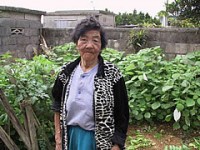
    We visited Chiyo Tomori (83), who cultivates ramie (called "boo" in the Miyako dialect) and is in charge of extracting fibers from the stems. Her backyard is a ramie field. She uses goat manure compost as fertilizer and does not use chemical fertilizers. She keeps three goats to make the compost. She goes to a field along the coast, where no pesticides are used, to cut grass for the goats to feed.
    Ms. Tomori is surprisingly energetic and does all the physically demanding work by herself. The ramie is harvested when it grows taller than her, and the fibers are extracted by stripping the bark from the stems with abalone shells. It is then dried and passed on to the next person to do the work.
    The people who spin the fibers into yarn are all grandmothers in their 80s and 90s. They tear the fibers into thin strips with their fingernails, twist them together, and join them to make a single thread.
    There are master weavers in their 80s who can weave quickly and beautifully. It is said that these elderly women involved in weaving high-quality linen rarely need to go to the hospital and do not suffer from dementia. Currently, efforts are underway to train successors to pass on the skills they have cultivated.

    • Ramie, being vulnerable to wind, is carefully cultivated in the backyard of the house.


overview

Craft item name MIYAKO Jofu (Ramie Textiles)
Reading Miyakojofu
Classification of crafts fabric
Main Products Kimono fabric
Main manufacturing area Miyakojima City and Tarama Village, Miyako District
Designated date February 17, 1975

contact address

■ Production area association

Miyako Textile Business Cooperative
〒906-0201
1190-188 Ueno Nohara, Miyakojima City, Okinawa Prefecture
TEL: 0980-74-7480
FAX: 0980-74-7482

https://miyako-joufu.com/

Features

Although it is a linen fabric, the threads are fine, the ikat patterns are intricate, and the woven cloth is as smooth as if it were coated with wax. It is highly breathable and so durable that it is said to last for three generations.

How to make it

The process involves taking a type of hemp called ramie, extracting the fibers from the outer layer, spinning them into yarn, and twisting them on a spinning wheel. A design is created and the ikat dyeing is performed. The fabric is dyed with Ryukyu indigo, woven over a period of two to three months, beaten with a mallet, and polished to finish.

Please see here for information on traditional craftspeople.

Japanese traditional craftsman
top