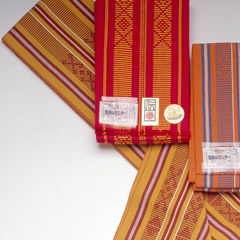
YUNTANZA Minsaa (Obi sash Textiles)

Okinawa Prefecture

Its origins date back to the same period as YUNTANZA Hana-ui (Flower Patterned Textiles), and it is a product strongly influenced by the southern regions. Production ceased for a time, but it was revived by elderly people who knew the history well.
Minsā means a thin strip of fabric.

  • Technology/techniques/raw materials

    Technology/techniques

    1. The fabric must be a patterned fabric woven using the following techniques or methods.
    (1) The fabric should be pre-dyed and ribbed.
    (2) A hand-thrown shuttle is used to insert the weft threads.
    (3) The crest shall be represented using a "crest stick" or "flower heddle".

    2. When using ikat yarn, the dyeing method for the ikat yarn shall be "hand-tying".
     

    raw materials

    The yarn used should be cotton.

  • Work scene

    Yomitan-san Minsaa fabrics feature raised floral and striped patterns across their entire surface. This is achieved through a technique called "Gushibana," where bamboo skewers are used to pick up the warp threads in the areas that need to be raised, creating the patterns. This technique is a major characteristic of YUNTANZA Minsaa (Obi sash Textiles). The overall process involves design, ikat tying, dyeing, warping, and weaving.

    Step 1: Design

    I draw the designs on graph paper with colored pencils. The basics are three floral patterns: Jinbana (coin flower), Kajimaya (windmill), and Ojibana (fan flower). I then create patterns by combining these with over 30 geometric patterns, ikat, and stripes.

    Step 2: Kasuri tying

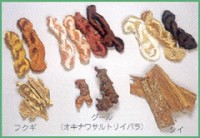
    The warp threads in the areas to be ikat are starched and pulled taut, then dried. The areas that are not to be dyed are tied with cotton thread. Cotton tightens when it absorbs moisture, making it difficult for the dye to penetrate. The threads are tied at equal intervals, with widths of 8 mm, 6 mm, and 1 cm. Once tied, the fabric is dyed. Dyes used include Fukugi, Tekachi (Rhaphiolepis indica), Guru (Smilax china), Shiitake, and Ryukyu indigo.

    Step 3: Winding the thread

    To make the thread easier to use, it is wound into skeins and then onto bobbins.

    工程4: 整経

    This is the process of adjusting the weaving width and the length of the minsar threads. The number and length of the warp threads are aligned. 32 threads are placed in a 1 cm width.

    Step 5: Temporary reed threading

    The warped threads are passed through the reed to the desired width. The upper and lower threads are passed through the reed in pairs. For a 10cm width on a mincer weaving machine, 320 threads are passed through.

    Step 6: Vertical winding

    Pull and straighten the thread that has passed through the reed, then begin winding it. Take care to ensure that the tension is even.

    Step 7: Threading the heddles

    Remove the reed and thread it through the heddles. Thread the threads one by one, separating them into front and back. This ensures the weft threads are neatly positioned between the warp threads.

    Step 8: Vertical winding

    Pull and straighten the thread that has passed through the reed, then begin winding it. Take care to ensure that the tension is even.

    Step 9: Weaving

    We weave using the Gushibana technique, which involves picking up the warp threads in the areas you want to float with a bamboo skewer.


  • Close-up

    Minsaa, with its floral and striped patterns raised across the entire surface, is a narrow obi typical of Yomitan, known for its floral weaving.

    While indigo dyeing is the basic technique, a wide variety of colorful dyes are now being produced. We spoke to Mr. Arakaki, who works in dyeing in Yomitan, about his journey so far.


    Traditional obi sashes woven in various parts of Okinawa

    The "min" in "minsaa" means cotton, and "saa" means narrow. This narrow obi is still woven in several regions of Okinawa, including Yomitan, Shuri, Yaeyama, and Yonaguni. It is basically indigo-dyed and about 10 centimeters wide, but the patterns and techniques vary slightly from region to region.
    The textiles from Yomitan feature floral and striped patterns raised on a navy blue background. The technique used is called "Gushibana," where bamboo skewers are used to pick up the warp threads and create the patterns. It is strongly influenced by Southeast Asian patterned weaving. It spread during the Ryukyu Kingdom era, died out during the Meiji era, but has now been revived along with hanaori (flower weaving).
    In Okinawa, women overwhelmingly make up the majority of those involved in weaving. However, dyeing is often the only area where men are responsible. We spoke with Takashi Arakaki, who has been dyeing Minsaa and Hanaori textiles for 27 years.

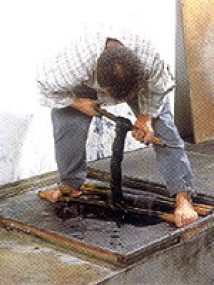
    Takashi Aragaki works diligently on the dyeing process.

    The arduous path to recovery of Yomitan Mountain textiles

    Shortly after graduating from university, Ms. Arakaki knew nothing of either Minsā or Hanaori weaving. Both were on the verge of extinction, having declined to the point where they were only vaguely remembered by the elderly. Yomitan Village began its revival efforts in 1964, during the height of Japan's economic boom. There was strong opposition to preserving hand-weaving in an age of mass production, and the path ahead was arduous. There were hardly any looms, and no one with the knowledge of dyeing. Ms. Arakaki, who had majored in chemistry at university, was chosen for the task.
    "I started in 1973. Because I had studied chemistry, I was able to understand what kind of chemical reactions occurred between dyes and mordants and why those colors were produced."
    Mr. Arakaki, with his knowledge of theory in addition to experience and intuition, must have been a source of reassurance for those around him.
    Even so, the struggles were endless. Although I understood it intellectually, I couldn't get the hang of dyeing large quantities of yarn at once. In my struggles, the yarn would become a tangled mess, and there were times when the weaver would say, "I can't reel this yarn."

    It's so popular now that production can't keep up.

    The fact that the products weren't selling was also a source of worry. They had no connections with wholesalers, and didn't know where to take their products.
    They shifted their focus from cotton to silk and experimented with obi patterns to explore consumer preferences. They also increased the range of colored fabrics. In the past, in Okinawa, only the samurai class of Shuri were allowed to wear colored clothing. Commoners were only permitted to wear black and navy blue. Both minsa and hanaori kimonos are based on navy blue. They listened carefully to customer feedback at exhibitions and began dyeing fabrics in a variety of colors.
    Thanks to their continued efforts to preserve hand-weaving, their production has now reached a point where they can't keep up with demand.
    "While traditional crafts are declining nationwide, it's gratifying to see ours growing steadily and surely. Last year, the cooperative had sales of 130 million yen. There are three local workshops in the village, and everyone uses them. I think having the production area concentrated in one place is a good thing."
    The successors are developing well, and new works are being created one after another.

    Craftsman Profile

    Takashi Shingaki

    Born in 1949. Chairman of YUNTANZA Hana-ui (Flower Patterned Textiles) Business Cooperative. He is involved in dyeing while training the next generation of artisans.

    Anecdotes

    I want to find new dyeing materials in my local area.

    In Yomitan, we practice natural dyeing using plants. Deep navy blue is achieved with Ryukyu indigo. Yellow is made from the bark of the Fukugi tree, and brown from the split trunk of the Tekachi (Rhaphiolepis indica) tree, both of which are boiled in large pots. The yarn is dipped in the dye solution and dyed repeatedly until a beautiful color is achieved. Other dyes used include the Okinawan smilax (Guru), which produces brown, and the chinquapin tree, which produces beige. The resulting color varies depending on the mordant used, such as iron or lime.
    The dyeing materials used are all naturally occurring. The other day, about 100 members of the YUNTANZA Hana-ui (Flower Patterned Textiles) Business Cooperative gathered in the mountains to dig up gooul. They collect a year's supply at once. Gooul is like a potato, and it becomes unusable when it dries out, so it is stored by burying it in the ground.
    With nearly 30 years of experience, Ms. Aragaki still seems to have many things she wants to do.
    "I think it's best to use local materials for the colors of traditional crafts. Almost everyone is using plants and trees, so I want to try something different." I'm thinking about using purple sweet potatoes, a specialty of Yomitan, or seaweed harvested from the nearby sea.

    • Threads dyed with natural plant dyes


overview

Craft item name YUNTANZA Minsaa (Obi sash Textiles)
Reading Yuntanzaminsa
Classification of crafts fabric
Main Products band
Main manufacturing area Yomitan Village, Nakagami District
Designated date June 2, 1976

contact address

■ Production area association

YUNTANZA Hana-ui (Flower Patterned Textiles) Business Cooperative
〒904-0301
2974-2 Zakimi, Yomitan Village, Nakagami District, Okinawa Prefecture
TEL: 098-958-4674
FAX: 098-958-4674

http://www.yomitanhanaori.com/

Features

This is a patterned woven fabric made from pre-dyed cotton ikat threads, known for its patterns full of the vibrant colors characteristic of the tropics. Patterns include Gushibana, Sokohana, and Kasuri.

How to make it

The techniques are almost identical to those of YUNTANZA Hana-ui (Flower Patterned Textiles), including the use of a hand-thrown shuttle for weaving the weft threads, the use of a patterned rod or heddle for patterned weaves, and the hand-tying of ikat threads when they are used.

top