YAEYAMA Jofu (Ramie Textiles)

Okinawa Prefecture

In the early 17th century, when Ryukyu was invaded by Satsuma (present-day western Kagoshima Prefecture), the forced production of Yaeyama Jofu fabrics to pay the resulting poll tax led to improvements in YAEYAMA Jofu (Ramie Textiles) techniques.
At the end of the Meiji era, after the abolition of the poll tax, a cooperative was formed, and the industry flourished. However, it was temporarily interrupted during World War II, and after the war, it continued on a small scale with only a few people.

  • Technology/techniques/raw materials

    Technology/techniques

    1. The fabric must be a kasuri textile woven using one of the following techniques or methods.
    (1) The fabric shall be plain weave with pre-dyed yarn.
    (2) A hand-thrown shuttle is used to insert the weft threads.

    2. The dyeing method for the ikat thread shall be by "hand-tying" or "hand-printing."
     

    raw materials

    The yarn to be used should be choma yarn or choma yarn made by hand.

  • Work scene

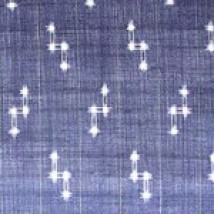
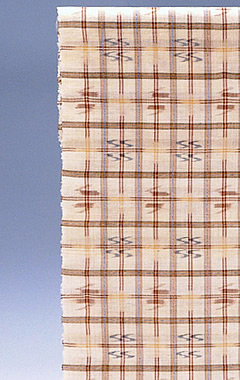
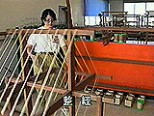
    From cultivating the ramie, the raw material for the yarn, to dyeing and weaving, everything is done by hand. There are two dyeing methods: tie-dyeing, where the yarn is tied by hand and then dipped in dye, and printing, where the dye is rubbed onto the fabric with a bamboo brush. The ikat patterns are designs of familiar creatures and everyday objects, such as flowing water, birds, and fireflies. The designs are still passed down from the illustrated notebooks sent as instructions from the royal government in Shuri during the time when linen was paid as tax.

    Step 1: Extracting yarn from ramie.

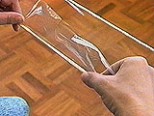
    Ramie is a plant belonging to the nettle family, and it can be harvested four or five times a year. After being cut, it is soaked in water for several hours, and the fibers inside the outer layer are scraped off with a dull knife or similar tool. After drying in the shade, it is moistened with water and finely split with the fingertips before being spun. The warp threads are twisted on a spinning wheel, while the weft threads are twisted by hand as they are spun. It is a task that requires experience and patience because the yarn must be of a consistent thickness. The spinning is mainly done by grandmothers in their 80s.

    画像をクリックすると動画が再生されます

    工程2: 整経

    Following the design, the yarn is divided into the ground yarn for the background and the ikat yarn for the ikat pattern, and the number and length of each thread are calculated and prepared. To prevent the ikat pattern from shifting and the dye from soaking in, starch is applied, and the yarn is stretched out and left to dry.

    Step 3: Tie-dyeing (in the case of tying)

    To prevent the background from being dyed, mark the thread with a ruler board and tie it securely with cotton thread or plastic string. Then, soak it in hot water to remove the starch from the part to be dyed.

    工程4: 染色

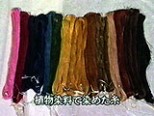
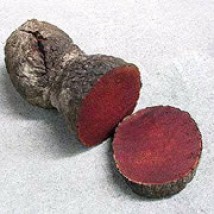
    Most of the dyes used are from naturally growing plants, including Yaeyama's unique kuru (red dew, Japanese name: Somemonoimo), fukugi, acacia, and Indian indigo.

    cool
    The skin is peeled and grated, and the liquid boiled and strained is used as a dye. The darker the reddish-brown color, the better the quality. The yarn is dipped in the dye solution and dyed, and to improve the color development, a mordant such as alum, lime water, wood ash water, or iron is used.
    mutual tree
    The leaves are boiled to make a dye solution. The yarn is then dipped in the solution, which has been strained through a cloth, and dyed. A mordant is used to improve the color development. Many different colors can be produced, from off-white to a vibrant yellow.
    Indian indigo
    The branches are cut and placed in water, then weighted down and left overnight. The branches are removed, lime is mixed into the liquid and stirred, causing the indigo pigment, which has combined with the lime, to precipitate. The supernatant is discarded. This process is repeated to create precipitated indigo, which is then placed in a vat. Wood ash water and water are added, and fermentation begins in about 10 days. Threads are placed in the indigo vat, and they are dyed while being exposed to air. This dyeing process is repeated several times.

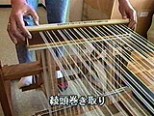
    Step 5: Winding the twill head

    The dyed and untied ikat threads are stretched out and passed through the reed according to the design. Cardboard is inserted between the threads as the thread is wound into a twill head to prevent the ikat pattern from shifting.

    Step 6: In the case of printing

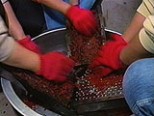
    The kurrha plant is grated, and the squeezed juice is dried in the sun to create a concentrated solution. This becomes the dye solution. The number of weft ikat threads is calculated, and the fabric is hung on a wooden frame the width of the weaving, and the dye solution is applied to the areas that will form the pattern using a bamboo brush. The ikat threads, which have been temporarily threaded through the reed, are wound onto a twill head before being printed.

    Step 7: Winding up the base

    The ground thread, which has been temporarily threaded through the reed, is wound onto the reed head, with a piece of cardboard in between.

    Step 8: Weaving

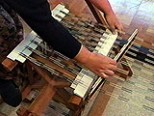
    The printed twill head is set at the top of the loom and the base head at the bottom, and then passed through the heddles and reed. The Yaeyama-style loom is divided into a twill head and a base head, making winding and other operations easier, and because it is adjusted with weights, weaving irregularities are less likely to occur. Another feature is that the loom as a whole is short, so there is less misalignment of the warp ikat.

    画像をクリックすると動画が再生されます

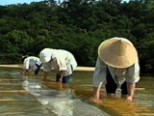
    Step 9: Sea blanching

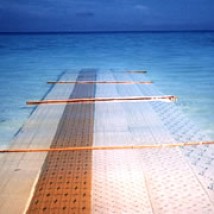
    After sun-drying and color-fastening, the fabric is exposed to seawater. This process makes the white ramie cloth even whiter and also helps to fix the ikat colors. This is a unique Yaeyama technique that utilizes the sea and the sun.

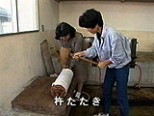
    Step 10: Pestling

    The washed and stretched taiko cloth is wrapped around a log and beaten with a pestle over a cotton cloth. This gives it a sheen and improves its texture and feel.


  • Close-up

    Delicate beauty nurtured by the tropical environment

    YAEYAMA Jofu (Ramie Textiles), woven from hand-spun hemp yarn, is known for its smooth texture and cool colors and patterns. It is highly popular as a summer kimono. We spoke with Sachiko Arakaki, who has won numerous awards for her outstanding works, about the nature of Yaeyama and Jofu.


    During the Ryukyu Kingdom era, Yaeyama was a source of dyes.

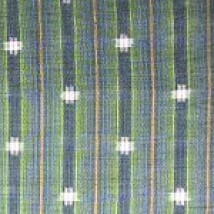
    Arakaki's works exude a refreshing quality, like a breeze blowing through young leaves, and a gentle appreciation for nature. For example, her piece exhibited this year at the "Oki-ten" exhibition, which brings together Okinawan arts and craftspeople, was a wonderfully refreshing piece featuring white ikat patterns on a background of varying shades of green.
    "The mountains here are beautiful from late January through February. They become brighter with the fresh green leaves. My favorite tree is the acacia. Its leaves are slender, and the sunlight filtering through them is so beautiful. I used to go out often just to see the sunlight filtering through the trees."
    Ms. Arakaki, who enjoys hiking in the mountains, spoke modestly about how Jofu is a product of the nature of the Yaeyama Islands.
    Yaeyama is said to be the northernmost limit of tropical plant distribution. Therefore, dye plants that are not found on Okinawa Island or Miyako Island can be obtained there. For example, kuru (also known as red dew or somemo in Japanese). It is a potato-like plant, and the juice squeezed out after chopping or grating it is used for dyeing. It does not require the boiling process like other dyes. During the Ryukyu Kingdom era, it was apparently shipped to Kumejima Island by order of the royal government.

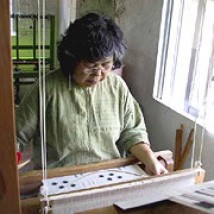
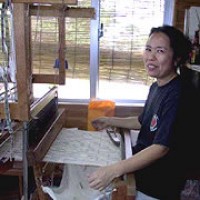
    Sachiko Arakaki weaving high-quality linen on a Yaeyama-style loom.

    There are no unpleasant colors when dyed with plants.

    They have an abundance of other dyes as well, and they use what they find in the mountains and gardens without any difficulty. Ms. Arakaki produces green by layering yellow dye extracted from the bark of a tree called Fukugi with indigo.
    "People often ask me if I like green because I make a lot of green-colored works, but it's not that I particularly like it; I just happened to get my hands on a lot of Fukugi leaves, so I used them to dye things."
    Fukugi trees are planted all over the property as windbreaks. Those that are 100 or 200 years old grow into trees so large that they are too big to embrace. When they hear that a tree is going to be cut down when a house is being rebuilt, they go to the house to get the bark. The trunks are used by people who make pottery. It's a wonderful recycling. When there is a bounty of gardenia fruit in the garden, they use it as dye. After a typhoon, they went to the mountains and found a large chinquapin tree that had fallen, and when they tried dyeing with it, they got a beautiful silver-gray color. Ms. Arakaki says, "There are no unpleasant colors when you dye with plants. They are all beautiful colors."

    A unique dye from this region, a cross-section of cool

    The cobalt blue sea and sun whiten the fabric.

    Other conditions besides the dyes are also met. Ishigaki Island has good water, which is also important for dyeing and weaving. In terms of tools, the presence of mountains and the ability to cut down timber meant that there were many skilled carpenters in the area from ancient times, which proved useful. The looms were improved, and it is said that the first high loom in Okinawa Prefecture was built in this region.
    The final scene is the cobalt blue sea. The woven cloth is exposed to seawater and sunlight, increasing its whiteness. The soft white color unique to YAEYAMA Jofu (Ramie Textiles) is born from this "sea bleaching." The sight of the white cloth swaying in the endlessly transparent sea is something that can only be seen on a southern island.

    The sea bleaching process brings out the unique whiteness of the Jofu fabric.

    While drawing on classical traditions, creating works that convey a sense of individuality.

    YAEYAMA Jofu (Ramie Textiles) are incredibly unique. Each piece is handled by a single person, from designing the pattern to dyeing, weaving, and finishing.
    "Each individual is creating a piece of art that reflects their own personality. There's a joy in seeing something come together when you use your own body to create something."
    The finished product, achieved by overcoming difficult tasks and monotonous work, makes all the hardship worthwhile. We asked Mr. Arakaki about his aspirations for the future.
    "Looking at classic patterns makes me feel at ease. They have a mysterious power. I want to revive classic patterns, and I hope to create works that skillfully incorporate the essence of Okinawa." After 30 years of working with yarn, it seemed as though there were still many things she wanted to do.

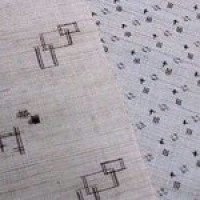
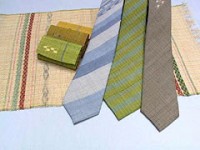
    • Aragaki's work

    • Aragaki's work

    Craftsman Profile

    Sachiko Arakaki

    Born in 1945.
    After much research, she successfully revived the tie-dyeing YAEYAMA Jofu (Ramie Textiles), a type of linen fabric that had been lost. Her work is highly acclaimed.

    Anecdotes

    Until the lost "Kakusen" technique is revived

    "There were only brown and white before, but then color was introduced. Everyone wanted to use color, so the number of people doing stencil dyeing increased rapidly."
    The quality of the printed fabrics has also improved thanks to the revival of the sea-bleaching process. "Printed fabrics can create patterns down to the millimeter, which are impossible with tie-dyeing," says Matsutake. Now, they are producing intricate and delicate ikat patterns. Printed fabrics with brown ikat patterns on a white background and colorful tie-dyed fabrics—these two types of high-quality linen fabrics are now competing with each other in terms of individuality.

    • The revival of saturation dyeing allows for the creation of a wide range of colors.

    • Miniature Shisa made from high-quality linen are popular among young people.

    • Uses yarn spun by hand from ramie.


overview

Craft item name YAEYAMA Jofu (Ramie Textiles)
Reading Yaeyama Jōfu
Classification of crafts fabric
Main Products Kimono fabric, obi sashes, tapestries, noren curtains
Main manufacturing area Ishigaki City, Taketomi Town, Yaeyama District
Designated date April 11, 1989

contact address

■ Production area association

Ishigaki City Textile Business Cooperative
〒907-0004
783-2 Tonoshiro, Ishigaki City, Okinawa Prefecture
TEL: 098-082-5200
FAX: 098-082-5200

Taketomi Town Textile Business Cooperative
〒907-1101
381-4 Taketomi, Taketomi-cho, Yaeyama-gun, Okinawa Prefecture
TEL: 0980-85-2302
FAX: 0980-85-2302

Features

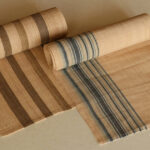
The design uses RYUKYU Kasuri (Ikat), the same technique used for other Okinawan textiles. The weft is woven from hand-spun ramie, dyed with plant-based dyes, and produced by hand weaving, so there are subtle differences in color and other characteristics, and no two pieces are exactly alike. It also has a pleasant feel against the skin, is cool and refreshing, and is perfect as a summer kimono.

How to make it

The yarn used is hand-spun ramie, which is harvested only a few times a year. In addition to the nationally renowned hand-tying technique, the dyeing process also utilizes a plant dye called Koru, which is said to be found only on Ishigaki Island, and is also done by printing. Finally, the fabric is soaked in seawater for about five hours to finish.

Please see here for information on traditional craftspeople.

Japanese traditional craftsman
top