TOKYO Tegaki Yuzen (Dyeing)

In the mid-Edo period, Edo, the center of samurai rule, flourished both culturally and economically, attracting a large influx of goods from the Kansai region known as "kudarimono." Following this trend, many dyers employed by daimyo (feudal lords) moved to Edo.
Various techniques were introduced. As townspeople gained economic leadership, townspeople culture developed, sensibilities such as "iki" (chic) and "sabi" (simplicity/refined elegance) became common, and hand-painted Yuzen dyeing by pattern painters flourished.

  • Technology/techniques/raw materials

    Technology/techniques

    1. The preliminary sketch should be drawn using blue and white pigments, etc.

    2. When resist dyeing, use thread glue, white glue, weir glue, resist paste, or wax drawing.

    3. For "inserting" and "painting," use a brush or paintbrush.

    4. When applying a coat of arms, it shall be done by hand-painting or by printing using a stencil with the coat of arms engraved on it.

    5. If embroidery is to be done, it must be done by hand.
     

    raw materials

    The fabric must be silk.

  • Work scene

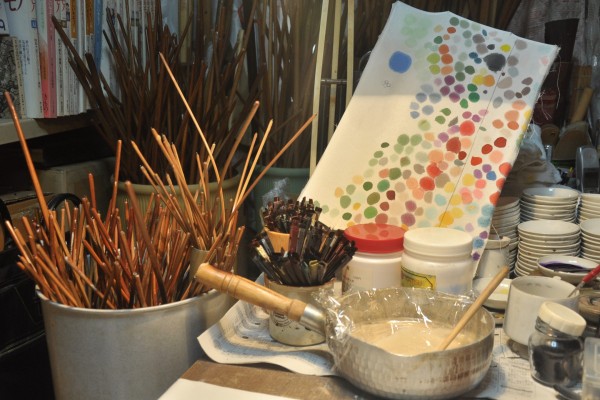
    Yuzen, a representative Japanese kimono, is made by meticulously applying colors by hand, stroke by stroke, to silk fabrics, depicting seasonal landscapes and plants. While the techniques are the same as those of Kyoto and Kaga, Tokyo Yuzen is characterized by its refined, understated, and sophisticated atmosphere, reflecting the spirit of Edo. Nowadays, brighter colors are also incorporated, resulting in a more modern finish.

    Step 1: Concept and Design

    I design the patterns to suit the wearer's personality and the season, treating the kimono as a painting and creating rough sketches on washi paper. Then I meticulously plan the overall composition, pattern development, color scheme, and techniques for each stage of the process. In some cases, I may add color in addition to the sketches.

    Step 2: Sketch

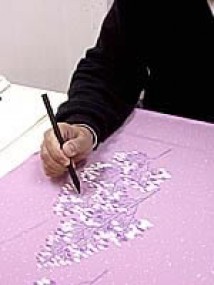
    Using a brush dipped in blue floral dye, the artist draws lines onto the fabric, which has been temporarily sewn into the shape of a kimono, according to the design and concept. The blue floral dye is made from the juice of the spiderwort flower, and it washes off easily with water. This is a fundamental step that determines the quality of the finished design.

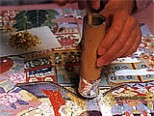
    Step 3: Applying glue to the threads

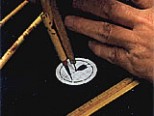
    A metal tip is attached to the end of a tube made of persimmon-dyed paper, and Yuzen paste (a mixture of glutinous rice paste, rice bran, and salt) is placed inside. The paste is squeezed out of the tube and applied to the surface of the fabric, following the outline of the drawn pattern. This is a resist dyeing process that prevents the dye from mixing or bleeding with other parts of the pattern, and it is an important step that affects the final finish. When the fabric is dyed, the lines of paste remain as white threads, hence the name "thread lines."

    画像をクリックすると動画が再生されます

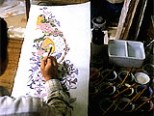
    Step 4: Hand-painted Yuzen dyeing

    The dye solution is applied to the inside of the pattern, which has been marked with a resist paste, using a small brush or paintbrush. This is a difficult task in the hottest part of summer, as the dye solution is dried over a flame to prevent the colors from bleeding. This is the most important step, as it involves considering the properties of the dyes, matching colors, and harmonizing the overall color scheme. For artisans, this is a stage where they can showcase their sense of color, aesthetic sense, and skill, as well as the beauty of the shades and shadows, the blending of colors, and the exquisite combination of colors.

    Step 5: Apply paste and leave it on.

    This is a resist dyeing process to prevent the dye from mixing with the base color dye. Paste (a mixture of glutinous rice paste and rice bran in a 7:3 ratio) is placed on the areas where the color has been applied to create the pattern, and then rice bran is sprinkled on top. The spatulas used to apply the paste are made by the craftsmen themselves by carving them out of cypress wood.

    Process 6: Hikizome

    The base fabric is dyed. A large brush is dipped in the base color dye, the fabric is stretched taut, and the entire piece is dyed in one swift motion to ensure even coverage. There are also techniques for creating various gradations using large and small brushes, which require highly skilled techniques.

    画像をクリックすると動画が再生されます

    Step 7: Steaming and washing

    The fabric is placed between sheets of paper and hung on a frame, then steamed at 100 degrees Celsius for 20 to 25 minutes. This allows the dye to set into the fabric. Then it is washed with water to remove any excess dye and starch. In the past, this washing (Yuzen-nagashi) was done in rivers, but this sight is rarely seen anymore. Once the fabric dries after washing, the white outlines of the threads become visible, and the color patterns stand out even more.

    Step 8: Steaming

    The fabric is passed through a metal drum heated with steam to perform a steaming process. This process corrects any distortions in the fabric and ensures that the length and width are consistent.

    工程9: 仕上げ

    The dyed patterns are then corrected and finished using brushes and other tools. To further enhance the patterns, gold or silver leaf may be fixed to certain areas, or embroidery may be added. Depending on the technique, one hand-painted Yuzen piece can be completed in one to several months.

    Step 10: Coat of arms overlay

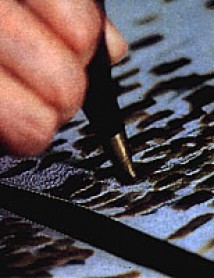
    If a family crest is required, a specialist crest painter will hand-paint it onto the finished Yuzen fabric. This is a highly skilled technique that involves drawing intricate patterns in ink on a small, flat surface the size of a postage stamp.

  • Close-up

    The understated TOKYO Tegaki Yuzen (Dyeing) transcends time and space.

    Two hundred years ago, hand-painted Yuzen dyeing was introduced to Edo (present-day Tokyo) from Kyoto. Adapting to the tastes of the townspeople, it evolved, becoming subdued and understated on the surface while subtly incorporating a sense of style in the hidden details. This versatility may be the reason why Tokyo Yuzen continues to be sought after in the new era.


    Edo Yuzen, which represented the rebellious spirit of the people of Edo.

    "Until the early Showa era, you could see people dyeing Yuzen fabrics in the river. Now, that's just a distant memory of a bygone era..."
    Masakazu Adachi says that he loved drawing from a young age and always wanted white paper instead of toys. Inspired by his father, who founded a dyeing and weaving business in Kanda, he began receiving instruction in Yuzen dyeing techniques as soon as he graduated from university.
    Compared to KYO Yuzen (Dyeing), which is colorful, vibrant, and dazzling, Edo-Yuzen is subdued and plain. Yuzen became widely popular among the townspeople of Edo during the Bunka-Bunsei era (1804-1830). The samurai class declined and merchants rose to prominence, and Edo culture was in its heyday. The shogunate imposed strict regulations on food, clothing, and other matters according to social class, and in particular, prohibited extravagant clothing for townspeople. Outwardly, townspeople appeared to obey the decree, wearing safe and plain kimonos with stripes and other simple patterns.
    "However, when they went to Yoshiwara for entertainment, they would simply flip over the inside of their haori jackets, revealing a dazzling fabric adorned with gold and silver. What started as a rebellious spirit against authority evolved into the Edo spirit of being stylish even in places that are usually hidden and unseen."

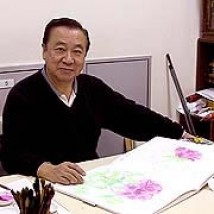
    Masakazu Adachi. For the past 15 years, he has been holding Yuzen dyeing classes several times a month. His purpose is to pass on the techniques and methods of Yuzen dyeing to future generations and to train successors.

    I capture what moves my heart in my kimono.

    Two hundred years have passed since then. Today, Yuzen dyeing in Tokyo is increasingly drawing on the ideas of modern painting. Originally, the theme was "what to depict," but now the focus is on "how to depict." Even if the designs depict flowers, birds, wind, and the moon, they do not simply end up being realistic. To express flowers and birds in their own unique way, they emphasize the invisible aspects of imagination, giving the kimono itself a narrative quality.
    "Of course, we must not neglect the fundamental technique of realism. I myself still practice drawing regularly. I often go out to sketch at places like Hyakkaen in Mukojima, Korakuen and Rikugien in Hongo, and the East Garden of the Imperial Palace."
    What can be built upon that technology? That depends on the individual craftsman's sensitivity and rich imagination. Mr. Adachi says he always keeps his antennae up wherever he goes.
    "There are so many things to feel in each moment—beautiful things, things that evoke sadness... For example, on my way back from Kyoto, I happened to catch a glimpse of Mount Omi-Fuji at dusk, and it resonated with me more than any famous historical site. I want to capture those kinds of things that move my heart in my kimonos."

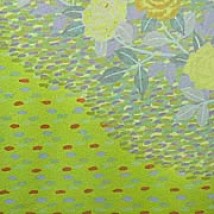
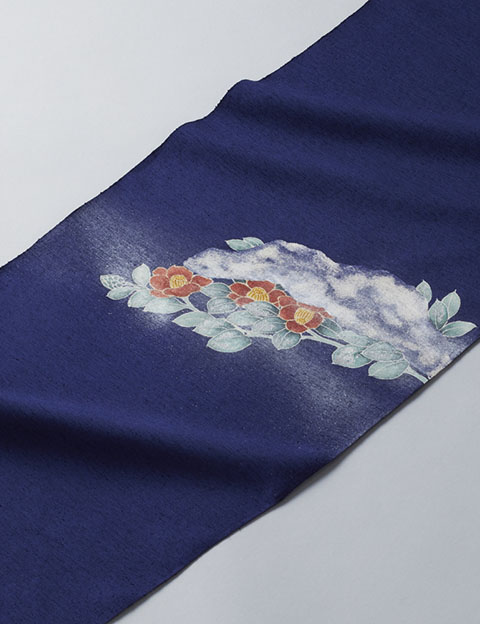
    This piece utilizes the "transfer paste" technique. Unlike typical Yuzen dyeing, it lacks the characteristic thread lines, and the boundaries of the patterns are entirely defined by color, resulting in a unique texture and three-dimensionality. It has an almost oil painting-like feel.

    To communicate effectively, change is also necessary.

    Ms. Adachi has a message she wants to convey to the world through Yuzen dyeing: How do we live in an era of zero growth, where continuous economic growth is no longer possible?
    "I hope you'll cherish the high-quality items made with genuine craftsmanship, and not let them end with your generation, but pass them on to your children and grandchildren. Passing on not only the objects but also the values to the next generation—isn't that what true richness is all about?"
    Adachi's belief is that traditional crafts must also change to achieve this. He argues that while using traditional techniques, they should reform themselves to align with the sensibilities of the new era. Sometimes, it may even be necessary to break down preconceived notions. Adachi, who emphasizes the richness of his ideas, has boundless creativity. Surprisingly, he is currently fascinated by the Jomon period.
    "When I'm immersed in Jomon culture, I can feel the scent of the earth on my skin, and it makes my heart race. The design source is from 10,000 years ago, but when I elevate it into a Yuzen dyeing piece, it has to be my own unique expression. Destroying it and rebuilding it again—that's an exhilarating job."
    When Yuzen dyeing was introduced from Kyoto to Edo, it adapted seamlessly to the local culture and spirit, changing without restraint. Now, once again, we are at a major turning point. It seems that Tokyo Yuzen possesses wings that can effortlessly transcend time and space. As long as the dialogue between those who love Yuzen and continue their tireless creative work, and those who are drawn into its story and long to wear it, continues, TOKYO Tegaki Yuzen (Dyeing) will continue to be reborn and passed down to future generations.

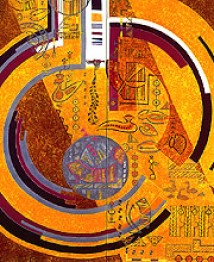
    • "Creation of Sacred Sites," a work exhibited at the Nitten exhibition, was inspired by the Jomon period. Other works in the Ancient Series include "Layers of Ancient Time," "Ancient Family," "Ancient Recollections," and "Ancient Sacred Sites."

    • Each stroke of color is applied meticulously.

    • Adachi's unique "transfer paste painting" technique involves mixing paste and dye, placing the mixture in a paste tube, and repeatedly applying the paste as it dries. In Yuzen dyeing, layering the paste is considered unorthodox because it muddies the colors, but Adachi deliberately challenged this traditional taboo.

    Craftsman Profile

    Masakazu Adachi

    Born in 1935.
    The "transfer paste painting" technique, which he perfected with his father, is a groundbreaking method that breaks away from conventional notions of Yuzen dyeing. He is active not only in Yuzen dyeing but also in the field of dyed folding screens.

    Anecdotes

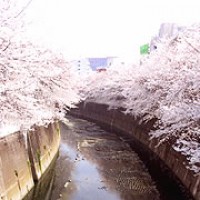
    Edo Yuzen dyeing developed along the Sumida River and Kanda River.


    • These two pieces depict vibrant flowers and are both works by Masakazu Adachi.

overview

Craft item name TOKYO Tegaki Yuzen (Dyeing)
Reading Tokyo Tegaki Yuzen
Classification of crafts Dyed products
Main Products Kimono fabric, haori jacket, obi belt
Main manufacturing area Entire special ward, etc.
Designated date March 3, 1980

contact address

■ Production area association

Tokyo Metropolitan Craft Dyeing Cooperative Association
161-0032
3-21-6 Nakaochiai, Shinjuku-ku, Tokyo
TEL: 03-3953-8843
FAX: 03-3953-8898

http://www.tokyotegakiyuzen.or.jp/

■ Visits to production areas from overseas
image
TOKYO Tegaki Yuzen (Dyeing) Dyeing: A Visit to the Production Area

Features

Edo, from that time to the present day, has been a major consumer market where sophisticated fashion has been in demand. TOKYO Tegaki Yuzen (Dyeing), against this backdrop, is characterized by its refined designs with a limited color palette, featuring bright tones and a sense of novelty despite its understated appearance.

How to make it

TOKYO Tegaki Yuzen (Dyeing) can be broadly categorized into three techniques: thread-resist dyeing, wax-resist dyeing, and wireless dyeing. All of these are dyeing techniques that use resist dyeing. Currently, thread-resist dyeing, in which white, thread-like lines vividly stand out after dyeing, is the most popular.

top