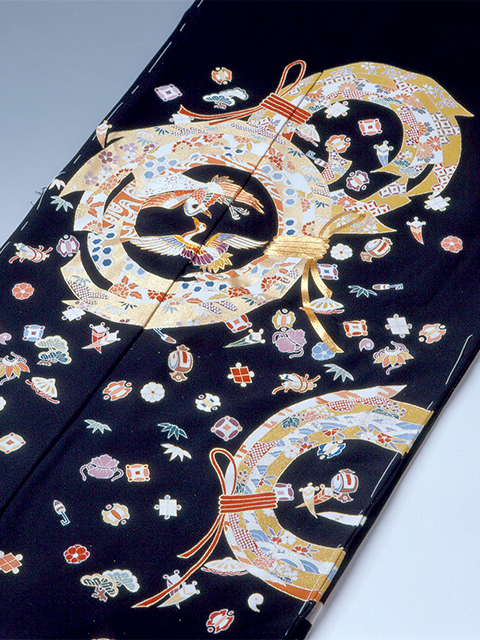
KYO Yuzen (Dyeing)

Kyoto Prefecture

The dyeing technique has been passed down since the 8th century, and it is said that hand-painted Yuzen dyeing was established in the Edo period by Miyazaki Yuzensai, a painter from Kyoto. Miyazaki Yuzensai, who was very popular as a fan painter, incorporated his own painting style into his designs and applied it to the field of pattern dyeing, which gave birth to "Yuzen dyeing."
Yuzen dyeing, which involves dyeing kimonos with a wide range of colors and pictorial patterns, became popular in the mid-Edo period, when townspeople's culture flourished. In the Meiji era, "transfer Yuzen dyeing," which uses stencils to dye Yuzen patterns, was developed.

  • Technology/techniques/raw materials

    Technology/techniques

    1. In the case of hand-painted Yuzen dyeing, the following techniques or methods shall be used:
    (1) The design shall be based on Yuzen patterns.
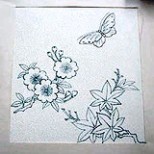
    (2) The preliminary sketch should be drawn using blue and white pigments, etc.
    (3) When resist dyeing, use thread glue, "weird glue," resist glue, or wax drawing.
    (4) For "inserting," "coloring," and "painting," use a brush or paintbrush.


    2. In the case of kata-yuzen dyeing, the following techniques or methods shall be used:
    (1) The stencil shall be made of a base paper made by pasting handmade Japanese paper with persimmon tannin, or a base paper of the same quality on which a Yuzen pattern has been carved.
    (2) The glove will be shaped by hand, matching the pattern.
     

    raw materials

    The fabric must be silk.

  • Work scene

    "Yuzen" refers to patterned dyeing. While techniques for dyeing cloth have existed since ancient times, it was during the Edo period that patterned dyeing known as Yuzen dyeing spread to Kyoto. It is said that Miyazaki Yuzensai (born in 1654), who was popular in Kyoto as a fan painter at the time, started by designing the innovative patterns he learned from fan painting with the various patterns that had been established by then. It is said that this technique came to be called "Yuzen dyeing" after Yuzensai, who devised it. In the Meiji era, bright and colorful chemical dyes were used, and "transfer Yuzen," which allowed for mass dyeing using stencils, was invented in contrast to the previous "hand-painted Yuzen." This is what is now called "stencil Yuzen," and it made mass production possible, spreading to many people. Even today, Yuzen dyeing techniques are richly used in furisode and tomesode kimonos, and further embroidery and gold and silver processing are added, developing the world of "dyeing and embroidery art."

    Step 1: Sketch

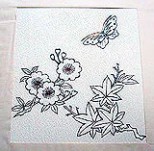
    First, the artist designs and creates a full-scale pattern for the kimono. Then, on a white piece of fabric that has been temporarily sewn into the shape of a kimono, the artist draws the design using a brush dipped in blue flower dye. This blue flower dye is derived from the large-leaved variety of the dayflower, *Commelina communis*.

    Step 2: Applying thread-like paste

    The thread-line paste application process involves pushing paste from a tube into the paper and applying it along the lines of the underpainting. This paste, called thread-line paste, acts as a barrier to prevent the dyes used in the subsequent coloring process from bleeding or mixing. After this, a process called "grounding" is performed, in which soy milk is brushed over the entire fabric, and then it is immediately dried over a high flame. This is done to erase the blue pigment from the underpainting and to allow the thread-line paste to adhere to the fabric.

    Step 3: Coloring

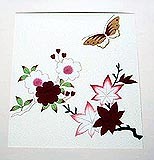
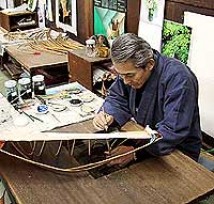
    The coloring process involves dipping a brush or paintbrush in dye solution, placing a resist paste along the underpainting onto the fabric, and then holding it over an electric heater (or charcoal fire in the past) to dry while applying various dyes to the pattern with a brush or small paintbrush. This is a process that requires years of experience, from mixing the dyes to achieving the desired colors. After this, there is a process called "steaming." Steaming fixes the dyes and sets the colors.

    Step 4: Applying paste to the back of the paper.

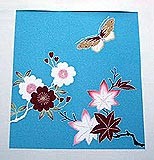
    The process of applying paste to a pattern involves covering the entire colored area with paste. This is preparation for the next step, background dyeing, and is done to prevent the background color from getting on the colored areas. After this, the fabric undergoes a process called "ground dyeing," where the entire fabric is dyed with the background color using a brush, followed by a "steaming" process to fix the dye to the fabric. Finally, the paste and dye are washed away in "water washing," and the fabric is straightened with "stretching and hot water pressing." These processes are carried out to ensure that the accent colors are fully developed on the fabric surface. In Kyoto, with its beautiful waterways such as the Kamo River and the now-dried Horikawa River, this was once a process where brightly colored bolts of fabric were washed in the river currents, a process known as Yuzen-nagashi that delighted people's eyes.

    工程5: 仕上げ

    Finally, the finishing touches are applied. Here, intricate coloring, foil, gold dust, and embroidery are added to bring out the splendor unique KYO Yuzen (Dyeing). Goldwork is a decorative technique in which metallic foil or metallic foil powder is attached to the dyed fabric using adhesives such as glue. There are various techniques, including thread-drawn goldwork, solid foil (pressed foil), stenciled foil, cut foil, gold dust (shaking gold), hammering, raised foil, and crumpled foil. In addition, embroidery is a process in which the hands are skillfully moved up and down to stitch from the front and back of the fabric, creating patterns with a variety of threads. Embroidery, along with goldwork, is a process that further enhances the Yuzen patterns.

  • Close-up

    The brilliance of the handiwork in every color and every brushstroke: KYO Yuzen (Dyeing)

    KYO Yuzen (Dyeing), said to have been founded in the Edo period by the Kyoto painter Miyazaki Yuzensai, is a dyeing craft that reflects the noble and refined aesthetic sense of Kyoto. We spoke with Kiichi Tabata, the fifth-generation owner of a company boasting a 200-year tradition since its founding, about his passionate feelings towards KYO Yuzen (Dyeing).


    Dyeing is, in a sense, a technique that pursues the pursuit of "not dyeing."

    From the Nara period, when a unique Japanese culture flourished, dyeing techniques such as batik, tie-dyeing, and pinching, as well as embroidery, developed in the field of clothing culture. In the Muromachi period, sarasa and inkin kimonos were produced, and in the Momoyama period, gorgeous kimonos such as tsujigahana and shibori-fuku were created, marking the beginning of Kyoto's dyeing craftsmanship. Then, in the Edo period, during the Genroku era, Miyazaki Yuzensai, a popular fan painter, created Yuzen dyeing to apply fan patterns to kimonos. "Dyeing is a technique that pursues how to avoid dyeing. It is very easy to dye fabric by dipping it in dye. Conversely, it is more difficult to leave white without dyeing it. The methods of resisting dyeing are batik for wax dyeing and tie-dyeing for thread dyeing. Yuzen dyeing is characterized by the use of paste. Especially in the case of hand-painted Yuzen, the artist's skill shines through in the precise brushwork because it is a line drawing."

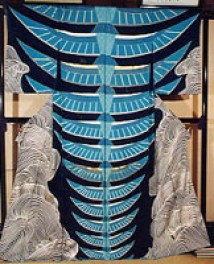
    Work name: “Tensho”

    The world of "elegance and profound beauty" as depicted by the Tabata family

    The first generation of the Tabata family, Kihachi, studied Japanese painting during the Edo period's Bunka-Bunsei era before founding a dyeing business. He was active as a bespoke dyer, creating clothing for the princesses and wives of court nobles and samurai families. The third generation was particularly impressed by the beauty of period costumes and actively collected clothing and fabrics to use as research material. Using the Tabata family's unique techniques such as "Mamegaki Yuzen" and "Sekidashi Yuzen," which are based on Japanese painting, he created works that breathed new life into KYO Yuzen (Dyeing), and was designated a Living National Treasure in 1955. Valuable costumes from the Momoyama and Edo periods were later compiled by the current generation as the "Tabata Collection." The Tabata family, which has depicted a world of refined elegance and profound beauty, also plays a significant role as storytellers of the history of dyeing culture.

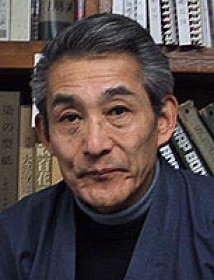
    Kiichi Godai Tabata

    The belief passed down through generations is "The Master of Flowers."

    The Tabata family's philosophy, passed down through generations, is that "the main character is the wearer." While highly regarded as a KYO Yuzen (Dyeing) artist, the artist considers themselves merely a supporting character. "The main character of the stage is always the woman wearing the kimono. Our role is to create that stage so that the woman looks more beautiful and more radiant. The artist should not take center stage. The way a kimono is worn is fundamental. A kimono is not something that is merely beautiful to adorn. We design the flow of the patterns and the use of colors with the main character's appearance in mind. Compared to the past, there are more people with bright, Western-style features. For these people, a sharp, dark background that creates contrast is more flattering than soft, traditional Japanese colors," he says, adding a refined modern sensibility to traditional techniques.

    They place charcoal under the table and apply color while drying the fabric. They use charcoal for the tea ceremony that doesn't produce sparks. Many workshops use electric heaters, but they say that you can't get the right colors without charcoal.

    For the present and into the future. Pursuing timeless beauty.

    "For example, even vermilion used to have a yellowish tint. That shade certainly suits the skin of people of East Asian descent. However, in modern times, which have become more Westernized, there is a tendency to prefer bluish vermilion. In terms of designs, there is a growing demand for more innovative ones. While respecting the dignity and tradition of KYO Yuzen (Dyeing) techniques, I want to pursue a timeless beauty that connects the present to the future. In the future, I would also like to create a museum in Kyoto where people can learn about dyeing. I want it to be a place where more people can learn about the beauty of Yuzen." Perhaps the reason she is able to properly observe the changing times, inherit the history of Yuzen, and bear the heavy responsibility of passing it on to the next generation is because she can view dyeing crafts from a broad perspective through the filter of arts and crafts, including Japanese painting.

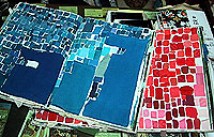
    Color swatch book

    Craftsman Profile

    Godai Tabata Kihachi

    Born in Kyoto in 1935. Graduated from Waseda University, Faculty of Letters, Department of Fine Arts, and completed a course in Japanese painting at Kyoto City University of Arts. Representative Director of Tabata Dyeing and Weaving Art Research Institute Co., Ltd. Numerous award-winning works. Author of many books on dyeing and weaving. Currently serves as the chairperson of the Japan Dyeing and Weaving Artists Association, among other positions.

    Anecdotes

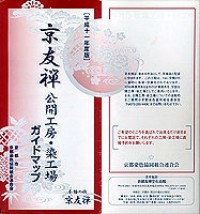
    Experience the charm of KYO Yuzen (Dyeing)- Open workshops and dyeing factories

    The process of KYO Yuzen (Dyeing) is divided into more than 15 stages, with specialized and divisional work involved. This map introduces workshops and dyeing factories that are open to the public, selected from among the 1250 businesses affiliated with the Kyoto Dyeing Cooperative Association. Why not stop by while strolling around Kyoto and experience the elegance of KYO Yuzen (Dyeing)?

    • Guide map of KYO Yuzen (Dyeing) dyeing workshops and factories.

overview

Craft item name KYO Yuzen (Dyeing)
Reading Kyoyuzen
Classification of crafts Dyed products
Main Products Kimono fabric, coats, haori jackets
Main manufacturing area Kyoto City, Uji City, Kameoka City, Joyo City, Mukō City, Kumiyama Town, Kuse District
Designated date June 2, 1976

contact address

■ Production area association

KYO Yuzen (Dyeing) Cooperative Association
604-8225
5th Floor, Kyozome Kaikan, 481 Kamakiriyama-cho, Nakagyo-ku, Kyoto City, Kyoto Prefecture
TEL: 075-255-4496
FAX: 075-255-4499

http://www.kyosenren.or.jp/


Features

It's no exaggeration to say that KYO Yuzen (Dyeing), which depicts flowers, birds, landscapes, and other motifs, has become synonymous with Japanese kimono. While using a wide range of colors, the noble and refined colors and patterns of KYO Yuzen (Dyeing) embody the beautiful sensibilities cultivated over a thousand years of Kyoto history.

How to make it

KYO Yuzen (Dyeing) is a type of dyeing technique using pure silk, involving hand-painting or stencil dyeing. The process can involve as many as 14 steps, and is specialized and divided among different craftsmen. KYO Yuzen (Dyeing) stencils feature a wide variety of designs. The techniques of KYO Yuzen (Dyeing) are broadly divided into stencil dyeing and hand-painted dyeing. A closer examination reveals that the techniques have been passed down from both Japan and other countries.

top