KYO Komon (Fine-pattern Dyeing)

Kyoto Prefecture

The origins of Kyo-komon (KYO Komon (Fine-pattern Dyeing) style small-patterned silk fabric) can be traced back 1200 years to the creation of the basic stencils. After the Onin War during the Muromachi period, various silk fabrics were produced, leading to the development of Tsujigahana dyeing and Chaya dyeing techniques, and a town of dyers centered around Horikawa in Kyoto.
Uesugi Kenshin's crested kimono and Tokugawa Ieyasu's small floral patterned kimono are examples of garments made using the techniques of komon dyeing. It was around this time that the technique of applying a resist paste before dyeing the fabric was perfected.

  • Technology/techniques/raw materials

    Technology/techniques

    1. The design should be in the style of a small pattern.

    2. The stencil shall be made by carving onto a base paper made by pasting handmade Japanese paper with persimmon tannin, or a base paper of equivalent quality.

    3. The shaping process involves manually matching the patterns.

    4. The base dyeing shall be done by either brush dyeing or "shigoki" (a type of scrubbing).

    5. Nasen nori shall be made by mixing rice flour with rice bran and salt, etc.

     

    raw materials

    The fabric must be silk.

  • Work scene

    "Kyoto Koshibori" is a type of dyeing technique that uses stencils to create patterns. The "kata-yuzen" technique used in KYO Yuzen (Dyeing) is basically the same process. There are many steps involved, and it usually takes about one to two months for KYO Komon (Fine-pattern Dyeing) to be dyed.
    In Japanese dyeing, the technique of "dyeing with a resist paste" has been practiced since ancient times.
    In contrast, European dyeing lacked the concept of "resist dyeing," and fabrics were dyed using copperplate engraving techniques from ancient times. The technique and existence of "resist dyeing" were unknown until Javanese batik was imported around the 18th century.
    The stencils for KYO Komon (Fine-pattern Dyeing)) stencil paper using a cutting tool. Rice paste has been used as a resist for dyeing. Kano Yoshinobu's (1552-1640) "Paper Painting of Craftsmen" (Important Cultural Property) also depicts a scene of stencil application, indicating that stencil dyeing was practiced in the 1600s.
    This "stencil dyeing" technique is a highly advanced dyeing technology that Japan can proudly present to the world. Even the beautiful Italian scarves and ties that are dyed in a variety of colors using photogravure stencils today have their dyeing principles based on Japan's "traditional stencil dyeing." In fact, the origin of the print dyeing techniques commonly used today lies in Japan's "traditional stencil dyeing" technique.

    Step 1: Mold carving

    Using carving tools suitable for the design, the pattern is carved into stencil paper (three or four sheets of Japanese paper, with the paper grains alternating, pasted together, coated with persimmon tannin, and dried).

    画像をクリックすると動画が再生されます

    Step 2: Color matching

    Add the dye solution to the Yuzen paste and mix thoroughly with a stirring rod to create a homogeneous colored paste, which then produces the desired color. (A test steaming is performed at this stage.)

    Step 3: Mold placement

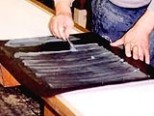
    The stencil is placed on the stretched fabric, and a resist paste or colored paste is applied to the stencil tool to transfer the pattern. The pattern is then applied one stencil at a time to the entire 12-meter length of fabric.

    Step 4: Dyeing the base fabric

    There are two methods for dyeing the base color.
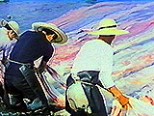
    The first method is "shigoki-zome," which involves applying colored paste with a spatula. The second method is "hiki-zome," which involves applying dye solution with a brush.

    画像をクリックすると動画が再生されます

    Step 5: Steaming and rinsing

    The fabric that has been dyed is placed in a steaming box and steamed for 20 to 60 minutes to allow the dye to fully penetrate the fabric.
    After steaming, rinse the dough under running water to remove any starch or excess dye, then wring it out and dry it.

    Process 6: Finishing

    After washing the cloth, use steam to stretch and straighten it, and you're done.


  • Close-up

    KYO Komon (Fine-pattern Dyeing) that reflect the four seasons of Japan

    "KYO Komon (Fine-pattern Dyeing)" has developed uniquely while influencing and being influenced by Yuzen dyeing. Because the techniques of kata-yuzen dyeing are directly utilized, KYO Komon (Fine-pattern Dyeing) has an elegant atmosphere. The use of color and patterns exudes gentleness and grace.


    The charm of KYO Komon (Fine-pattern Dyeing) lies in its gentle elegance.

    The history of KYO Komon (Fine-pattern Dyeing) is long, with its origins dating back 1200 years to the creation of the basic stencils. Komon dyeing developed as a form of formal attire for samurai during the Edo period and is generally known as "Edo-komon." Stylish and fashionable komon dyeing became popular among the common people of Edo and Kyoto as "kosode" for both men and women. In the Meiji era, influenced by "kata-yuzen," it evolved from single colors to multi-colored designs and developed uniquely as "KYO Yuzen (Dyeing)." KYO Komon (Fine-pattern Dyeing) has a different, more refined and elegant atmosphere than TOKYO Some Komon (fine-pattern Dyeing). Its use of color and patterns are characterized by gentleness and grace. Currently, Ikeda Sen-gei is finding a new path for KYO Komon (Fine-pattern Dyeing) by utilizing its traditional characteristics while employing new techniques. We visited dyer Kazuo Ikeda at the site of their development.

    It is dyed using delicately carved ISE Katagami (Paper Stencils). By changing the obi (sash), it is a versatile kimono that can be worn for a wide range of occasions, from weddings to funerals.

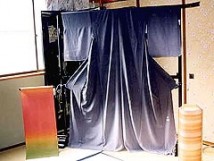
    "Sharkskin pattern gradation dyeing" created using the traditional "KYO Komon (Fine-pattern Dyeing) dyeing" technique.

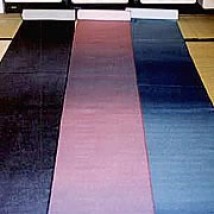
    KYO Komon (Fine-pattern Dyeing), also known as kata-yuzen, features numerous traditional patterns. While Ikeda previously dyed various patterns, she says, "Recently, I've been focusing on the 'same-komon' pattern, which is considered the most aesthetically pleasing of all the komon patterns." This "same-komon" pattern is imbued with the unique "elegant atmosphere" of KYO Komon (Fine-pattern Dyeing). It's a "gradation same-komon" with a gradient effect at the bottom of the background color. The development of this patented "new technique, gradation dyeing," also utilizes traditional KYO Komon (Fine-pattern Dyeing) techniques. The komon, finished with a soft texture, won the Good Design Award in the fall of 1999. It was the first kimono to receive the "G Mark" designation. The "gradation same-komon," which also received high scores in the judging, was nominated for a special award.

    I want to create something that has never existed before.

    Ms. Ikeda is the third generation of her family's dyeing business. After graduating from high school with a degree in commerce, she began working in the family dyeing business. At the same time, for three years, she studied color theory and art history as an auditing student at Kyoto City University of Arts (now Kyoto University of the Arts), while working.
    He says his hobby is "making use of his creativity." He used slide films for sample books with color photographs, which are called "book samples" in the industry, and installed a simple shower in the pattern washing area to improve work efficiency. He also thought of covering the yuzen boards with paper tape to prevent them from getting dirty. As he reviewed and proposed and implemented his daily work processes, at the age of 23 he invented the "Auto Air Sprayer." Sprayers used to moisten dye stencils traditionally had a hand pump built in to supply air, but he came up with the idea of using an air compressor instead. This invention was registered as a utility model and won the Director-General of the Science and Technology Agency Award. He likes "doing things that have never been done before, things that have no precedent." In his twenties, he founded the "Kimono Fashion Research Group," a study group that brought together people from different industries, which was unprecedented at the time, and continued it for over 10 years.
    The reality of the kimono industry that Ikeda faces is harsh. The emergence of "komon" (small-patterned kimono) made using the "machine printing" technique, which involves engraving delicate patterns such as sharkskin patterns onto metal cylinders using the principles of copperplate engraving, has put pressure on "mass-produced komon" that are inexpensive and uniformly dyed beautifully, forcing "komon dyed using traditional techniques" to struggle. "Is there a way for anyone to distinguish at a glance between genuine 'KYO Komon (Fine-pattern Dyeing) made with ISE Katagami (Paper Stencils) resist dyeing' and 'machine-printed' komon?" For Ikeda, who faced reality head-on as a dyer, this challenge became a worthwhile "theme." He decided to apply the gradation techniques of color theory that he had studied at art school and work on developing a new technology.

    Kyoto is a "city of history and craftsmen."

    "To truly appreciate the value of traditional crafts, the best way is to visit the production area and see them for yourself," says Ikeda. "Kyoto is a city with a long history, and it boasts a large number of traditional crafts—17 in total. It's also a city of technology that supports Japanese culture. I want to make Kyoto a city for shopping and sightseeing, where people come to buy 'authentic' traditional crafts."
    Ikeda is also actively involved in things outside of his main business, and he has a wide circle of acquaintances. He says that the thing he is currently focusing on most, besides his dyeing business, is the internet. "From now on, I want to gradually enrich the content of my website. I want to share information about the history and background of 'KYO Komon (Fine-pattern Dyeing)' (a type of traditional Japanese dyeing)," he said, describing his next goal.

    A formal kimono with a "sharkskin pattern gradation dye" by Ikeda Sen-gei was also used in a Suntory "Hibiki" whiskey commercial.

    Craftsman Profile

    Kazuo Ikeda

    Born on January 7, 1937.
    KYO Komon (Fine-pattern Dyeing) Dyeing Craftsman
    Traditional craftsman
    Kyoto Prefecture's Outstanding Technicians in Traditional Industries

    Anecdotes

    Tools that adorn the history of traditional crafts

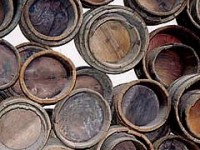
    In the "Screen Painting of Craftsmen" by Kano Yoshinobu, who was active during the Momoyama period, various sizes of dyeing vats are depicted beside the craftsmen setting up the stencils. At Ikeda Dyeing, there were also dyeing vats piled up all the way up the wall on the landing of the workshop's staircase. These vats were familiar to the craftsmen of the time they were used, tools that were always there alongside their lives. You can feel the beauty of their form and the passage of time in these dyeing vats that have lived through such a long history.
    Wooden tubs still retain a traditional Japanese aesthetic, and are familiar to us in many ways, from sushi tubs for cooking to bath tubs. Our own wooden tubs, too, are closely intertwined with our daily lives and continue to live on alongside our family's history.

    • It has received the G-mark as a "Gokuzame Komon Susome Bokashi Houmongi" (premium sharkskin patterned visiting kimono). The vibrant base color is striking.


overview

Craft item name KYO Komon (Fine-pattern Dyeing)
Reading Kyokomon
Classification of crafts Dyed products
Main Products Kimono fabric, coats, haori jackets
Main manufacturing area Kyoto City, Uji City, Kameoka City, Joyo City, Mukō City, and others
Designated date June 2, 1976

contact address

■ Production area association

KYO Yuzen (Dyeing) Cooperative Association
604-8217
97 Nishirokkaku-cho, Nakagyo-ku, Kyoto City, Kyoto Prefecture
TEL: 075-221-1713
FAX: 075-744-6444

http://www.kyosenren.or.jp/

Features

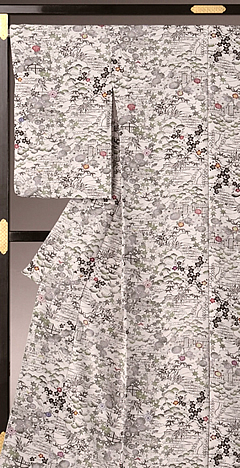
Komono are small patterns, similar to those found on samurai kamishimo (formal samurai attire), that are dyed in a single color using a stencil. In modern times, there are many varieties of komono, from those with the traditional, literally tiny patterns to those with bold designs of Western flowers and other motifs.

How to make it

After the refined white fabric is pre-treated with hot water, it is attached to a Yuzen board coated with a thick paste. A resist paste or colored paste is then applied to the fabric using a spatula over a stencil to transfer the pattern. The fabric is then dyed with a background color using a base dyeing or brush dyeing method, steamed, and rinsed with water.

伝統工芸士についてはこちらからご覧ください。

日本の伝統工芸士
top