SHIGARAKI Yaki (Pottery)

Shiga Prefecture

It is said that the kiln's origins date back to the Tenpyo era, when Emperor Shomu built the Shigaraki Palace and fired roof tiles. It is counted as one of Japan's six ancient kilns.
During the Kamakura period, water jars and seed jars were produced, and during the Muromachi and Azuchi-Momoyama periods, the production of tea ceremony utensils flourished, giving rise to many masterpieces.
During the Edo period, climbing kilns were used to produce a wide variety of everyday items, including tea caddies. From the Taisho era until before World War II, hibachi (charcoal braziers) were the main product, but today, products that make the most of the natural beauty of the clay are made, such as tiles, vases, tableware, and ornaments that are deeply rooted in daily life.

  • Technology/techniques/raw materials

    Technology/techniques

    1. The excavated soil should be manufactured without elutriation.

    2. Forming shall be done by wheel throwing, mold pressing, or hand twisting.

    3. When applying patterns to the base material, the following techniques are used: "pine bark," "insect-eaten pattern," "cloth pattern," "stamped pattern," "line engraving," and "comb drawing."
    This involves "tochiri," "kakiotoshi," or "keshokake."

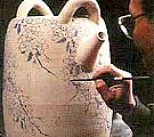
    4. The decoration shall be done by hand-painting underglaze. In this case, the pigment shall be oniita or gosu.

    5. When applying glaze, use the following methods: "overlapping glaze," "pouring glaze," "dipping glaze," "wax removal," "slip trailing," "half-glaze glaze," "spray glaze," "brush glaze," or "brush strokes."

    6. If the base material is not decorated, painted, or glazed, the natural glaze or firing color shall be brought out by firing in a climbing kiln or pit kiln.

     

    raw materials

    1. The clay used shall be "Jitsuchi clay," Shigaraki-produced Irome clay, Kibushi clay, or clay of equivalent quality.

    2. The slip used shall be "white clay" or a material of equivalent quality.

  • Work scene

    SHIGARAKI Yaki (Pottery) is one of Japan's six ancient kilns, with a history dating back over 1200 years to the Nara period. The Shigaraki area is a source of exceptionally high-quality clay, characterized by its plasticity and resilience. The warm "fire color" (scarlet) obtained during firing, the "velvet glaze" and "scorched" areas created by natural glazes, and the resulting aesthetic appeal are truly remarkable. Its simplicity and understated elegance have made it highly valued as pottery that expresses the "wabi-sabi" aesthetic, coinciding with the flourishing of tea ceremony culture since the Muromachi period. To this day, a wide range of pottery rooted in daily life is produced, from tea ceremony utensils and vases to garden pottery, architectural pottery, and tableware. SHIGARAKI Yaki (Pottery) process begins with clay preparation, but here we will introduce the process from shaping to final firing.
    *Plasticity = The property of changing shape when a strong force is applied and not returning to its original state.

    Step 1: Molding

    Pottery clay is made by drying and crushing raw clays such as Kibushi clay and Gairome clay, then mixing and kneading them with water. There are about 20 different types, and they are used according to their intended purpose.
    To remove air bubbles and eliminate unevenness in the clay, the clay is grasped and pressed against the table, then slammed down again. This process is repeated many times.
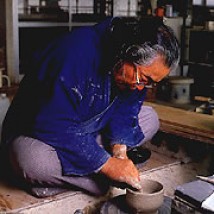
    The clay is rolled into a string and then twisted into a ring shape on a potter's wheel, stacking it upwards. The potter wets his hands and spins the wheel, smoothing the surface as he gradually stretches it upwards to form the shape. In addition to using a potter's wheel, other methods include hand-building, using plaster molds, and slip casting.

    Step 2: Patterning

    Patterns are created on the base material by scraping or pressing. Techniques include "pine bark," "cloth pattern," "line engraving," "stamped design," "scratching," and "tochiri."

    Step 3: Painting

    Depending on the piece, underpainting may be done by hand. The pigments used are oniita (a type of iron oxide pigment) or gosu (a type of cobalt blue pigment).

    Step 4: Glazing

    After thoroughly drying the pottery, it is bisque-fired at around 750 degrees Celsius before being glazed. The glaze is often an ash glaze, made from wood ash, straw ash, feldspar, and wood ash. Metal powders such as iron oxide, copper oxide, cobalt oxide, and manganese are added to give it color. There are also various glazing techniques, such as "pouring," "layering," "dipping," and "wax removal."

    工程5: 本焼き

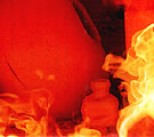
    The pottery is arranged inside the kiln and fired at a high temperature of around 1300 degrees Celsius. In a climbing kiln, firing takes place 24 hours a day, day and night, for more than a week. After firing, the pieces are left to cool naturally for two or three days before being removed from the kiln. The finished pieces become denser and shrink by about 13% compared to when they were shaped. For glazed pieces, the glaze color differs depending on whether they are fired with plenty of air (oxidation) or with little air (reduction). Also, even without decorating the clay body, painting, or glazing, firing in a climbing kiln or anagama kiln brings out the unique natural glaze and fire color of SHIGARAKI Yaki (Pottery). Nowadays, new kilns that use not only firewood but also kerosene, gas, and electricity are increasing.


  • Close-up

    SHIGARAKI Yaki (Pottery) an art form created by the interplay of flames exceeding 1300 degrees Celsius and clay.

    SHIGARAKI Yaki (Pottery) ware is known for its trademark "raccoon dog," but it is an ancient kiln with a history dating back to the Nara period, and its simple beauty, which resonates with the "wabi" aesthetic of the tea ceremony, has been loved across generations. We spoke with Soju Ueda of Sotoen, who is committed to using climbing kilns, about his thoughts on SHIGARAKI Yaki (Pottery).


    They are committed to the techniques of using climbing kilns and handcrafted wood-fired pottery.

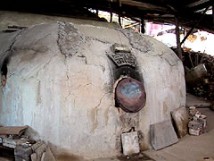
    Shigaraki is a town of pottery whose history began over 1200 years ago when Emperor Shomu had roof tiles fired there while constructing the Shigaraki Palace. Kilns, retailers, and galleries are clustered all over the area. Among them, Sotoen, headed by Mr. Ueda, is the only kiln in Shigaraki that boasts the largest climbing kiln in Japan with 11 chambers and is committed to wood-fired pottery.
    "Around 1951, when I opened my kiln, Shigaraki was in its heyday of mass production of everyday items like hibachi (charcoal braziers). However, I wanted to make tea bowls and vases by hand. When firing in a climbing kiln, you light the firewood in the firebox, and as the temperature of the firebox rises, the temperature of the first chamber where the pottery is placed also rises. Once the temperature of the first chamber rises, you finish firing the firebox and add firewood directly through the firebox opening of the first chamber for inter-firing. When the first chamber is fired up, you move on to the next chamber. We have 11 such chambers. When the main firing begins, for nearly 10 days, 24 hours a day, you add firewood while watching the color of the fire and the color of the pottery, raising the temperature to over 1300 degrees Celsius and adjusting the temperature accordingly. It tests the experience and skill of the craftsman, and there is no room for error. It is true that there are fewer failures when temperature control is done by machine. However, traditional crafts are fundamentally handmade. That is why I want to stick to climbing kilns and firewood without relying on machines."

    The entrance to Japan's largest climbing kiln, which has 11 chambers.

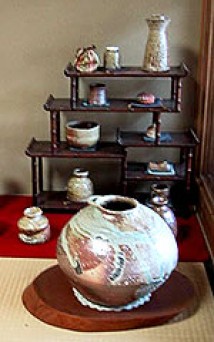
    The exquisite beauty of crimson, natural glaze, and charring.

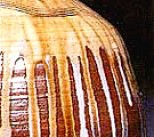
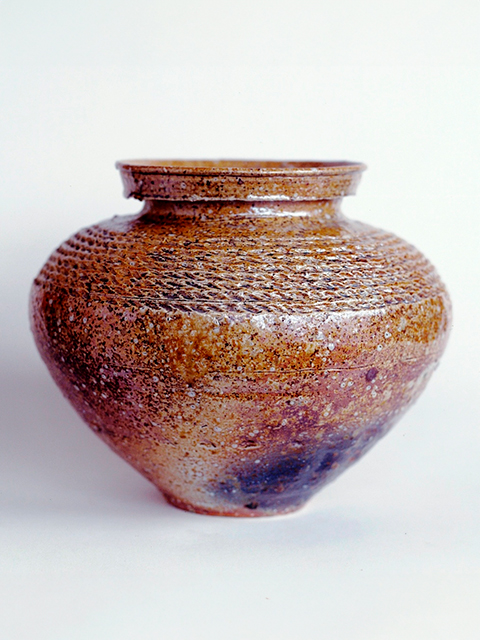
    When viewing SHIGARAKI Yaki (Pottery) ware, there are three key points to appreciate. First, the "fire color (scarlet)" that appears during firing. Second, the "vitreous glaze" created when the ash from the firewood melts with the feldspar in the clay during firing, forming glassy streaks and patterns. Third, the "scorching" where the base of the vessel is buried in ash, turning it a dark brown color. These elements harmonize to create the unique, simple beauty of SHIGARAKI Yaki (Pottery).
    "I've been in the world of pottery for over 60 years. I want to create works that depict scenes like this. That's why I carefully calculate everything, from what kind of clay and spatula to use, to mixing in this much mixed wood firewood instead of just red pine," he says, revealing the confidence and skill with which he handles clay and fire, backed by his many years of experience.

    A deeply flavorful work that showcases Ueda's skill.

    Pottery is all about honing your skills.

    Ueda recounts a shocking encounter he had during a trip to India. On the roadside, a man was using crude tools to spin a potter's wheel and fire pottery. When he asked, Ueda explained that the clay was rice paddy mud. "I realized then that pottery isn't about the quality of the clay, but about refining one's technique. As long as the earth exists, pottery will never disappear. Of course, it's better to have good clay. But even with bad clay, you can create something good. You need that level of skill. I believe it's the duty of those who inherit the traditional techniques created by our predecessors." He doesn't rest on his laurels, but instead sets increasingly demanding challenges for himself. Perhaps that's what gives his work its dynamism.

    Ueda-san at the workshop

    The pottery class is part of the training of future generations of artisans.

    Pottery classes are currently popular not only in Shigaraki but also at kilns throughout Japan, but it was Ms. Ueda who pioneered them nationwide. "When I visited a local kiln, an elderly potter there was telling elementary school students about the history and characteristics of pottery. I thought this was important for training successors. Since then, I have been accepting children on tours of the production area and have started pottery classes. I would be happy if as many people as possible could touch clay and learn the joy of making things, and become interested in the charm of pottery," says Ms. Ueda, whose gaze is directed not only SHIGARAKI Yaki (Pottery) but also at the future of pottery culture.

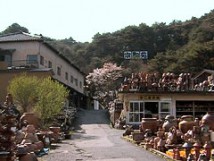
    On the vast grounds of Sōtōen, large ceramic pieces are lined up endlessly. Within the grounds, there is a資料室 (archive room), a pottery class, a workshop, and a tea room.

    Craftsman Profile

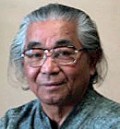
    Soju Ueda

    His pen name was Juhō.
    Born in 1925 (Taisho 14).
    The 6th generation of the Uzaemon family of pottery makers.
    President of Sotoen Co., Ltd., Chairman of SHIGARAKI Yaki (Pottery) Traditional Craftsmen's Association, and Advisor to the Shigaraki Town Cultural Association.

    Anecdotes

    SHIGARAKI Yaki (Pottery) that suits modern lifestyles

    The history of SHIGARAKI Yaki (Pottery) began in the Nara period when Emperor Shomu had roof tiles fired in this area for the construction of the Shigaraki Palace. From the Kamakura to the Muromachi period, agricultural utensils were fired here, and with the rise of tea ceremony culture from the Muromachi period onward, tea ceremony utensils were also produced. From the Edo period to the present day, pottery rooted in people's lives has been produced, including flowerpots, braziers, tableware, and vases. In recent years, its diverse appeal has spread to include popular gardening goods, architectural tiles, and interior design items.
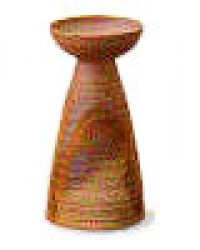
    Candle stands that are gaining attention for their healing properties.

    • A stand that can be enjoyed as interior decor. Its chic and simple design means it will match any room and enhance its style.

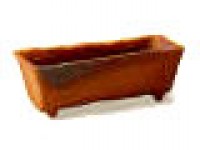
    • These gardening pots are currently very popular. Their texture enhances the beauty of any flower.


overview

Craft item name SHIGARAKI Yaki (Pottery)
Reading Shigaraki ware
Classification of crafts Ceramics
Main Products Vases, tableware, umbrella stands, ornaments, flower pots, garden supplies
Main manufacturing area Koka City
Designated date September 4, 1975

contact address

■ Production area association

Shigaraki Pottery Industry Cooperative Association
529-1811
985 Eda, Shigaraki-cho, Koka City, Shiga Prefecture
TEL: 0748-82-0831
FAX: 0748-82-3473

http://www.shigaraki.ne.jp/

Features

Many large-scale pottery pieces are produced, taking full advantage of the characteristics of the clay. Because they are fired in climbing kilns or anagama kilns, the pottery exhibits unique features such as natural glaze (shizen-yu), where ash from burning firewood adheres to and melts onto the surface of the clay, acting as a glaze; reddish mottled patterns called "fire color" that appear on the surface of the pottery; and "ash glaze" (ash deposits) where ash from burning firewood falls and melts onto the surface. The key point is the rustic, earthy feel of the clay.

How to make it

The clay used is made by finely crushing and mixing raw materials such as kibushi, gairome, and mizuchi, which are sourced from Shigaraki and the surrounding area, and then kneading them well with water. After shaping the clay on a potter's wheel and letting it dry, it is bisque-fired, glazed, and then fired in a kiln at a high temperature of approximately 1200 degrees Celsius to produce the finished product.

Please see here for information on traditional craftspeople.

Japanese traditional craftsman
top