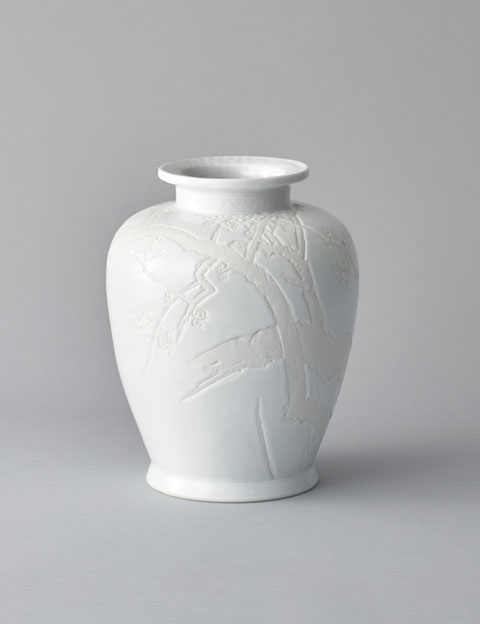
IZUSHI Yaki (Porcelain)

Hyogo Prefecture

It is said that the production of porcelain began in the castle town of Izushi in the mid-Edo period when a large quantity of raw white porcelain stones were discovered locally. With the support of the feudal lord, potters from what is now Arita Town in Saga Prefecture were invited to Izushi to produce porcelain.
Subsequently, the number of kilns increased, and a production area was formed.

  • Technology/techniques/raw materials

    Technology/techniques

    1. The molding shall be done by wheel-throwing, press molding, or bag-casting, in which the entire surface of the base material is shaped and finished with water so that it has properties equivalent to those obtained by these molding methods.

    2. When decorating the base material, the method shall be carving, openwork, or plastering.

    3. When applying underglaze, use line drawing, smearing, or direct application. In this case, the paint used shall be "cobalt blue pigment."

    4. Glazing shall be done by "dip glazing" or "pouring glaze." In this case, the glaze shall be "transparent glaze" or "celadon glaze."

    5. When applying overglaze decoration, it shall be done by drawing lines, smearing, or applying directly. In this case, the paints shall be "Japanese pigments" or "gold and silver pigments."
     

    raw materials

    The ceramic stone used for the clay layer shall be Kakitani ceramic stone or a material of equivalent quality.

  • Work scene

    Let's take a look at the main steps involved in making IZUSHI Yaki (Porcelain).

    Step 1: Making the porcelain clay

    The raw material for IZUSHI Yaki (Porcelain), a type of porcelain, is pottery stone. This pottery stone is ground and kneaded to create porcelain clay (what is commonly known as clay). In the past, this was done by craftsmen, but now it is all outsourced.

    工程2: 成形

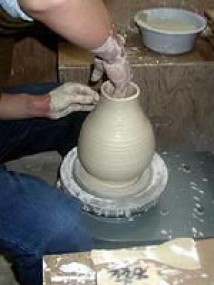
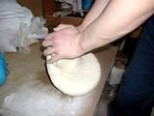
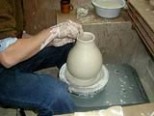
    The shaping process is further divided into three stages. First is "kneading." This can be considered a preliminary stage to shaping, but it is an extremely important step. This removes air from the porcelain clay. The kneading is done carefully for about 1 to 2 hours. Next is "shaping." Using a potter's wheel, the artist puts their thoughts into their hands and concentrates their attention on their fingertips to create the piece. The third stage is the "trimming" process. The bottom and surface are trimmed on the potter's wheel to make them smooth. This completes the shaping process.

    工程3: 乾燥

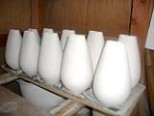
    The molded pieces are left to dry indoors for 20 days to a month.

    Step 4: Carving

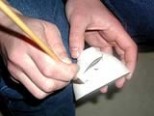
    This process may or may not be part of the overall process, but it involves creating a relief-like pattern on the surface.

    Process 5: Bisque firing

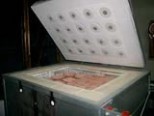
    The pieces are fired in a kiln at 800-900 degrees Celsius for 12-20 hours. After that, they are allowed to cool for two days and removed from the kiln on the third day. The reasons for bisque firing are (1) once fired, the pieces cannot revert back to their original clay state, and (2) the pieces will not be damaged when glazed, and the glaze will be applied more easily.

    Process 6: Painting

    When painting in blue, we use Gosu (a type of red pigment). When painting in red, we use underglaze red or similar pigments.

    Step 7: Applying glaze

    Although glazes are sometimes called "medicines," their materials are natural. Feldspar, pottery stone, and limestone are among the raw materials. There are two types of glazes. The first is a transparent glaze used to give a glossy finish. The second is a crystalline glaze (with added talc) used to create a matte finish. Both serve to protect the finished piece.

    Step 8: Final firing

    Bake at 1250-1300 degrees Celsius for approximately 20 hours.

    工程9: 窯出し

    The pieces are taken out of the kiln on the third day after the final firing. They are finally complete. It takes over a month for them to be finished.


  • Close-up

    New sprouts nurtured by the nature of Tajima = IZUSHI Yaki (Porcelain) artisans

    Izushi, sometimes called the Kyoto of Tajima, is a charming castle town where history still breathes within its picturesque streets. It is in this delicate environment that IZUSHI Yaki (Porcelain) was born. I met a young man who was captivated by the smooth porcelain surface and delicate craftsmanship of Izushi pottery.


    The importance of tradition

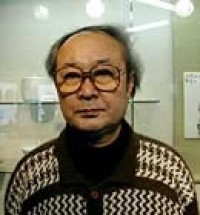
    "It's 95% classical and 5% new technology. Or maybe 99 to 1," says Mr. Kunimura of the association. IZUSHI Yaki (Porcelain) is a type of pottery where there is very little room for chance. "Ambiguousness is not allowed. It won't succeed unless it's calculated. Thorough management is necessary," he continues. Over its long history, IZUSHI Yaki (Porcelain) has been refined under the foundation of tradition, in harmony with the beautiful nature of Tajima. It's understandable that it takes more than 10 years of training to move beyond amateur level, and more than 20 years to become a professional. As a result, beautiful white porcelain, IZUSHI Yaki (Porcelain) is produced, which further enhances the whiteness of the base material.

    Nitten Exhibition Selected Work “Iron Glazed Flat Jar”

    Unrelenting spirit of inquiry

    During his apprenticeship, Mr. Kunimura desperately wanted to own his own kiln, so he worked as a salaried employee for two years to raise the funds, and nine years ago he was able to open his own kiln and become independent. "I want to create works that are elegant and refined," says Mr. Kunimura, his eyes shining with passionate determination. Drawing inspiration from the beautiful nature of Tajima, he wants to "create works that people find beautiful." If he were to put it into words, he would describe it as "refreshing," "gorgeous," "pale blue," "tension," and "a sense of relief." To express this, he says, "The artist's own awareness is crucial, and I want to thoroughly pursue aesthetic sense along with technique," and "Continuing to question myself and honing my skills is necessary to create works that people find beautiful."

    A scene from the pottery wheel shaping process.

    New challenges

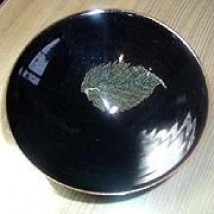
    Looking ahead, while preserving tradition and further refining their techniques, they also want to challenge themselves by introducing other technologies. For example, they want to increase the variety of their work by creating "leaf tenmoku" which incorporates leaf patterns, and "oil spot tenmoku" which features patterns resembling oil droplets. We look forward to their continued efforts to create "IZUSHI Yaki (Porcelain) that feels even more beautiful."

    • Konoha Tenmoku

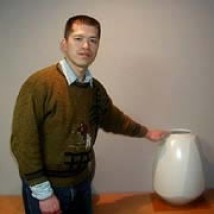
    • Hiroshi Kunimura and his works

    Craftsman Profile

    Hiroshi Kunimura

    Born in 1964.
    He began his apprenticeship while still a student at Osaka University of Arts. He spent two years working as a salaried employee to save money for purchasing a kiln. He became independent at the age of 27. He is currently a lecturer at Izushi High School and an officer of the Izushi Pottery Mine Cooperative. He has been selected twice for the Japan Traditional Crafts Exhibition and twice for the Japan Ceramics Exhibition.

    Anecdotes

    White porcelain and IZUSHI Yaki (Porcelain) passed down through generations.

    Works by Koji Yamamoto, who continues his avant-garde creative activities.

    • Works by Naganobu Nagasawa

    • Works by Naganobu Nagasawa

    • Works by Naganobu Nagasawa


overview

Craft item name IZUSHI Yaki (Porcelain)
Reading Izushiyaki
Classification of crafts Ceramics
Main Products Flower vases, tea ceremony utensils
Main manufacturing area Toyooka City
Designated date March 3, 1980

contact address

■ Production area association

IZUSHI Yaki (Porcelain) Friends Association
668-0214
104-7 Uchimachi, Izushi-cho, Toyooka City, Hyogo Prefecture
Within the Tajima Province Izushi Tourism Association (NPO)
TEL: 0796-52-4806
FAX: 0796-52-4815

https://www.izushi.co.jp/izushiyaki/

Features

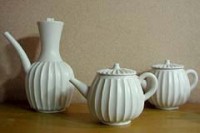
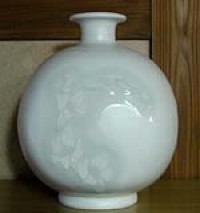
Izushi ware is the only porcelain producing region that boasts "pure white" white porcelain. Furthermore, the carving techniques that enhance its beauty are highly sophisticated. IZUSHI Yaki (Porcelain), reminiscent of silken skin, possesses a refined elegance and is full of grace and refinement.

How to make it

Using local white pottery stone as the main raw material, the pieces are decorated with carving, openwork, pasting techniques, and painting before being fired.

Please see here for information on traditional craftspeople.

Japanese traditional craftsman
top