BIZEN Yaki (Pottery)

Okayama Prefecture

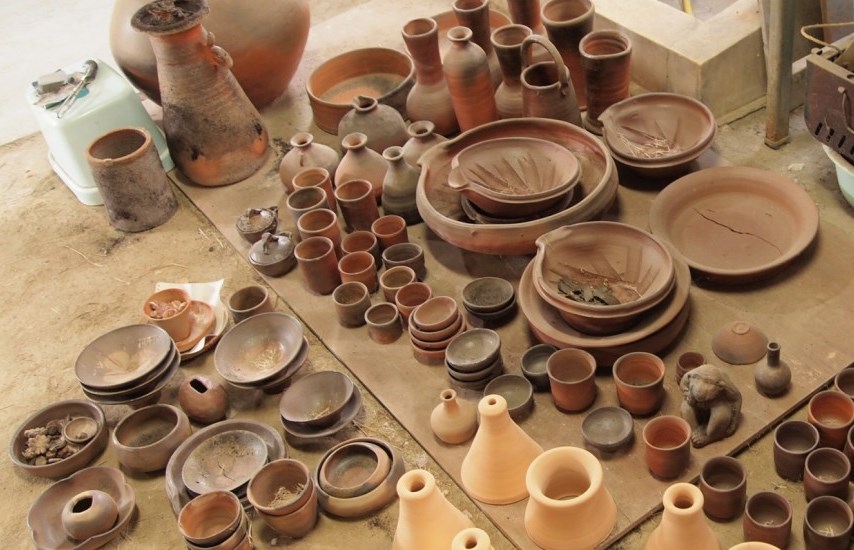
BIZEN Yaki (Pottery) has a long history, dating back to the Heian period. It is counted as one of Japan's six ancient kilns and is nationally famous as pottery (strictly speaking, "stoneware") with a thousand-year history.
From around the end of the Muromachi period, its simplicity became beloved by tea masters, and many tea ceremony utensils were produced using this material.
During the Edo period, with the protection of the feudal domains, Bizen ware spread throughout the country. In the early Showa era, figures such as Kaneshige Toyo, Fujiwara Kei, and Yamamoto Tohide, who were called the "restorers of BIZEN Yaki (Pottery)," were designated as Living National Treasures, and the craft continued its steady progress.

  • Technology/techniques/raw materials

    Technology/techniques

    1. The molding shall be done by wheel throwing, slab throwing, mold pressing, or hand twisting.

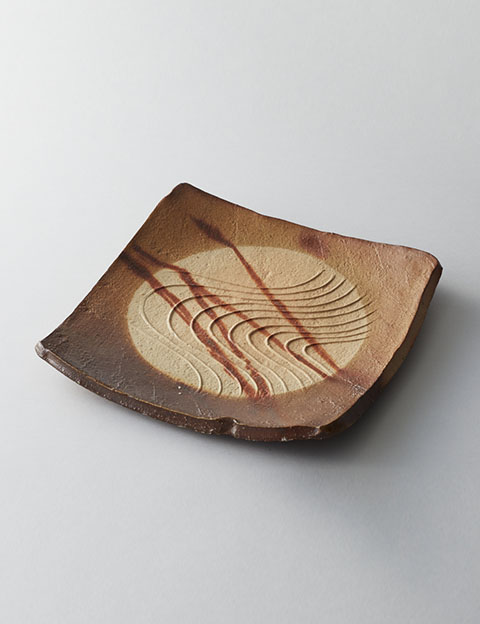
    2. When applying patterns to the base material, the method shall be spatula marks, comb marks, openwork carving, pasting, or "carving".

    3. When applying plaster, use "Tomochi" (a type of clay).

    4. Create the appearance of fire patterns such as "sesame," "sankiri," "botamochi," "fuseyaki," or "aobizen" through firing.
     

    raw materials

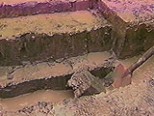
    The clay used shall be "Hiyose clay," "Osafune black clay," or "mountain clay," or a material of equivalent quality.

  • Work scene

    Step 1: Collection of Hiyose (clayey soil)

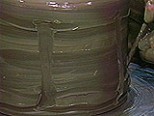
    The clayey soil, known as Hiyose, is collected from the bottom of rice paddies, digging down 2 to 3 meters. Bizen soil is characterized by its high viscosity and well-balanced iron content.

    Step 2: Chrysanthemum paste

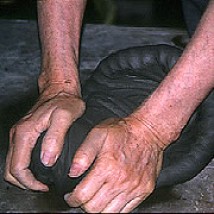
    This process involves kneading the refined clay to make it uniform and remove air bubbles before shaping begins. It's called "chrysanthemum kneading" because the kneading resembles a chrysanthemum flower. It's a physically demanding task, especially for those unfamiliar with it. (It's considered a crucial and time-consuming process, often said to require three years of practice.)

    工程3: 成形

    (1) Hand twist
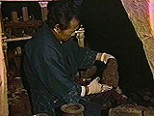
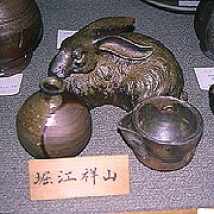
    The clay is piled up on a molding table and kneaded to the desired shape. For items with unique shapes, such as teapots, the rough shaping is followed by detailed shaping. Finally, a pre-formed lid is attached. Ceramic sculpture is a molding technique that creates figurines as a variation of hand-molding. It refers to the creation of concrete objects such as birds, rabbits, animals, and people. Recently, some artists have emerged who use Bizen techniques to create abstract sculptures and avant-garde works.

    (2) Potter's wheel
    There are three types of pottery wheels: hand-operated, kick-wheeled, and electric.
    Hand-throwing pottery: A method of shaping pottery by rotating clay on a rotating potter's wheel. Hand-throwing pottery was once the mainstream method.
    Kick wheel: A pottery wheel that is rotated by kicking it with your foot.
    Electric pottery wheel: Nowadays, most of my work is done using an electric pottery wheel. It allows for subtle adjustments, so I can create unique pieces with individual characteristics.
    There is also a separate potter's wheel for finishing (shaping).

    画像をクリックすると動画が再生されます

    Step 4: Using a spatula

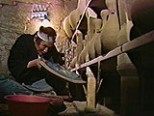
    After shaping on the potter's wheel, various patterns are carved into the pottery. In Bizen ware, painting and glaze are not applied. Even for ornaments and intricate crafts made from molds, the final finishing touches are almost always done on the shaping wheel using a spatula.

    Step 5: Kiln loading

    In BIZEN Yaki (Pottery), where everything is entrusted to the flames, the artist puts the utmost effort into loading the kiln while imagining the finished product. Before firing, they arrange pieces of various shapes in a balanced way, some wrapped in straw and some not, rather than placing many pieces of the same shape together. The structure of the climbing kiln includes the udo, first kiln, second kiln, kedo, and smoke play areas, and the finished product differs depending on the chamber. This is a major characteristic of BIZEN Yaki (Pottery).

    Step 6: The Fire-Lighting Ceremony

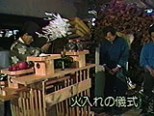
    The quality of the finished piece depends on the firing process, so the firing is done carefully on an auspicious day, after praying to the gods. After reciting prayers and purifying the area, it is a tense moment performed with passion.

    工程7: 焼成

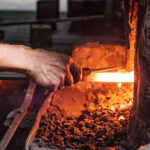
    Thoroughly dried red pine firewood is added, and the fire is kept burning. The number of days the fire is fired varies depending on the size of the kiln, but for 10 to 15 days the artist remains in front of the kiln, battling the flames while watching their color. The flames change from red to orange to white, and a fierce struggle takes place inside the kiln.
    Sometimes charcoal is added during the firing process to create a "kiln transformation" effect. The patterns created by the flames are unique to each piece, depending on where it is placed, how the flames hit it, and how the ash settles on it.

    画像をクリックすると動画が再生されます

    工程8: 窯出し

    Unloading the kiln is the most tense moment, after battling the flames and taking out the newly created pottery. For the artist, it's a complex time filled with a mix of joy and sorrow. This is where they select the pieces they will release.

    工程9: 仕上げ

    The pieces are polished with sandpaper or stones, washed with water, and then tested for water leakage before being completed as works of art.

  • Close-up

    Bizen, where earth and fire clash even today, surpassing a thousand years of tradition.

    BIZEN Yaki (Pottery), which has its roots in Sue ware, has been produced since the Kofun period. Among Japan's representative traditional kilns are Bizen, Seto, Tokoname, Tanba, Shigaraki, and Echizen, collectively known as the Six Ancient Kilns, but Bizen is the oldest kiln in Japan.
    Without applying glaze, high-quality clay is slowly fired using traditional pine firewood as fuel. The encounter and fusion of earth and fire creates a simple, rustic texture. It is unassuming and unadorned, yet possesses a strong presence that speaks to you reassuringly. This is why it is said to be the origin of Japanese beauty.


    The beauty of nature in its natural state is a defining characteristic of Bizen ware.

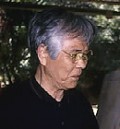
    Even those with little knowledge of traditional crafts have probably heard of it at least once. With a history spanning over 1,000 years, what is the secret to its enduring appeal? We asked Shozan Horie, BIZEN Yaki (Pottery) artist, former director of the Okayama Prefecture BIZEN Yaki (Pottery) Pottery Association, and chairman of BIZEN Yaki (Pottery) Traditional Craftsmen's Association, about this. He is a veteran with over 50 years of experience and numerous awards. "BIZEN Yaki (Pottery) can only be made when the clay, the making process, and the firing method are all in perfect harmony. The clay, which is the lifeblood of BIZEN Yaki (Pottery), is taken from the bottom of rice paddies and is called 'tatsuchi' (paddy field clay), but it can only be found here. It contains a lot of iron, has fine particles, and is sticky." It is usually dug up during the winter, exposed to the elements for 1-2 years, and then mixed with mountain clay and black clay before use. By firing it slowly for a long time using red pine without applying glaze, the natural beauty of the clay, unique to Bizen, is created.

    It's called "kiku-neri" (chrysanthemum kneading) because it resembles the shape of a chrysanthemum flower. It's done carefully and thoroughly because it affects the quality of the finished product.

    The local climate, history, and geographical factors made BIZEN Yaki (Pottery) widely known to the world.

    "BIZEN Yaki (Pottery) developed from the manufacturing methods of Sue ware during the Kofun period, and it is said that in the Heian period, many potters moved from Oku to Imbe, where the current prototype was established. The reasons why potters moved to Imbe include the fact that it had all the necessary conditions for creating excellent works, such as high-quality clay, red pine trees, and a warm climate, as well as its location along the Sanyo Road and proximity to sea routes. From the early to late Kamakura period, it further developed its characteristics, and it suddenly became popular with the rise of the tea ceremony from the Muromachi period onward. In particular, during the Momoyama period, Toyotomi Hideyoshi favored the tasteful style of "wabi" and "sabi" and recommended BIZEN Yaki (Pottery), so many masterpieces of tea ceremony pottery were produced, and it reached its peak of prosperity. The fact that it had both land and sea transportation also seems to have been a factor in its widespread distribution. Later, during the Edo period, Lord Ikeda Mitsumasa protected and encouraged BIZEN Yaki (Pottery), selecting master craftsmen from the kilns and providing them with stipends as artisans. It was around this time that practical items such as sake bottles, water jars, mortars, and seed jars were produced in large quantities, and BIZEN Yaki (Pottery) became integrated into people's lives.

    The finished works. Each one is a testament to the brilliance of tradition.

    No two BIZEN Yaki (Pottery) are exactly alike; a traditional technique that we want to continue refining.

    "BIZEN Yaki (Pottery) gets its character from how the flame hits it and how the ash settles on it. That's why even a slight difference in how the pieces are placed in the kiln can affect the firing process. To ensure the flame passes through evenly and create a unique look, you have to place a variety of shapes of pieces in the kiln in small amounts, in a balanced way. This means that not all finished pieces are fired; you have to select which ones to keep. Moreover, because BIZEN Yaki (Pottery) cannot be produced by slip casting due to the type of clay used, each piece is handmade (including wheel throwing). That's why mass production is impossible."
    For those who use traditional climbing kilns like Mr. Horie, firing is apparently only done once or twice a year. Therefore, they dedicate six months to creating their pieces, pouring their heart and soul into each one. It's a tough world; one failure means six months of effort is wasted. In that sense, it's only natural to want to fire every piece you've created...

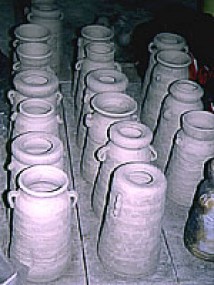
    • What kind of colors will the pieces, awaiting firing, take on?

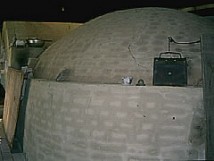
    • A traditional climbing kiln. Its sheer size is overwhelming.

    "I've only ever made one or two pieces that I'm truly satisfied with. Sometimes I think something is good at the time, but the next day I realize it's no good. The more I make, the less satisfied I become. This depth is what makes pottery so fascinating. It's a lifelong learning process." On this day, he actually kneaded the clay and turned the potter's wheel for me, and I was surprised to see his expression change the moment he touched the clay. I was also impressed by the brilliance of his technique. As I was leaving, he gave me a wonderful piece of pottery. There was a slight roughness on the rim, so he diligently polished it with a file, saying, "If I give this to you and you cut your lip, it would be a disgrace to Bizen ware." His tone was gentle, but his words conveyed the seriousness only a skilled craftsman possesses and the weight of responsibility that an artisan who upholds tradition feels. This is how the inherited tradition continues to capture the hearts of those who love BIZEN Yaki (Pottery).

    Craftsman Profile

    Shozan Horie (real name Hiroyuki)

    Born in 1923 in Katsuta-cho, Okayama Prefecture.
    He joined a pottery studio in 1937 and built his own kiln in 1964, becoming independent. He is highly skilled in intricate craftsmanship.
    Currently, he mainly creates vases and tea ceremony ceramics, and occasionally ornaments. He is the first chairman of the Bizen Ceramic Heart Association and a director of the Okayama Prefecture BIZEN Yaki (Pottery) Ceramic Friends Association. His awards include the Okayama Prefectural Governor's Award for Outstanding Skilled Craftsman, the Minister of Labor and International Trade and Industry Awards, and selections for traditional exhibitions, branch exhibitions, the Japan Ceramic Art Exhibition, and the Prefectural Exhibition.

    Anecdotes

    Main kiln transformations

    BIZEN Yaki (Pottery) is known for its kiln transformations (yohen). Kiln transformation refers to the accidental changes that occur in the clay and natural glaze of the pottery due to the conditions inside the kiln. These accidental natural processes create a variety of patterns.

    Here are some of the main kiln-fired variations.
    Sesame
    This refers to a type of glaze where wood ash falls onto the pottery during firing, melts at high temperatures, and forms a natural glaze. It's called "tamadare" because it looks like sesame seeds have been sprinkled on it. (Sangiri)
    When a piece of pottery is placed in a kiln, it can become partially buried in charcoal or other materials, preventing direct exposure to the flames. As a result, those parts undergo reduction firing, resulting in a grayish-blue or dark gray color. (This is known as "hidasuki" or "fire sash").
    This phenomenon occurs when alkaline components in the straw used to prevent the pottery from sticking together during firing react with the iron content in the clay, resulting in reddish-brown streaks on the surface of the pottery. It can also be written as "hitasuki" (緋襷). (Botamochi)
    When a smaller object is placed on top of a larger one during firing, the area where the object is placed is not directly exposed to the fire and ash, resulting in a reddish pattern that takes on the shape of the larger object. This is also known as "manju-nuke" (a type of porcelain). (Aobizen)
    Normally, Bizen ware is fired in an oxidizing atmosphere, resulting in a reddish color. However, depending on its position in the kiln, it may be fired in a reducing atmosphere, altering the iron content in the clay and resulting in a bluish finish. Sometimes, a blue Bizen firing is artificially achieved.


overview

Craft item name BIZEN Yaki (Pottery)
Reading Bizen-yaki
Classification of crafts Ceramics
Main Products Tableware, sake sets, tea sets, flower vases, ornaments
Main manufacturing area Bizen City, Okayama City, Setouchi City
Designated date November 1, 1982

contact address

■ Production area association

Okayama Prefecture BIZEN Yaki (Pottery) Pottery Association Cooperative
705-0001
974-2 Ibe, Bizen City, Okayama Prefecture
TEL: 0869-64-1001
FAX: 0869-64-1002

https://touyuukai.jp/

■ Visits to production areas from overseas
image
BIZEN Yaki (Pottery)- A visit to the production area

Features

Bizen ware is characterized by its simple yet substantial style, the warmth of its clay, and its ease of use, but its greatest feature is arguably the kiln transformation (yohen). Because of kiln transformation, a natural product where the color and surface of the pottery change depending on the conditions inside the kiln during firing, no two BIZEN Yaki (Pottery) pieces are exactly alike, making it a natural art form.

How to make it

BIZEN Yaki (Pottery) is fired without glaze or painting. The kiln is a climbing kiln, fueled by red pine, and fired at a high temperature of approximately 1230 degrees Celsius. The duration varies depending on the size of the kiln, but firewood is continuously burned for about two weeks. During this time, the surface of the piece changes due to the high heat and the effects of flames and ash inside the kiln, which is called kiln transformation.

Please see here for information on traditional craftspeople.

Japanese traditional craftsman
top