OTANI Yaki (Pottery)

Tokushima Prefecture

In 1780, the lord of the Tokushima domain ordered the production of Nanjing and Karatsu porcelain. Many craftsmen were hired from Kyushu, a domain kiln was established, and porcelain production began.
Due to the lack of local materials, the kiln suffered significant losses and closed down after a short period. Later, in 1784, Heijihei Noda hired SHIGARAKI Yaki (Pottery) artisans to learn pottery techniques, built a climbing kiln in Otani Village (present-day Oasa-cho, Naruto City), and began producing pottery (folk kilns), which is considered the origin of OTANI Yaki (Pottery).
During the Meiji era, indigo vats were produced, and during the Taisho era, the industry underwent various changes, including the wartime economic boom. Today, a wide range of products are produced, from large vats to everyday utensils.

  • Technology/techniques/raw materials

    Technology/techniques

    1. In the wet process, the clay body is manufactured by elutriation. In the dry process, it is manufactured without elutriation.

    2. The shaping shall be done by pottery wheel shaping.

    3. Glazing shall be done by dipping or pouring. In this case, the glaze used shall be a mixture of Himeda clay, lime, wood ash, feldspar, silica, and iron.


    raw materials

    The clay used must be "Hagiwara clay," "Sanuki clay," "Himeda clay," or clay of equivalent quality.

  • Work scene

    OTANI Yaki (Pottery) is made using clay sourced locally in Tokushima Prefecture.
    OTANI Yaki (Pottery) is produced using two methods: a wet method that involves elutriation and a dry method that does not involve elutriation.
    Here, we will introduce a process known as the wet process.

    Step 1: Grinding


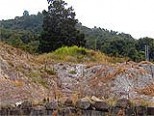
    The raw soil is excavated, dried, and then finely crushed.

    Step 2: Sieving

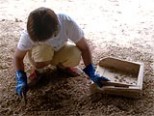
    The crushed soil is sifted to refine it.

    Process 3: Elutriation

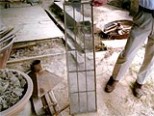
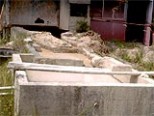
    The refined clay is placed in a water tank, stirred, and then poured into another tank. After sieving, it is collected and allowed to settle. The clay is then placed in a serving bowl and left to stand until it reaches a clay-like consistency.

    Step 4: Clay preparation


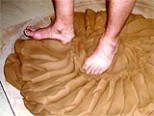
    The clay-like soil is trampled on with the feet to create a uniform consistency. (Rough kneading)
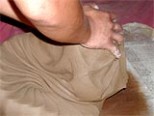
    Next, knead the clay by hand to remove air bubbles and make it easier to shape. (Kiku-neri)

    工程5: 成形


    画像をクリックすると動画が再生されます

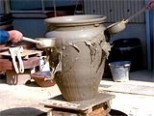
    After preparing the clay, place it on a potter's wheel and shape it by hand.
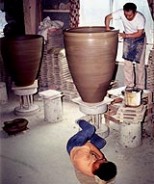
    When creating particularly large pieces, which are a characteristic feature of OTANI Yaki (Pottery), two people work together to shape them using a technique called "sleeping potter's wheel."

    工程6: 乾燥

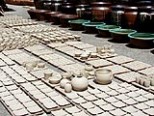
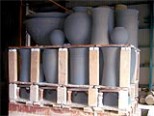
    Dry it indoors in the shade until it is moderately dry, then dry it in the sun.
    For larger items such as jars and pots, dry them indoors for about 20 days and outdoors for 2-3 days.
    For small items such as sake cups, dry them indoors for about 2 to 7 days and outdoors for 1 day.

    Process 7: Glazing

    Glaze is applied to the dried products. The method of applying glaze without bisque firing is called raw glazing. Glazing methods include "dipping," where the ware is dipped in the glaze, and "pouring," where the glaze is poured onto the ware using a ladle or similar tool. *For products that are not raw-glazed, the glaze is applied after bisque firing.
    "Bisque firing" involves firing the pottery in a kiln at around 800°C for 8 to 16 hours.

    Process 8: Kiln filling

    The glazed products are loaded into the kiln.

    工程9: 焼成

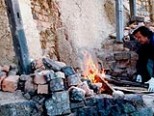
    It is baked at a high temperature of 1,230℃.
    Firing takes 5-6 days and nights in a climbing kiln, and 1-2 days in an electric or gas kiln.

    工程10: 検品

    We inspect the finished products and remove any defective items.

    工程11: 完成


overview

Craft item name OTANI Yaki (Pottery)
Reading Ootani Yaki
Classification of crafts Ceramics
Main Products Sake vessels, jars, bowls
Main manufacturing area Naruto City
Designated date September 10, 2003

contact address

■ Production area association

OTANI Yaki (Pottery) Association
779-0302
3 Nishidai, Otani, Oasa-cho, Naruto City, Tokushima Prefecture
Inside the Oasa Town Chamber of Commerce
TEL: 088-689-0204
FAX: 088-689-0213

https://r.goope.jp/ootaniyaki

Features

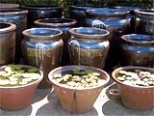
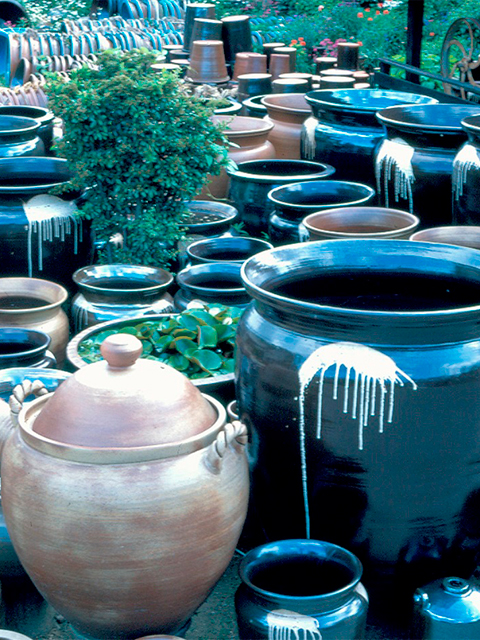
OTANI Yaki (Pottery) is one of Shikoku's representative pottery types, produced in Oasa-cho, Naruto City, Tokushima Prefecture, for approximately 200 years. It is particularly famous for its use of a "sleeping potter's wheel" (where two people work together, one shaping the clay while the other lies down and kicks the wheel with their feet) to create large pottery pieces such as jars and lotus bowls that are as tall as a person. The climbing kiln used to fire these pieces is said to be the largest in Japan. In addition, sake vessels are characterized by their extreme thinness yet durability, thanks to the exquisite potter's wheel technique.

How to make it

OTANI Yaki (Pottery) is made primarily from Hagiwara clay, Sanuki clay, and Himeda clay, which are sedimentary clays rich in iron. The glaze is made by mixing Himeda clay, lime, wood ash, feldspar, silica, and iron, and is applied by dipping and pouring. The main processes of OTANI Yaki (Pottery) are crushing, sieving, elutriation, kneading, mixing, shaping, drying, raw glazing, bisque firing, glazing, kiln loading, firing, and inspection. Each of these processes is done by hand, and traditional tools such as potter's wheels, trowels, turtle boards, cloth, planes, tanned leather, cutting thread, brushes, and ladles are used.

Please see here for information on traditional craftspeople.

Japanese traditional craftsman
top