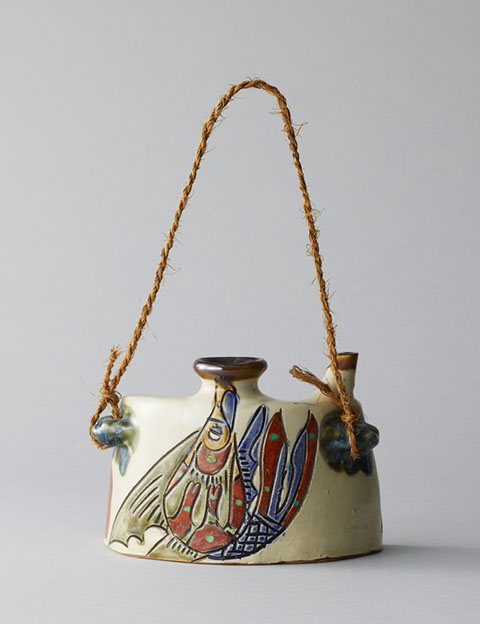
TSUBOYA Yaki (Pottery)

Okinawa Prefecture

In the late 17th century, the Ryukyu Kingdom government consolidated the Chibana kiln in Misato, the Takaraguchi kiln in Shuri, and the Wakuta kiln in Naha into what is now Tsuboya-cho.

  • Technology/techniques/raw materials

    Technology/techniques

    1. For rough firing, the following techniques or methods shall be used:
    (1) The soil must be manufactured without elutriation.
    (2) Forming shall be done by wheel throwing, hand twisting, or press molding.
    (3) When applying patterns to the base material, they shall be done by adhesive.
    (4) A Nanban kiln shall be used for firing.

    2. For the final firing, the following techniques or methods shall be used:
    (1) The soil is manufactured by elutriation.
    (2) Forming shall be done by wheel throwing, press forming, mold forming, or hand twisting.
    (3) When decorating the base material, the method shall be slip coating, scraping, line engraving, inlay, stamping, "flying plane," or raised application. In this case, slip coating shall be done by dipping, pouring, sprinkling, brushing, or cloth application.
    (4) Glazing shall be done by dipping, sprinkling, pouring, or clothing. In this case, the glaze shall be "Shirugusui", "Mishiru", "Kuwadesa", or "Gushikami Iru".
    (5) If decoration is to be done, it must be done by hand.
     

    raw materials

    1. For rough firing, the clay used shall be "Shimajiri clay" or a material of equivalent quality, and for fine firing, it shall be "Kise clay," "Kogachi clay," "Ishikawa clay," "Maeganehisa clay," "Yamada clay," or "Kina clay" or a material of equivalent quality.

    2. The slip used shall be either "Kise clay" or "Yasufuso clay".

  • Work scene

    There are two types of TSUBOYA Yaki (Pottery): Joyachi and Arayachi. Joyachi is fired with a glaze, while Arayachi is fired without a glaze. Joyachi is used to make tableware, sake vessels, and vases, while Arayachi is mainly used to make jars and pots. Many of the pieces have unique Okinawan shapes, such as the karakara sake vessel, dachibin, zushikame, and shisa (lion statues), and a variety of techniques are used to suit each piece. The glazes are all made from readily available materials, reflecting the local climate and culture of Okinawa.

    Step 1: Excavation of clay

    White clay and red clay, mined from various locations, are blended at a clay processing plant in Onna Village. After mixing in a mill, filtering, and stirring, the mixture is pressed using a filter press and then kneaded in a clay mixer. After being left to rest for a while, it is transported to the workshop.

    工程2: 成形

    We use different techniques depending on what we are making.

    potter's wheel
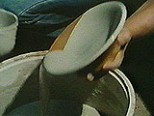
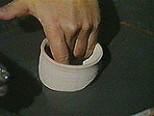
    Left-hand rotation is the basic technique. Traditional kick wheels are also used.
    mold
    It is used for bottles and small Shisa (Okinawan guardian lion-dogs). In the case of bottles, a slab of clay is attached to a plaster mold, and the two molds are joined together to form the shape of a bottle. After that, the mouth and handles are added to finish it.
    Wooden mold
    It is used when making a burial urn to hold the bones of the deceased.
    Hand-building
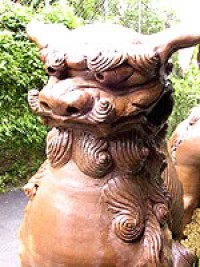
    Shisa, which are placed on roofs and other places as a charm against evil spirits, are handmade.

    For rough-fired pottery, the pieces are shaped, decorated, dried, and then fired.
    The top-baked product is made through the following process:

    画像をクリックすると動画が再生されます

    Step 3: Applying makeup

    Once the shape is formed, a mixture of white clay and water (naboo) is poured over it. This is called slip coating (jigaki), and it creates the warm white color unique to TSUBOYA Yaki (Pottery). It serves to hide the red clay base.

    工程4: 加飾

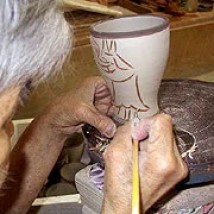
    The decoration is applied while the clay is semi-dry. Various techniques are used, including line carving with carving tools or styluses, skewer carving, finger carving, stamped patterns, flying plane carving, scraping, pouring, and takkuwasa, which involves building up clay like a sculpture. Red painting, where the design is applied after the final firing, is considered a superior type of TSUBOYA Yaki (Pottery). The contrast between the white background and the red painting creates a vibrant, tropical feel.

    画像をクリックすると動画が再生されます

    Step 5: Glaze

    There are many different types of glazes. In addition to shirogusui (transparent glaze), which is made by mixing coral limestone with rice husks and firing it, then adding white clay, other glazes used include akagua (amber glaze), ugusuya (green glaze), kurogusui (black glaze), and gosu (cobalt blue glaze).

    工程6: 焼成

    After drying, the pottery is fired in a kiln. While it's common on the mainland to fire the pottery once, decorate it, and then fire it again, TSUBOYA Yaki (Pottery) only once. There are two types of kilns:

    Climbing kiln
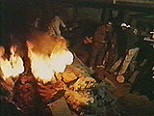
    This is a wood-fired kiln. When lighting the fire, the potters offer a prayer, "Umarashimisoure" (May good things be produced). They continue burning the wood for over ten hours, watching the fire closely. Sometimes it can take up to 30 hours. Because it produces a lot of smoke, it has become difficult to use in Tsuboya, which is located in the city, and some workshops have moved their kilns to Yomitan Village.

    Gas oven
    This is the mainstream method now. It's easy to control the temperature and ensures consistent quality.

    Let it cool, then remove it from the oven and it's done.


  • Close-up

    The heartwarming, powerful warmth of people and pottery.

    For over 300 years, since the time of the Ryukyu Kingdom, TSUBOYA Yaki (Pottery) has been passed down from potter to potter in the Tsuboya district of Naha. Its simple warmth has captivated many visitors to Okinawa. We spoke with Isao Arakaki, the 7th generation owner of the pottery kiln.


    The gentle white creates a peaceful atmosphere.

    The people of Ryukyu have engaged in thriving trade across the sea with Asian countries such as China, Thailand, and Vietnam. Combined with the climate of the southern islands, a free-spirited and rich culture flourished in the Ryukyu Kingdom, distinct from that of Yamato (Japan). One example of this is Tsuboya ware, TSUBOYA Yaki (Pottery) known locally as "yachimun." When stir-fried dishes or sashimi are served on TSUBOYA Yaki (Pottery) plates, the dining table is enveloped in a warm and inviting atmosphere. The secret lies in its gentle, off-white color. This is a unique color of Tsuboya ware, achieved by applying a white clay mixture called TSUBOYA Yaki (Pottery)." Known works include those by Living National Treasure Jiro Kinjo, as well as plates and vases with boldly carved fish designs.

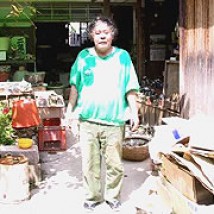
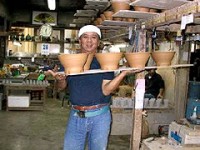
    • Isao Arakaki standing in the workshop courtyard.

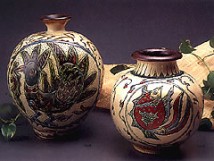
    • Works by Mr. Arakaki: Bird-patterned flat vase, red-painted vase.

    TSUBOYA Yaki (Pottery) can be broadly divided into two types. Those with a slip glaze and incised or red painted designs are called "joyachi," while those without a glaze, which are simple and powerful, are called "arayachi." Both are based on red clay. The motifs, such as fish, shrimp, and flowers, also have a tropical feel. Isao Arakaki has created many dynamic works depicting fish and birds. When we visited his workshop, his grandmother, wife, and the whole family were busy painting and incising. Arakaki's grandfather was Eitoku, who was friends with Soetsu Yanagi and Shoji Hamada of the folk art movement, and his father was Eizaburo, a renowned potter. He started making pottery when he was in high school. For the first year, he worked diligently on toothpick holders. Then he gradually learned to make larger items, such as teacups, vases, and jars.

    Good things remain, and bad things disappear.

    "Have I ever had a hard time? No. It's normal. It's just the way things are." Okinawans have a relaxed attitude that allows them to pass through hardships without even thinking of them as hardships. The bold patterns and heartwarming shapes may be born from that kind of open-mindedness.
    Ms. Aragaki says that by her second year, she was already able to create things almost exactly as she envisioned. Of all the different processes, her favorite is using the potter's wheel.
    "I wonder why. I guess I'm good at it."
    I'm currently exploring new vase designs.
    "If the shape is different, the way the person arranging the flowers thinks will also change. If you have an idea, try making it right away. If it doesn't work, stop and think of something else. The good things will endure, and the bad things will disappear."
    What should we keep in mind when making our choice?
    "You can't really tell what pottery is like until you use it. I want people to actually use it before buying their next piece."
    For example, with rice bowls that have engraved designs on the inside, chopsticks can sometimes get caught in the grooves when you're eating. These kinds of things are hard to notice just by looking at them in a store.
    Karakarara (small wooden carafe for pouring sake) and dachibin (portable sake bottles with crescent-shaped bases) are popular Okinawan souvenirs. They are perfect for sharing awamori (Okinawan liquor) and also make impressive decorative pieces. Shisa (lion statues) are also very popular with people of all ages. Arakaki said, "I will continue to make traditional items. At the same time, I want to create my own unique works, pieces that will last."

    • Line engraving is a dynamic technique characteristic of TSUBOYA Yaki (Pottery)

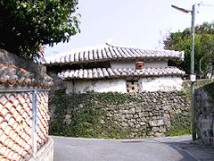
    • As you enter the alley of Tsuboya, you can hear the sound of pottery wheels.

    Craftsman Profile

    Isao Arakaki

    The 7th generation owner of the pottery studio, Arakaki Pottery. He started working in the industry while still in high school, making it 40 years in total. Former chairman of the Tsuboya Pottery Business Cooperative Association.

    Anecdotes

    Shisa that protect you from disaster

    The clay used is primarily red clay. Smaller pieces are hand-built, while larger ones utilize a potter's wheel. The hands and feet are made on the wheel. Some pieces are unglazed, while others are glazed. Tadashi's father, Ikuo Takaesu, was a renowned "modern master craftsman" famous for his hand-built Shisa statues. Tadashi is known for his mastery of the potter's wheel and for his dynamic fish paintings, but since Ikuo's death, he has been actively working on Shisa statues. "My dad's Shisa are handsome. Watching him make them, it looked easy, but it's actually quite difficult."
    They say it's fun to create because the pieces have movement, like sculptures.

    • Shisa from Ikutouen

    • Various Shisa statues found on the streets of Okinawa


overview

Craft item name TSUBOYA Yaki (Pottery)
Reading Tsuboya Yaki
Classification of crafts Ceramics
Main Products Sake vessel (karakara), sake bottle (dachibin), lion (shisa), pot
Main manufacturing area Naha City, Onna Village (Kunigami District), Yomitan Village (Nakagami District)
Designated date June 2, 1976

contact address

■ Production area association

Tsuboya Pottery Business Cooperative
〒902-0065
1-21-14 Tsuboya, Naha City, Okinawa Prefecture
TEL: 098-866-3284
FAX: 098-864-1472

https://tuboya.com/

Features

Okinawan pottery (yachimun) is broadly divided into two types: Joyachi and Arayachi. Joyachi is made using glazes and produces tableware with unique Okinawan colors and designs. Arayachi, also known as Nanban-yaki, is made without glaze and is relatively large, with sake jars and water jars being commonly produced.

How to make it

The pieces are shaped using techniques such as the potter's wheel, pressing molds, and mold making. A white clay mixture is applied to the base using techniques such as dipping, pouring, and sprinkling, and then decorated with scratching and inlay. The top-fired pieces are fired at a high temperature of approximately 1,200 degrees Celsius after glazing, resulting in products with unique Okinawan painted patterns. The unglazed pieces are fired at approximately 1,000 degrees Celsius.

Please see here for information on traditional craftspeople.

Japanese traditional craftsman
top