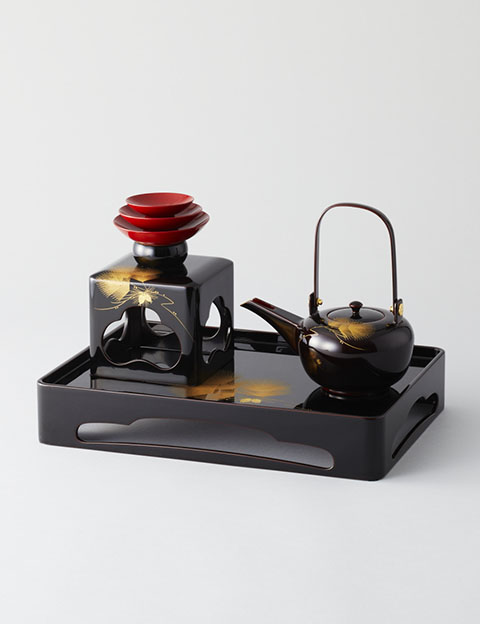
AIZU Nuri (Lacquerware)

Fukushima Prefecture

It all began during the Muromachi period when a powerful family in this region encouraged the planting of lacquer trees.
During the Azuchi-Momoyama period, a warlord from Omi Province came to rule Aizu. He invited lacquerware artisans from Omi to Aizu, spreading their techniques and promoting the development of lacquerware craftsmanship and technological advancements. As a result, lacquerware production in Aizu rapidly became an industrialized industry.
Subsequently, AIZU Nuri (Lacquerware), which incorporated maki-e (gold lacquer) techniques from Kyoto, steadily developed and spread, and by the mid-Edo period, it even obtained permission from the shogunate to attempt overseas exports. Although its power as a production center weakened temporarily during the turmoil of the Meiji Restoration, it later regained its vitality and reached its peak.

  • Technology/techniques/raw materials

    Technology/techniques

    1. The base preparation shall be carried out by one of the following methods:
    (1) For a tannin base coat, apply a mixture of persimmon tannin, charcoal powder, pine soot, or oil soot, then sand it down repeatedly, and then apply persimmon tannin.
    (2) For a rust-colored base coat, apply a mixture of raw lacquer and polishing powder.


    2. The top coat shall be "Hana-nuri," "Kijiro-nuri," or "Kinmushikui-nuri."


    3. When adding decoration, one of the following methods shall be used:
    (1) For lacquerware with powdered gold, flat lacquerware, round powder lacquerware, gold ground, and vermilion polished finishes, after sprinkling gold powder, silver powder, vermilion powder, or other powders, refined raw lacquer is repeatedly rubbed into the surface.
    (2) In woodblock prints, cloud shapes should be depicted.
    (3) In the case of Aizu paintings, after painting the cypress fence, a diamond-shaped gold leaf is applied.
    (4) In the case of iron rust lacquer, the painting is done using a mixture of raw lacquer and rust clay, and then the surface is polished by sprinkling with a mixture of ground powder and polishing powder, or a mixture of these with red iron oxide.
    (5) In the case of colored powder lacquerware, after sprinkling the colored powder, polish it using Japanese paper coated with wax.
    (6) In the case of chinkin, the process involves carving with a chisel, rubbing in refined lacquer, and then applying gold leaf or sprinkling powder.
     

    raw materials

    1 漆は、天然漆とすること。

    2. The wood used shall be magnolia, horse chestnut, zelkova, or sen wood, or timber of equivalent quality.

  • Work scene

    Lacquered items, which boast a unique, lustrous sheen, are created through numerous processes and the skilled hands of craftsmen, starting with the drying of the base material. In particular, the drying process of the base material and the preparation of the undercoat, which are not visible on the surface, determine the quality of the lacquered item. Here, we will introduce some of these complex processes.

    Process 1: Rough grinding

    The materials, such as horse chestnut and zelkova, are roughly sawn and then dried for a long time to prevent warping.

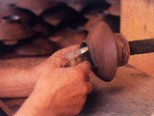
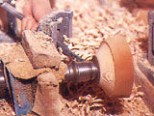
    Step 2: Turning on the potter's wheel

    We use a potter's wheel to create the wooden base. Gradually, the shape of the bowl begins to emerge.

    Step 3: Preparing the base

    Next, we apply a rust-like finish to the wood. This is the most important step in the lacquering process.

    Step 4: Sharpening

    The surface is polished to improve the adhesion of the lacquer and to eliminate any unevenness.

    画像をクリックすると動画が再生されます

    Step 5: Painting

    After completing the intermediate coat and sanding steps, it's finally time for the top coat. To ensure even drying, we occasionally flip the piece upside down.

    画像をクリックすると動画が再生されます

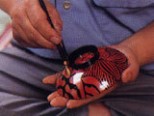
    工程6: 蒔絵

    The process involves drawing pictures with lacquer and then sprinkling gold powder, colored gold powder, and other materials onto them. A variety of techniques are used to complete the maki-e (lacquerware with gold or silver powder) design.


  • Close-up

    AIZU Nuri (Lacquerware)

    Aizu, a land of scenic beauty surrounded by mountains on all sides. AIZU Nuri (Lacquerware) has been nurtured in this town with a long history and a humid climate. The skills of the craftsmen have been passed down through generations within the division of labor. We spoke with Taiji Yamauchi, a maki-e (gold lacquer) artist who applies maki-e to AIZU Nuri (Lacquerware)."


    Aizu's producer, Gamo Ujisato, and the prosperity of AIZU Nuri (Lacquerware) as an industry

    In 1590, Lord Gamo Ujisato, who became the lord of Aizu at the command of Toyotomi Hideyoshi, brought many craftsmen from his hometown of Omi, including lacquerers, fabric makers, and maki-e (gold lacquer) artists, and encouraged the industry. Since then, lacquerware has taken root in Aizu. At that time, the skills of these craftsmen were truly cutting-edge. From there, AIZU Nuri (Lacquerware) techniques advanced dramatically, and it became a major production area that handled everything from lacquer cultivation to decoration. Furthermore, during the Edo period, Lord Hoshina Masayuki worked to protect and cultivate lacquer trees, and successive feudal lords enthusiastically worked on technological innovation, leading to exports to China, the Netherlands, and other countries, and the region flourished. However, Aizu lacquerware was severely damaged by the fires of war during the Boshin War at the end of the Edo period. The reconstruction of Aizu, which had been reduced to ruins by the war, was also the reconstruction of Aizu lacquer. Later, in the mid-Meiji period, Aizu once again became one of Japan's leading lacquerware production areas. After 400 years of history, lacquerware has evolved to the present day, incorporating modern technological innovations along with changes in the lacquer used as a material. Lacquerware that is mass-produced for everyday use and reinforced to withstand exports, and elegant lacquerware that relies entirely on traditional handcrafting, are now completely different in value and purpose, even though they are both called AIZU Nuri (Lacquerware).

    This technique involves applying fine gold powder called "keshifun." It is a delicate and highly focused technique of AIZU Nuri (Lacquerware).

    Skills passed down through generations, stories to be told

    Mr. Yamauchi carries on the tradition of handcrafted work as a maki-e (lacquerware) artist. Now, holding a piece of pottery made by his grandfather, Mr. Yamauchi says, "There is a wonderful artistry in the work of my predecessors that cannot be imitated." Around him, there is an increase in work using durable Chinese lacquer, printed decorations, and chemical paints. Precisely because of this era, Mr. Yamauchi wishes that people would use his work, which has been made by generations of handcrafted artisans, and feel the warmth of the maker's hands. Times have changed, and what used to be 100 percent work from wholesalers has now become about 10 percent. At one time, he employed many craftsmen in his home workshop, but now Mr. Yamauchi does everything by himself. "This is better for me," says Mr. Yamauchi. The room that was used as a resting place for the craftsmen who worked through the night is now open as a gallery, open to customers who come directly to him. Old photographs hanging on the wall reflect the past. In this open space, one can feel the hustle and bustle of traditional techniques and their power.

    • Colorful long tray

    • Currently, there are about 20 lacquerware artists who paint by hand.

    • The second floor, which used to be a resting room for craftsmen, has been transformed into a gallery with a wonderful atmosphere.

    You only truly understand your hometown and family business after you've left it.

    Like his father, Mr. Yamauchi studied lacquerware as an art form at a university in Tokyo. His father later became more of an artist than a craftsman, and also worked as a teacher. After graduating from university, Mr. Yamauchi worked for a company for nine years before returning to his hometown, where he trained elsewhere before taking over the family business. Both father and son, having gone out into the world and broadened their own horizons before returning home, now understand the greatness of tradition. At the time, he was sometimes asked why the son of a craftsman would go to university. He uses his own sensibilities as a foundation and integrates them with traditional work. Perhaps this is how Mr. Yamauchi's respect for the historical profession of maki-e artist was born. His home workshop has a noren (traditional Japanese curtain) that reads "Omaki-e Yamauchi." "I named it with respect for maki-e and pride in creating authentic maki-e," Mr. Yamauchi says. Here, he values sharing and passing on traditional techniques to users he knows personally. "We want to paint maki-e (gold lacquer) designs according to each individual's wishes, so that they can use a one-of-a-kind piece of lacquerware." This is surely what the warmth of lacquerware is all about.

    "Omakie Yamauchi"

    Craftsman Profile

    Taiji Yamauchi

    He returned to his hometown from Tokyo to take over the family business, becoming the third generation of a maki-e (lacquerware) artist. He is committed to the art of handcrafted work, meticulously painting each piece with heartfelt care, and is carrying on the tradition of Aizu lacquerware.

    Anecdotes

    Life with lacquer

    The excellent heat retention and insulation properties of wood and lacquerware have been proven through tradition. Since they neither conduct nor escape heat, it would be a shame not to utilize these properties in modern dining. In today's diverse and expanding Japanese dining culture, we should incorporate more lacquerware into our meals. Let's explore some fresh and functional ways to use lacquerware.

    When entertaining guests, you want to keep your wine chilled while still making it look beautiful. Recently, lacquerware wine coolers have been gaining attention. They keep wine cold for a long time, the ice melts slowly, and the cooler itself doesn't get wet with condensation. This way, you can serve delicious, chilled white wine without wetting the table. The black and red colors of the lacquerware also harmonize well with white wine.

    A tiered bento box, with its separate layers for different dishes, is incredibly functional. You can easily prepare a full course meal in one box—an appetizer tier, a salad tier, a main course tier, or a dessert tier—and start a party simply by opening the box. It's also fun to create a surprise when the box is opened by dividing the contents into layers: the main dish in the first layer and condiments, sauces, and small spoons in the second layer. Dividing the contents of the bento box with small glass dishes or bamboo tubes, or adding accents with seasonal flowers and plants, allows for creative and imaginative presentations. Lacquerware is inherently antibacterial and ideal for preserving food. It also protects food from sudden temperature changes. Bento boxes that utilize these properties of lacquerware are truly a testament to the wisdom of our ancestors. Let's bring its elegance and functionality to our dining tables right away.

    • Aizu Kozuyu is a local dish from Aizu that is always served during New Year's and celebrations. Because of the custom of having multiple refills and sharing sake, it's served in small, shallow bowls. This light and refreshing style seems like it could be adapted to modern tastes.

    • The paintings depict vibrant flowers, birds, wind, and moon. The celebratory tiered boxes, for example, have a powerful and impressive appearance.


overview

Craft item name AIZU Nuri (Lacquerware)
Reading Aizu Nuri
Classification of crafts lacquerware
Main Products Bowls, tiered boxes, tea coasters, trays
Main manufacturing area Aizuwakamatsu City, Kitakata City, Minamiaizu Town (Minamiaizu District), Nishiaizu Town (Yama District), Kitashiobara Village, Aizumisato Town (Onuma District)
Designated date May 10, 1975

contact address

■ Production area association

Aizu Lacquerware Cooperative
〒965-0042
1-7-3 Omachi, Aizuwakamatsu City, Fukushima Prefecture
Inside the Fukushima Prefectural Traditional Industries Hall
TEL: 0242-24-5757
FAX: 0242-24-5726

http://www.chuokai-fukushima.or.jp/aizushikkikumiai/

Features

You can enjoy auspicious designs that appeal to Japanese tastes, as well as a variety of decorative techniques. Highlights include the subdued "iron rust lacquer" using rust-colored paint, the "gold insect husk lacquer" which creates patterns by scattering rice husks, and the "wood grain lacquer" which showcases the beauty of the wood grain.

How to make it

The manufacturing process is broadly divided into wood preparation, undercoating, top coating, and decoration. Work is divided among different stages of production, as well as by product type, such as round or flat items.

Please see here for information on traditional craftspeople.

Japanese traditional craftsman
top