WAKASA Nuri (Lacquerware)

Fukui Prefecture

WAKASA Nuri (Lacquerware) originated in the early Edo period when lacquer craftsmen in the Obama domain, located near Wakasa Bay, were inspired by Chinese lacquerware making techniques and began creating designs depicting the seabed. Through repeated improvements and refinements, "Kikujin-nuri" was created, and later, a disciple of the inventor developed "Isokusa-nuri."
By the mid-17th century, the method of decorating with eggshells, gold leaf, and silver leaf, which is still practiced today, was perfected. The feudal lord at the time named this WAKASA Nuri (Lacquerware) and protected and encouraged it as a side job for foot soldiers, which led to the creation of various elegant and beautiful designs such as "Kikusui Shioboshi."

  • Technology/techniques/raw materials

    Technology/techniques

    1. The base preparation shall be carried out by one of the following methods:
    (1) For items other than chopsticks, the process involves "covering with cloth," applying "rusting paint," and then repeatedly applying a mixture of raw lacquer, ground powder, and rice paste to create a "ground powder base coat."
    (2) In the case of chopsticks, the "heading" shall be done using raw lacquer or vermilion lacquer.


    2. The base coat finish shall be one of the following:
    (1) For items other than chopsticks, a "undercoat" using raw lacquer shall be applied.
    (2) In the case of chopsticks, a "painted base coat" using vermilion lacquer shall be applied.


    3. The patterning shall be done in one of the following ways:
    (1) For the "eggshell pattern," the eggshell is placed on top of the application of various hard lacquers, and then a "combination coating" is applied using colored lacquer.
    (2) For the "seashell pattern," after applying various hard lacquers, seashells are placed on top, and then a "combination coating" is applied using colored lacquer.
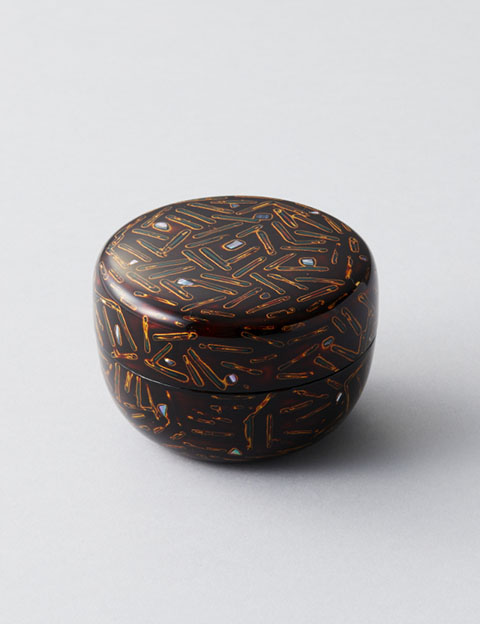
    (3) In the case of "raised patterns", after applying various hard lacquers, patterns are raised using pine needles, cypress leaves, rapeseed, or rice husks, etc., and then "combined coating" is applied using colored lacquer.


    4. To create the pattern, perform "rough grinding," "medium grinding," and "finishing grinding" using a whetstone.


    5. The finishing touches on the patterned surface include "glossy coating" using vermilion lacquer, followed by "rough charcoal polishing," "medium charcoal polishing," and "roiro finish polishing" using magnolia charcoal and roiro charcoal, and then "body polishing" and "finishing polishing."


    6. "Interior coating" refers to applying a top coat using matte black lacquer, glossy black lacquer, colored lacquer, or multi-colored lacquer.
     

    raw materials

    1 漆は、天然漆とすること。


    2. The woodwork shall be one of the following:
    (1) For items other than chopsticks, the material shall be horse chestnut, Japanese cherry, zelkova, cypress, magnolia, katsura, or a material of equivalent quality.
    (2) Chopsticks shall be made of cherry wood, rosewood, moso bamboo, or a material of equivalent quality.

  • Work scene

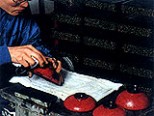
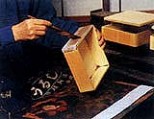
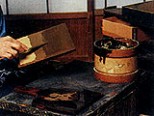
    WAKASA Nuri (Lacquerware) is made through approximately 60 steps, but it can be broadly divided into several parts.
    First, the "wood base" is created by selecting raw wood from highly durable trees such as zelkova, Japanese cherry, horse chestnut, cherry, chestnut, and magnolia, and then shaping the wood according to its form. At this stage, the key is the proper drying of the raw wood to obtain a wood base without warping, and the skill of the craftsman to finish it to precise dimensions.
    The wooden base, crafted by a woodworker, is sent for priming before proceeding to the lacquering process. This priming work is not visible in the finished lacquerware. However, it is no exaggeration to say that the durability of the lacquerware and the quality of the topcoat depend on the quality of this priming work. This includes tasks such as filling holes and cracks in the joints and scratches of the wooden base with kokuso (a type of filler) and reinforcing vulnerable areas with cloth.
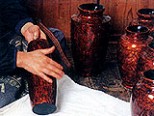
    After the undercoating process, the painting finally begins. Lacquer involves repeatedly applying and sanding the lacquer, progressing through the undercoat, intermediate coat, and topcoat stages. Moisture is necessary for the applied lacquer to "dry," and it might be easier to understand it as "hardening" rather than simply "drying." The drying speed is affected by daily weather conditions, and this is where the craftsman's skill is put to the test. The final topcoat is applied with the utmost care, ensuring that not even the slightest dust or dirt adheres to it.
    The defining characteristic of WAKASA Nuri (Lacquerware) lies in its "variation lacquering" technique, where patterns are created using eggshells, seashells, pine needles, cypress leaves, and other materials, and then these patterns are brought to life through repeated lacquering and sanding. Let's take a look at the main steps involved.

    Step 1: Fabric application

    It eliminates warping and bending of the product, reinforces joints, and prevents shrinkage and cracking of the wood.

    Step 2: Primer application

    Mix raw lacquer, clay powder (made by firing clay and grinding it into a powder), and glue, then apply the mixture evenly to the entire surface with a brush to make it smooth. Next, apply rust lacquer (raw lacquer mixed with polishing powder) with a spatula.

    Step 3: Intermediate Coat

    After applying the base coat, the rust is removed by sanding, and then an undercoat of lacquer is applied to prevent the polishing powder from absorbing the lacquer used for the pattern.

    Step 4: Patterning

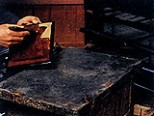
    The patterns are created by drawing designs on top of the undercoat using materials such as eggshells, seashells, pine needles, and rapeseed, according to the individual craftsman's design.

    画像をクリックすると動画が再生されます

    Step 5: Undercoat

    The process involves applying two or more layers of colored lacquer, and this layering technique creates the unique colors and luster characteristic WAKASA Nuri (Lacquerware).

    Step 6: Foil application

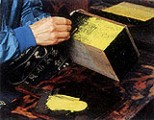
    Gold leaf is applied to the finished product after the base coat has been applied, giving it a unique and elegant shine. This expresses the depth and mellowness of WAKASA Nuri (Lacquerware).

    画像をクリックすると動画が再生されます

    Step 7: Coating

    The lacquering technique involves applying multiple layers of lacquer to give the product strength, and then polishing it to bring out a variety of patterns.

    Process 8: Stone sharpening

    This process involves using a coarse whetstone, a medium whetstone, and a finishing whetstone in that order, sharpening until the pattern is fully visible.

    Process 9: Charcoal sharpening

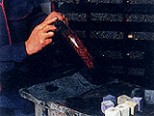
    After sharpening the stone, a glossy lacquer or a light lacquer is applied, and then the surface is meticulously polished using coarse and medium charcoal made from magnolia wood, followed by roiro charcoal made from crape myrtle and lettuce, to make it even smoother.

    工程10: 磨き

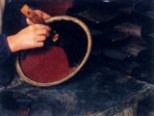
    First, the surface is polished by rubbing it with a cloth using a mixture of polishing powder and rapeseed oil. Next, it is polished with raw lacquer soaked in cotton wool, and finally, it is carefully polished with red iron oxide and rapeseed oil using the palms and fingertips in a circular motion.


  • Close-up

    WAKASA Nuri (Lacquerware) lacquerware expresses the beauty of the ocean floor.

    WAKASA Nuri (Lacquerware) is famous for its mystical patterns reminiscent of a crystal-clear sea, but it has another significant characteristic. In WAKASA Nuri (Lacquerware), the processes are not divided among different craftsmen; one craftsman handles everything except the wood preparation. The craftsman's passion is poured into every detail, from the intricate patterns to the colors and sheen.


    The natural beauty created by the repeated process of painting and polishing.

    The unique patterns, often described as resembling the beautiful seabed or the stars in the night sky, are achieved through a "polishing" technique that skillfully utilizes various natural materials such as eggshells, seashells, pine needles, cypress leaves, rapeseed, and rice husks. "The area is close to the sea, so it's windy, and there's a legend that the patterns were created when the wind blew during the lacquering process and rice husks and sand got stuck to the surface," says Mitsusaku Furukawa, the third-generation owner of the Furukawa WAKASA Nuri (Lacquerware) Shop, which has been in business since his grandfather's time, and a certified traditional craftsman.
    WAKASA Nuri (Lacquerware) has a history of about 400 years. "It is said that this distinctive pattern was created when a young lacquer craftsman, long ago, went to Sotomo (a scenic spot on the outer edge of Obama Bay) and was so moved by the beauty of the seabed that he expressed it in WAKASA Nuri (Lacquerware)." WAKASA Nuri (Lacquerware) is a craft that uses natural materials to express the beauty of nature.

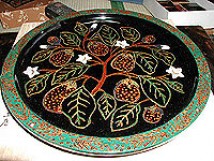
    WAKASA Nuri (Lacquerware) said to depict patterns of the seabed.

    "Patterning" can only be done during the winter.

    The patterns that emerge when the wood is polished are determined by the "patterning" process, which is performed after the base coat has been applied to the wood.
    "This is the most nerve-wracking part of the process. This pattern is fundamental to WAKASA Nuri (Lacquerware), and of course, the quality of this work affects the final finish. The pattern is created by applying pine needles and other materials after the lacquer has been applied and before it dries. However, if the lacquer dries too quickly at this stage, it won't gather properly and the pattern won't form. That's why this work can only be done when the temperature and humidity are low, from December to March." Lacquer needs humidity to dry, but during the rainy season, it dries too quickly.
    After applying the patterns, the process involves endlessly repeating the painting and polishing steps. "It's called Wakasa's 'foolish painting,' meaning you paint and polish so much that you become a fool." It takes about a year to complete one piece.

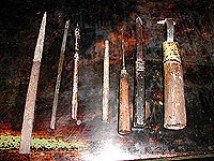
    Some tools have been in use for over 100 years since the first generation.

    From the base work to the final finish, everything is handled by a single craftsman.

    Another characteristic of WAKASA Nuri (Lacquerware) is that one craftsman handles all stages of production, from preparing the wood base to applying the top coat.
    "We only purchase the raw wood, and then we do everything ourselves. There's no division of labor. It's the same at our place; the craftsmen set up their shops right next to their workshops and sell what they make themselves." As a result, they take full responsibility for the products they create.
    "The entire process of WAKASA Nuri (Lacquerware) involves 66 steps. There's so much to learn, so it takes at least five years just to be able to make a product. To actually be able to make something that customers will buy and to be able to make a living from it, it takes about ten years."

    Each store has its own unique pattern.

    Because one person handles everything, the individuality of each craftsman is strongly reflected in the products. "The patterns differ slightly from shop to shop. The okoshi patterns (patterns made with pine needles or rapeseed) can be fine or coarse. There are also traditional designs that have been passed down in each shop. So, if you know what you're looking for, you can tell, 'Ah, this is a Furukawa piece.' For example, this plum blossom pattern is unique to Furukawa." Customers also have different preferences depending on the pattern. That's why, even among the several WAKASA Nuri (Lacquerware) shops, there are those who are "regular customers of the Furukawa shop."

    The eggplant painting was created using a powder of colored lacquer called kanshitsu fun.

    The work done behind the scenes is what creates value.

    Lacquerware is inevitably expensive due to the manufacturing process. However, it's pointless to not use something you've bought just because you don't want to waste it. "Because it's something you use every day, I want you to choose something expensive. Lacquerware is valuable because of the meticulous undercoating work that goes into the parts you can't see. Valuable things don't break, and they develop a beautiful sheen the more you use them. And if they do break, they can be repaired. If it's one of our products, we'll take full responsibility and repair it to the very end."
    Mr. Furukawa says he enjoys receiving various requests from customers. Having grown up watching his parents work, he started this job out of a pure passion for craftsmanship. That passion shows no signs of waning.

    Mitsusaku Furukawa wants to continue making good products.

    Craftsman Profile

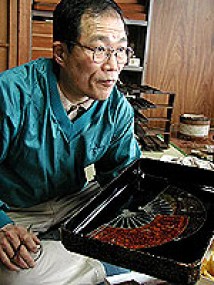
    Kosaku Furukawa

    The third-generation owner of Furukawa WAKASA Nuri (Lacquerware) Shop and a certified traditional craftsman. He has 33 years of experience as a craftsman, starting at the age of 27. He wants to create and preserve high-quality products.

    Anecdotes

    Carry your own cherished, personal lacquered chopsticks with you.

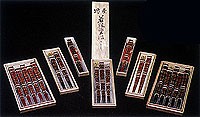
    Wakasa produces over 80% of the nation's lacquered chopsticks. These chopsticks are durable and can last for five years even with daily use. Of course, they feature the beautiful patterns created by WAKASA Nuri (Lacquerware) 's unique polishing technique. Wouldn't it be a shame to only use these traditional and beautiful chopsticks at home? Why not carry them with you and use your favorite pair when dining out? It might feel a little awkward at first, but if you're serious about food, you should naturally pay attention to your utensils as well. In recent years, some coffee shops, especially popular among young people, have even started offering a service where they'll pour your drink into your own cup. Perhaps the day will come when carrying not only chopsticks, but even a bowl for miso soup, feels completely natural...?

    • Lightweight, durable, and beautiful Wakasa lacquered chopsticks


overview

Craft item name WAKASA Nuri (Lacquerware)
Reading Wakasa-nuri
Classification of crafts lacquerware
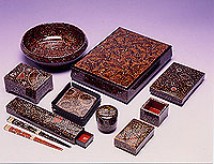
Main Products Flower vases, tea sets, sake sets, chopstick boxes
Main manufacturing area Kohaya City
Designated date February 6, 1978

contact address

■ Production area association

Wakasa Lacquerware Cooperative
〒917-0071
1-9 Ichibancho, Obama City, Fukui Prefecture
Kafuku lacquerware store
TEL: 0770-52-0921
FAX: 0770-52-0921

Features

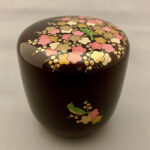
WAKASA Nuri (Lacquerware) uses eggshells, abalone shells, pine needles, cypress leaves, rapeseed, and other materials to create patterns that depict the seabed. Gold leaf also shines within these patterns, like stars or jewels. Because each piece is handmade, no two are exactly alike.

How to make it

The lacquerware is inlaid with abalone shells and eggshells, then layered with blue, yellow, and red lacquer, wrapped in gold leaf, and then coated dozens of times with high-quality lacquer. Finally, it is polished with whetstones and special charcoal, given a glossy finish, and a top coat is applied to the plain areas. Because it takes a long year to produce, it remains unaffected by heat and moisture, resulting in a robust, elegant, and high-quality lacquerware.

Please see here for information on traditional craftspeople.

Japanese traditional craftsman
top