RYUKYU Shikki (Lacquerware)

Okinawa Prefecture

RYUKYU Shikki (Lacquerware) is thought to have developed alongside the trade that began in the 14th century, involving the sending of tribute goods to China.
In the early 17th century, a lacquerware workshop called the Kai-zuri Bugyosho was established in the Shuri royal government, producing high-quality crafts both technically and artistically. Additionally, Wakasa-cho in Naha was a center of lacquerware production as a private industry.

  • Technology/techniques/raw materials

    Technology/techniques

    1. The base preparation shall be carried out by one of the following methods:
    (1) In the case of a pig's blood base, after covering it with cloth or paper, apply a mixture of pig's blood, tung oil, "nii" and "kuchiya".
    (2) In the case of a lacquer base coat, after applying a cloth or paper, a mixture of raw lacquer, "niibi" and "kuchiya" or a mixture of raw lacquer, "niibi" and polishing powder shall be applied.

    2. The top coat shall be applied using refined lacquer, either by applying it directly or by applying it in a roiro (multi-layered) pattern.

    3. When decoration is to be applied, it shall be done by "tsuinishiki," mother-of-pearl inlay, gold inlay, or foil painting. In the case of "tsuinishiki," the "tsuinishiki mochi-zukuri" method shall be used, which involves hammering a mixture of black lacquer and pigment.
     

    raw materials

    1 漆は、天然漆とすること。

    2. The wood used shall be coral tree, Japanese snowbell, chinaberry, Japanese sandalwood, Japanese yew, banyan tree, or Japanese cedar, or timber of equivalent quality.

  • Work scene

    RYUKYU Shikki (Lacquerware) uses Okinawan woods such as deigo and shichamagi (Egonoki). The dried wood is carved and glued together to create the shape, and then multiple coats are applied: a base coat, an undercoat, and a top coat. After each coat, the surface is sanded with sandpaper. There are many decorative techniques, including chinkin (gold inlay), raden (mother-of-pearl inlay), hakue (gold leaf painting), and tsuikin (layered brocade), and this diversity is a characteristic feature of RYUKYU Shikki (Lacquerware).

    Step 1: Making the wooden base

    There are two main types of woodworking: sashimono, which involves assembling planks to create tiered boxes and trays, and hikimono, which involves turning wood on a lathe and then using a chisel to shape it into bowls and trays. In both cases, the wood is dried for about six months before use.
    Joinery
    Apply adhesive to the boards and quickly assemble them. Let them dry for several hours, then plane the surface to shape them into a bento box or similar object.

    ground food
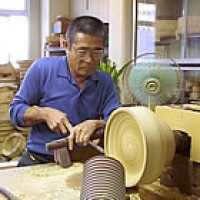
    There are two main methods of woodturning: vertical turning, which uses wood cut into cross-sections, and cross-cutting, which uses wood cut lengthwise. For coral trees (Deigo), the wood is cut into cross-sections and then turned on a lathe into shapes such as trays. For styrax (Styrax japonica), the wood is smoke-dried in a drying kiln for 10 to 15 days before being turned on a lathe. The finish is then applied with sandpaper.

    Step 2: Primer application

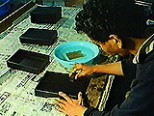
    Surface scratches and cracks are filled with a Niibi base coat, which is a mixture of Niibi (Oroku sandstone) and raw lacquer. This process is called "kokuso." Niibi has finer grains than sand but coarser grains than soil, making it ideal for coating woods with a rough texture, such as coral trees.
    Next, a kucha base coat, made by mixing kucha (Shimajiri mudstone) powder with raw lacquer, is applied. In the past, a pig's blood base coat, made by mixing pig's blood with tung oil, niiburi (a type of lacquer), and kucha (Shimajiri mudstone), was used. After applying the base coat, it is allowed to dry.

    画像をクリックすると動画が再生されます

    Step 3: Wet sanding

    While applying water, sand the surface with a whetstone or sandpaper. Start with coarse sandpaper and gradually move to finer sandpaper. Repeat this process several times between priming and painting.

    Step 4: Intermediate Coat

    To improve the finish of the top coat, a lacquer mixture containing the same color pigment as the top coat is applied.

    Step 5: Top Coat

    We prepare the lacquer for the topcoat. We evaporate the water from the raw lacquer by adding infrared and ultraviolet rays. This process is called "kurome." When kurome is done sufficiently, a transparent lacquer is produced. We mix vermilion pigment into the lacquer. We mix it further using a mixer. When the thick liquid is filtered through many sheets of Japanese paper, it becomes the topcoat lacquer.
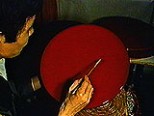
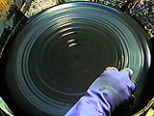
    The lacquer is applied using a stiff brush made from hair. This is done in a closed room to prevent dust from getting on it. Fine dust is carefully removed. The piece is then placed in a rotating drying bath to dry. It is rotated approximately every 10 minutes to prevent the lacquer from dripping and to ensure the piece dries evenly.

    工程6: 加飾

    There are various decorative techniques used in RYUKYU Shikki (Lacquerware).
    Mother-of-pearl inlay
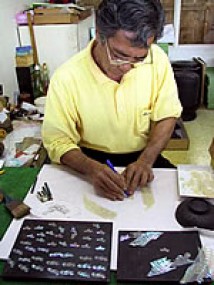
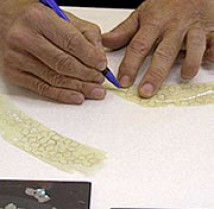
    Thinly shaved turban shells or abalone shells are cut into the desired pattern using a silk needle. The cut shells are then glued onto paper on which a design has been drawn. The shell-side is placed on the vessel, and the paper is removed, leaving only the shells. Lacquer is then applied over the shells. When sharpened with charcoal, the shells are revealed. To remove the charcoal marks, the piece is polished with a mixture of wood filler and oil. A powder made from deer antler is used to give it a shine.

    Foil painting
    The design is transferred onto the vessel by applying a preliminary sketch with pigment, then outlined with bengara lacquer, and finally the inside of the pattern is painted. Gold leaf is applied while it is still semi-dry. Excess gold leaf is removed with a brush, leaving a golden pattern. After drying for one or two days, the outline is drawn with black lacquer.

    Chinkin
    The design is transferred onto the vessel by applying a preliminary sketch with pigment. The lines of the pattern are carved using a chinkin knife. Black lacquer is rubbed into the lines. Before the lacquer dries, gold leaf is applied, pressing it down. After it dries, it is wiped off, leaving the gold leaf in place along the lines.

    Tsuikinshi
    We will make Tsuinishiki mochi. We will mix black lacquer and pigment by hammering them together and make it into a mochi-like consistency. We will then flatten it with a roller. Next, we will apply black lacquer to the back of the mochi and stick it to a Tsuinishiki board. We will place a pre-drawn design with pigment on top and transfer the image. We will cut out shapes such as pine trees, flowers, and rocks according to the design using a Tsuinishiki knife. We will create a three-dimensional effect by adding bumps, lines, and rubbing in pigment. We will peel it off the Tsuinishiki board and stick it onto a vessel on which the pre-drawn design has been transferred.

    画像をクリックすると動画が再生されます


  • Close-up

    A translucent vermilion that highlights the essence of Okinawa.

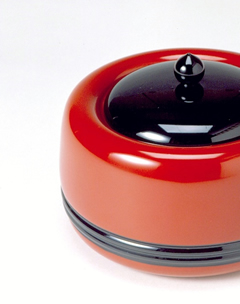
    While black lacquerware is common throughout Japan, RYUKYU Shikki (Lacquerware) is characterized by its translucent vermilion color. Utilizing materials unique to Okinawa, such as the deigo tree and niibi (Oroku sandstone), and taking advantage of the hot and humid climate ideal for lacquer work, people have cultivated a unique lacquer art form since ancient times.


    Vermilion with yellow and green accents

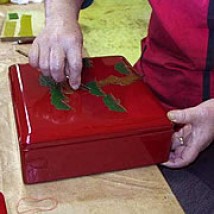
    Under the southern sun, the vibrant colors shine beautifully. There is a jujube jar adorned with flowers drawn in vermilion with gold lines, and a vermilion-lacquered tray made from the light yet durable coral tree. The colorful inkstone box, decorated with yellow hibiscus flowers and green pine branches, is made using a technique called "tsuikin," which is unique to RYUKYU Shikki (Lacquerware). A mixture of lacquer and pigment, called tsuikin mochi, is rolled out thinly, cut into the shapes of flowers and pine branches, and then pasted onto the surface.
    Besides Tsuinishiki, there are various other techniques such as "Raden," which involves inlaying glittering shells; "Hakue," which involves applying gold leaf to the patterned areas; and "Chinkin," which involves filling in engraved lines with gold leaf.
    "I don't think there's any other production area that uses so many different techniques."
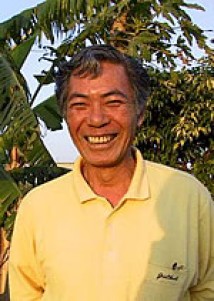
    These are the words of Isao Matsuda, who has been making lacquerware for 40 years. He is a traditional craftsman who has won numerous awards at exhibitions.

    Isao Matsuda. Last year he demonstrated mother-of-pearl inlay in France.

    Learn from your mistakes

    His boundless curiosity is astonishing. While lacquerware artisans often specialize in different techniques, Matsuda learned maki-e (gold lacquer), raden (mother-of-pearl inlay), chinkin (gold inlay), and hakue (gold leaf painting) from their respective masters, and has mastered many techniques, including tsuinishiki (layered brocade). "I wanted to do it all. I do things that not many people do."
    For example, there is a technique called "total covering," where thinly rolled tsuikin mochi is applied to the entire jujube-shaped container, and then tsuikin mochi cut into the shape of a pattern is applied on top. Alternatively, leaves picked up from the garden are coated with lacquer and attached to the incense box, and then only the leaves are removed, leaving the traces of the leaf veins.
    I often get hints from my failures. "That's what makes it interesting. I think about whether there's anything I can use from my mistakes. I might leave a failed attempt as is, and then later I'll look at it and it'll have turned into a beautiful color. So I might think, 'What if I did that to the whole thing?'"

    Cut the abalone shells used for mother-of-pearl inlay into the shape of the design.

    Things I learned from my master

    Matsuda, who had been good at drawing since elementary school, studied lacquerware in high school and then apprenticed at a company in Kainan City, Wakayama Prefecture, a production area of Kuroe lacquerware. For Matsuda, who had been doted on as the youngest of six siblings, this was his first time standing on his own two feet. At first, there were hardly any people from Okinawa around him.
    "I was lonely. My boss was a really nice person, and he treated me like family, even sharing meals with me, but he had a short temper. When he scolded me severely, it reminded me of Okinawa. I've stumbled many times, but it's normal to get yelled at for making mistakes at work. I won't let that get me down."
    I learned Japanese painting and calligraphy at the recommendation of my master. He taught me the fundamental technique of sketching, which is the very basis of lacquerware. I still remember the way he taught me to draw grass back then.
    After studying maki-e (lacquerware with gold or silver inlay) for four years, I returned to Okinawa. I also studied other techniques to hone my skills and began exhibiting my work in exhibitions.

    The mechanical pencil has a silk needle attached to its barrel.

    I'm looking for something interesting.

    Even with technical proficiency, design remains a challenge. Looking at sketchbooks and books can be difficult to resolve. When inspiration strikes, work progresses quickly, and the process feels great. Planning and execution come together instantly. However, even then, there's a gap between the image in your head and the actual finished product.
    "The finished product is about 70 to 80 percent of the ideal. 100% perfection is practically impossible. There's no such thing as a perfect piece yet."
    What kind of projects will you be working on next? "I'll just go with the flow. I'm always looking for something interesting. You have to keep moving forward no matter what."
    I've been involved with lacquer for 40 years now, and my curiosity remains as strong as ever.

    Paste the rice cakes cut into the shapes of pine trees and rocks.

    Craftsman Profile

    Isao Matsuda

    Born in 1944. Traditional craftsman, inheritor of prefectural intangible cultural heritage, and member of the Okinawa Art Exhibition.

    Anecdotes

    Lacquerware making, protected and nurtured by the Ryukyu Kingdom government.

    Lacquerware was introduced to Ryukyu from China around the 15th century, when the Ryukyu Kingdom was actively trading with China and Southeast Asian countries. In Ryukyu, a unique style of lacquer art flourished, and many excellent pieces were produced as gifts for the shogun's family and as tribute items to China. The royal government established an institution called the Kaizuri Bugyosho (Shell Inlay Magistrate's Office) to protect and nurture lacquer art.
    At the Kaizuri Bugyosho (Shell Inlay Magistrate's Office), production primarily focused on the raden (mother-of-pearl inlay) technique, which involves cutting and pasting small pieces of seashell. It seems they performed extremely intricate work, completing only about one inch (3 centimeters) square in a whole day.
    One of the items made during that time is the Tungdabun (東道盆). It was a vessel used to entertain envoys from China, and it is divided into sections to hold 8 to 9 different kinds of food.
    Large vessels like these are made from the coral tree (Erythrina variegata). Because of its coarse grain, it is surprisingly light for its size. Yet it is also strong and does not deform even when dried. It is mainly sourced from the central and northern parts of Okinawa Island. For smaller items such as bowls, the Styrax japonica tree (Styrax japonica) from the northern part of the island is used.

    • The coral tree should be dried for about six months before use.

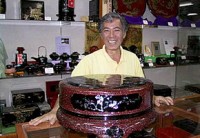
    • Isao Matsuda in front of his homemade Todo bonsai.


overview

Craft item name RYUKYU Shikki (Lacquerware)
Reading Ryukyu Shikki
Classification of crafts lacquerware
Main Products Tray, tea bowl, individual plates, bowl, tiered box, jujube caddy
Main manufacturing area Naha City, Urasoe City, Itoman City, Okinawa City, Tomigusuku City, Nakagusuku Village (Nakagami District), Haebaru Town (Shimajiri District)
Designated date March 12, 1986

contact address

■ Production area association

RYUKYU Shikki (Lacquerware) Business Cooperative
〒902-0078
3-19-6 Shikina, Naha City, Okinawa Prefecture
Shikina Community Center Hall, 1st Floor
TEL: 098-855-6789
FAX: 098-836-2636

Features

RYUKYU Shikki (Lacquerware) is primarily made using the hananuri technique, which involves applying vermilion or black lacquer. Various other techniques are used to create patterns, including tsuikin, chinkin, foil painting, and mother-of-pearl inlay. The wood used is typically coral tree, styrax, or chinaberry, with a base coat made from pig's blood (tonketsu shitaji) and a top coat of natural lacquer. The vibrant beauty of the vermilion is particularly unparalleled.

How to make it

Okinawa's "Tsuikin" is a unique technique of Ryukyu lacquerware in which pigments and lacquer are mixed together to form a mochi-like mixture, which is then rolled out thinly on a board, cut into patterns, attached to a vessel, and then further carved with fine lines RYUKYU Shikki (Lacquerware) colored to finish it off.

Please see here for information on traditional craftspeople.

Japanese traditional craftsman
top