NAGISO Rokuro Zaiku (Wood Turnery)

Nagano Prefecture

According to old documents from Nagiso Town, the origins of NAGISO Rokuro Zaiku (Wood Turnery) date back to the first half of the 18th century.
Records indicate that wooden goods such as trays and bowls were shipped to the Nagoya and Osaka areas. This suggests that turned wooden products were being produced in this region during the mid-Edo period.

  • Technology/techniques/raw materials

    Technology/techniques

    1. Wood selection involves determining the dimensions, cutting into logs, marking, and splitting, followed by rough sawing.

    2. Drying should be done in a way that prevents cracking and allows the material to be exposed to the outside air.

    3. The finishing process shall be one of the following:
    (1) For unfinished wood products, the following techniques or methods shall be used:
    (i) Using a rough-finishing plane, perform edge turning and rough finishing on a vertical lathe.
    (b) After finishing the turning on a vertical lathe using a finishing plane and a shaka plane, and then polishing it, "water polishing" is performed using horsetail and "sugukiwara".
    (2) For lacquer-coated products, the following techniques or methods shall be used:
    (i) Using a rough-finishing plane, perform edge turning and rough finishing on a vertical lathe.
    (b) After finishing the turning on a vertical lathe using a finishing plane and a shaka plane, and then polishing it, wipe it with raw lacquer.
     

    raw materials

    1. The wood used shall be horse chestnut, zelkova, sen, katsura, or mizume, or timber of equivalent quality.

    2 漆は、天然漆とすること。

  • Work scene

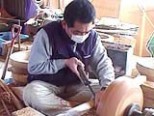
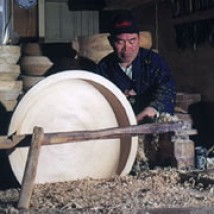
    As the name "lathe work" suggests, the distinctive feature of this craft lies in the planing process using a lathe. It is very similar to the lathe work of ceramics, where a plane blade is applied to the wood while it is rotating on the lathe to carve it out. In NAGISO Rokuro Zaiku (Wood Turnery), not only is the lathe turning process done by hand, but all processes from wood selection and cutting to painting are carried out by a single skilled craftsman, resulting in a high level of craftsmanship.

    Process 1: Selected wood

    The main types of raw timber used are horse chestnut, zelkova, sen, katsura, and mizume, all native to Kiso. The beauty of NAGISO Rokuro Zaiku (Wood Turnery) lies in its ability to utilize the natural wood grain, conveying a simple, warm, and handcrafted feel in every detail of the wooden products. Therefore, meticulous care is taken in selecting the raw timber, determining the product to be made according to the subtle variations in the wood's texture and character.
    The bark of the raw timber is removed using a tool called an yoki, and dirt is removed using brushes and scrubbing brushes. Then, the condition of the end grain and surface is examined to determine the felling time, growing location, growth process, and the wood quality, texture, color, presence and extent of figured grain within the wood. The wood is then selected while comparing this assessment with the intended product.

    Step 2: Wood preparation (cutting into logs to rough sawing)

    The process of carefully selecting logs and cutting them into cross-sections is called "log cutting." Next, the cross-sections are cut with the end grain facing upwards. This is called "sawing." The sawn logs are then rounded to create a circular or oval shape, allowing the grain and figure to be fully appreciated. This rounding process involves cutting the outer edges of the logs. Finally, the logs are planed to a thicker size using a lathe, and this process is called "rough sawing."

    工程3: 乾燥

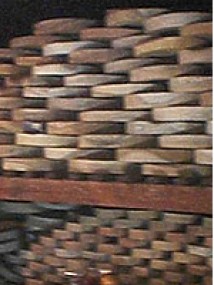
    Roughly sawn lumber cannot be used directly to create finished products. It must undergo a long drying period to remove excess moisture and increase its hardness as wood. The lumber is laid out in a room and dried for about three months using a stove or hearth. Larger pieces can take up to three years, and the drying period varies depending on the size of the lumber. The moisture content of the wood is the indicator of dryness. When it reaches about 10%, the drying using the stove or other means is stopped, and the wood is left to naturally acclimate to normal air, returning the moisture content to about 12%.

    Step 4: Finishing milling

    After the wood has been air-conditioned, the surface is smoothed using a plane while it is rotated on a lathe. This process requires highly skilled techniques. In particular, the way the blade is applied and the planing motion require considerable experience, and the combination of the lathe and the blade cannot be achieved overnight.
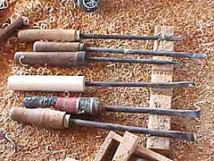
    There are various types of planes used at this stage. Lathe turners skillfully use tools such as roughing planes to shape the workpiece, finishing planes to make the workpiece smoother, and smoothing planes to remove the streaks from the turn and create the final finished surface. Even with the same type of plane, they always use two or three at a time to complete the turn. Furthermore, each craftsman makes and forges these planes themselves to suit the material they are turning and to make them easy to use.
    The finished pieces are then polished further with sandpaper.

    Step 5: Polishing the horsetail and wiping off the lacquer.

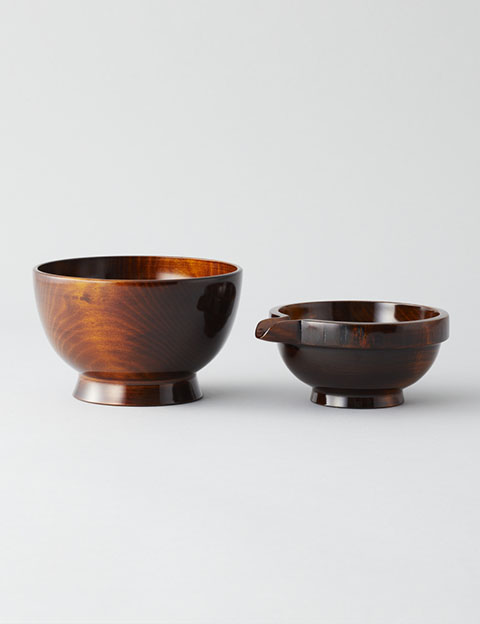
    There are two finishing methods: "horsetail polishing," which involves water polishing using horsetail or sugukiwara straw, and "lacquer polishing," which involves rubbing in natural lacquer and polishing it. Products polished with horsetail polishing have a natural, unpolished finish that makes the most of the beauty of the wood grain. Both methods serve similar purposes; the simple finish is aesthetically pleasing, and the smooth surface and even wood grain showcase the quality of the material. In the tea caddies, tea trays, wooden bowls, bowls, tea canisters, and tea coasters that are carefully crafted in this way, the techniques of selecting wood that best makes the most of the wood grain are vividly evident.


  • Close-up

    The feel of the wood grain in your hand NAGISO Rokuro Zaiku (Wood Turnery)

    NAGISO Rokuro Zaiku (Wood Turnery) fully utilizes the beauty of the wood grain, conveying the breath of nature and the history of natural wood. The simple and warm charm of handmade work soothes the hearts of those who see it.


    High level of perfection as a practical item

    Kiso has long been blessed with abundant forest resources that produce fine timber. NAGISO Rokuro Zaiku (Wood Turnery) is characterized by its soft and mellow texture, similar to that of ceramics, as it brings out the best qualities of the wood through the special technique of "lathe work". Moriji Okura is the fourth generation of Yamadai Okura, which makes lathe work in Minami-Kiso Town, Nagano Prefecture. He has been doing this work for 47 years. "The characteristic of NAGISO Rokuro Zaiku (Wood Turnery) is that we make a wide range of products, from teacups to large lids, in other words, from small to large. All processes, from wood selection and cutting to painting, can be done here, so we can achieve a high level of perfection as a practical item." NAGISO Rokuro Zaiku (Wood Turnery) is broadly divided into two types: "plain wood products" that make the most of the beauty of the wood grain, and "lacquered products" that are rubbed with natural lacquer and polished. The types of products are diverse, including bowls, dishes, basins, trays, tea caddies, as well as low tables and round kotatsu tables. While pottery wheel work traditionally focused on round shapes, Mr. Okura explains that he is now using the techniques he has cultivated to create square products (such as desks).

    A serious battle with natural wood, wood selection

    The process of creating NAGISO Rokuro Zaiku (Wood Turnery) is incredibly time-consuming. First, there's the "wood selection" process, where the sourced logs are cut into cross-sections. "While turning the wood on the lathe is certainly difficult, the wood selection is actually the most challenging part. No matter how expensive the sourced logs are, there's no guarantee that the contents will be of commensurate value. Therefore, both the ability to discern the quality of the wood and the skill to cut it in a way that maximizes the use of the wood grain are necessary."

    He started working with pottery wheels at the age of 16, right after graduating from junior high school. He is a skilled traditional craftsman who has honed his skills for 47 years.

    Creates strength that rivals plastic, through natural drying.

    Furthermore, the process involves "splitting," where the cut logs are roughly cut to size with the end grain facing upwards; "rounding," where the outer edges are trimmed and the wood is shaped into a circle; and "rough turning," where the wood is planed to a thicker dimension using a lathe. After these steps, the wood is allowed to air dry. "Electric drying takes about a month, but the chances of cracking or warping are higher. On the other hand, air drying takes about three months, and for larger pieces, it can take up to three years." By allowing ample time for drying, the wood becomes incredibly durable, rivaling even plastic and metal utensils, and lasts a long time. Woods with tannins, like persimmon wood, are soaked in water. Tea caddies made from persimmon wood, after the tannins have been removed, have an indescribable astringency that enhances their rustic charm. Once the wood's humidity reaches about 10%, drying is stopped, and it is allowed to adapt to normal air. Then, the final steps of "finish turning" and "lacquering (water polishing)" are performed.

    The roughly sawn lumber is naturally dried over a long period of time, waiting for the day it will be carefully finished.

    Breathing necessary for planing

    As the name "lathe work" suggests, the distinctive feature of this craft lies in planing the wood on a lathe. It is very similar to the lathe work of ceramics, where the raw wood is rotated on the lathe while a plane blade is applied to carve it. Mr. Okura says that breathing is paramount when it comes to the "finishing turn," which is done by hand. Because the plane is held against the chest while working, if you don't regulate your breathing, your hands will slip. Each craftsman forges their own plane. Making their own tools easy to use is another example of their commitment to consistent work. It takes five years to figure out what shape suits you best. Through these processes, the beauty of the smooth surface and the even grain of the wood is created. Mr. Okura said, "It is difficult to make the most of the goodness of the wood, so I cannot let my guard down at any stage. That is why I am happy when the goodness of the wood grain comes out when it is finished."

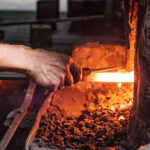
    Planes, each forged by its respective craftsman.

    Craftsman Profile

    Okura Seiji

    He started working with pottery wheels at the age of 16, right after graduating from junior high school. He is a skilled traditional craftsman who has honed his skills for 47 years.

    Anecdotes

    How to distinguish imported products

    Currently, imported products that closely resemble NAGISO Rokuro Zaiku (Wood Turnery) are widely available. Most of these seem to come from China, but how can one distinguish between genuine Nagiso products and these imitations? Here, we'll explain how to tell the difference.
    First, let's look at the raw materials and appearance. Since zelkova trees are not readily available in China, the raw material for Chinese-made lathe-turned pottery is mostly jujube wood. Some lathe-turned pottery from other regions also uses knotweed, but the finer details are superior. However, to the untrained eye, it's difficult to tell the difference, and most people can't tell the difference.
    Another way to distinguish them is by price. While it depends on the item, some Chinese-made pottery pieces, especially small items, can be purchased for around 500 yen. Items from the country of origin, however, will likely cost several times more for the same shape.
    What about the traditional craft mark? Currently, most products do not have it attached. This is because the lathe work itself breathes, and removing the sticker can cause discoloration.
    The most reliable way to purchase is undoubtedly from a local direct sales store. At a direct sales store, the staff will provide thorough explanations, and some even offer pottery wheel making experiences. How about taking a tour of "Kiso woodworkers" to see the work process while purchasing products?


overview

Craft item name NAGISO Rokuro Zaiku (Wood Turnery)
Reading Nagisorokurozaiku
Classification of crafts Woodwork/bamboo products
Main Products Wooden bowls, tea caddies, trays, soup bowls
Main manufacturing area Minami-Kiso Town, Kiso District; Achi Village, Shimoina District; Nakatsugawa City, Gifu Prefecture
Designated date March 3, 1980

contact address

■ Production area association

Minami Kiso Pottery Craft Cooperative
399-5302
4689-239 Azuma, Minami-Kiso-machi, Kiso-gun, Nagano Prefecture
TEL: 0264-58-2041
FAX: 0264-58-2665

Features

The beauty of NAGISO Rokuro Zaiku (Wood Turnery) lies in its ability to utilize the natural grain of the wood, conveying a simple, warm, and handcrafted feel in every detail of the wooden product. The products are determined based on the subtle variations in the wood grain and character of the carefully selected natural wood.

How to make it

The bark of the wood to be used is removed, dirt is removed with a brush, and the condition of the cut surface and the wood itself are examined. This allows us to determine the time of felling, the place where the wood grew, the growth process, and the wood's internal structure, texture, color, and whether there are any unusual patterns called "moku" (figure grain), and the extent of these patterns. By comparing these findings with the product to be made, we create an image of the planned product within the raw timber, making the most of the wood's texture, grain, and figure.

Please see here for information on traditional craftspeople.

Japanese traditional craftsman
top