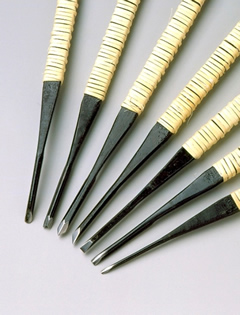
ECHIGO YOITA Uchihamono (Forged Blades)

Niigata Prefecture

During the Sengoku period, in the latter half of the 16th century, a retainer of Uesugi Kenshin invited swordsmiths from Kasugayama to produce forged bladed weapons, which marked the beginning of this craft.
By the mid-Edo period, carpentry tools from Yoita had become known as "Doi-no-mi" or "Hyobu-no-mi."
In the Meiji era, sword makers began manufacturing planes, and these planes became known throughout Japan. ECHIGO YOITA Uchihamono (Forged Blades) is a type of blade cultivated through more than 400 years of traditional techniques and methods.

  • Technology/techniques/raw materials

    Technology/techniques

    1. Blade steel is made by heating iron and carbon steel in a furnace and forge-welding them by hammering. In this case, for chisels, the carbon steel should encase the "small blade," and for planes that use "raw material," the process should be done by "double welding."

    2. The shaping process involves heating the blade steel in a furnace and then hammering and widening it.

    3. The entire axe shall be joined together by "fitting."

    4. The "warts" and "hitsu" of the adze should be joined by "body binding".

    5. For hardening chisels and planes, apply a "mud coating" and then rapidly cool them.

    6. "Sharpening," "sharpening," and "finishing" must be done by hand.
     

    raw materials

    1. The materials to be used shall be iron and carbon steel.

    2. The handle and the base of the plane shall be made of wood.

  • Work scene

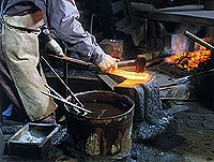
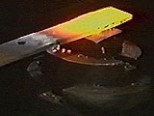
    Process 1: Metal heating and forging

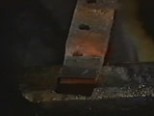
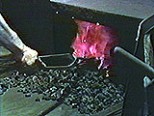
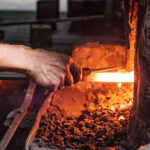
    The metal is placed in heated coke and heated. Nowadays, instead of bellows, a blower is used to blow air and burn the coke well. The heated metal exceeds 1200 degrees Celsius, so it is struck with a spring hammer before it cools down.

    Step 2: Forge welding

    The blade is formed by a combination of different properties: the hard but brittle steel that makes up the cutting edge, and the tough but soft base metal.
    A bonding agent (the residue left over from filing down the iron) is sprinkled onto the heated base metal, and then the soft iron and steel are placed on top.
    Temperature control during heating is judged by the color of the flame and the color of the heated iron. This is a process that cannot be mechanized and relies on the experience and intuition of the craftsman. Once the blade, heated to 1000-1100 degrees, is removed from the fire, it is quickly struck with a spring hammer. Occasionally, it is struck with a hammer dipped in water to remove the oxide film on the surface along with the water vapor.

    画像をクリックすると動画が再生されます

    Step 3: Seasoning and Forging

    The steel is heated to 950 degrees Celsius. Here, the roughened iron crystals from the high-temperature welding process are smoothed out. After that, it is heated and hammered at high temperatures of 880-900 degrees Celsius, medium temperatures of 840 degrees Celsius, and low temperatures of 750 degrees Celsius. The forging temperature is varied depending on the steel being used. This process makes the origin of the name "forging" clear.

    Step 4: Annealing

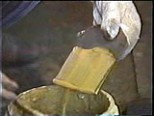
    After applying mud to the steel, it is placed in a furnace, filled with charcoal, and heated at 750 degrees Celsius for 3 hours, then allowed to cool naturally. The mud is applied to the steel to prevent the carbon components contained in the steel from escaping (decarburization prevention). This heat treatment removes internal stress in the steel, making it easier to process.

    Process 5: Rough finishing

    After washing the blade with a sulfuric acid solution, the blade tip is ground down with a grinder to reduce its thickness.

    Step 6: Leveling the ground

    By heat-treating iron at a temperature where it does not turn red at 400 degrees Celsius, the structure of the iron is further strengthened.

    Step 7: Applying the finishing touches

    A pattern is applied to the back of the blade. To create the pattern, a patterned hammer is struck onto it. Then, the center of the blade is slightly indented. This ensures that the blade protrudes evenly on both sides when mounted on the base. It also improves the fit between the blade and the base, reducing vibration during cutting.

    画像をクリックすると動画が再生されます

    Step 8: Hardening and tempering

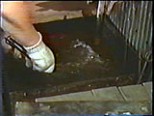
    The blade is coated with mud and heated in charcoal at 800-820 degrees Celsius for 7-8 minutes. The composition of the mud is a secret recipe for each craftsman. After heating, the blade is immersed in a tank filled with plenty of water. It is better to use water that has been used many times before, rather than fresh water, as this allows the blade to adapt to the conditions better.
    Each time heat treatment is performed, any resulting distortions are corrected by hammering.
    Then, hot air at 160 degrees Celsius is blown onto it for 40 minutes. If this time is too long, the blade will lose its sharpness, and if it's too short, the blade will become brittle. By removing the stress (internal stress) from the iron, the blade will become sharp, tough, and long-lasting.

    Step 9: Sharpening and cutting

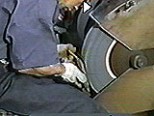
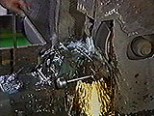
    When sharpening the blade with a grinder, keep the blade from overheating by applying plenty of water. Carefully grind the blade so that about 0.3 millimeters of the tip is exposed.
    Sharpen the front, back, and sides of the blade, changing whetstones as you go.

    Step 10: Placement on the stand

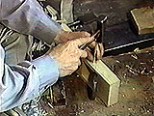
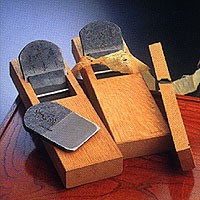
    A retaining nail is driven into the plane body, which has a cutout for inserting the blade, and a backing plate is inserted to secure the blade. The center of the body is slightly indented to reduce friction between the body and the wood when planing.
    This is how a tool for craftsmen that can produce shavings in the micron range is completed.


  • Close-up

    The sharpness achieved through hammering ECHIGO YOITA Uchihamono (Forged Blades)

    The sharpness achieved only after repeatedly hammering hot iron has been cherished by professional carpenters for generations. While forged blades are often associated with household knives and other everyday items, forged blades from Echigo Yoita, exemplified by planes, continue to hold the status of the finest tools made by craftsmen for craftsmen.


    A tradition that continued to be preserved even as the feudal lord changed.

    In Yoita, Echigo Province, blessed with the water transport of the Shinano River, bladed weapons were first brought to the region during the time of Uesugi Kenshin. It is said that it all began when Naoe Yamato-no-kami Sanetsuna, one of Kenshin's four retainers, brought a swordsmith to the area.
    The fact that the tradition of forged blades continued to be preserved even as the feudal lord changed hands is likely because the reputation of Yoita forged blades had spread throughout the country.

    Tools made by craftsmen for craftsmen

    In Yoita, the industry has traditionally focused on manufacturing carpentry tools such as planes, chisels, adzes, and axes. Carpenters are also craftsmen, and therefore, their tools must be of superior quality. Without the combination of toolmaking skills and woodworking skills, excellent Japanese wooden architecture could not exist. The exquisite and serene construction of wooden houses, shrines, and temples that the Japanese seek is the result of the combined skills of various craftsmen.

    Cutting tools for craftsmen, chosen by craftsmen for generations.

    Forging, heating and hammering, heating and hammering

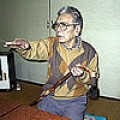
    "The defining characteristic of Yoita forged blades is their exceptional sharpness, achieved through hand-hammering," says traditional craftsman Seiji Kusumi. Mr. Kusumi is also the chairman of the Yoita Hardware Promotion Cooperative Association.
    "The secret to achieving sharpness lies in the process from forge welding (attaching steel to the base metal) to forging, annealing, and repeatedly heating and hammering." This is the first time you truly understand the meaning of "tanren," the origin of the word for training the body. They repeat it over and over again.
    A soft but resilient base metal is forge-welded with hard but brittle steel, then heated and hammered to form a single unit. The contrasting properties complement each other, resulting in a sharp cutting edge.
    "Our family has only ever made professional-grade planes, since the time of my predecessor," says plane blade craftsman Shogo Tanaka. "I'm proud that we make tools that are chosen by craftsmen," he says confidently.

    The blades are being forged with a pleasant rhythm.

    "Plane making is a division of labor: forging the blade, sharpening, and making the plane body."

    A plane blade, once heated and hammered, is nothing more than a lump of iron. The blade, tempered under strict temperature control, is then transformed into a cutting tool by the next craftsman, the sharpener. Only when it is assembled onto a plane body crafted by a plane body maker does it become a plane. The culmination of the plane-making skills lies in its next co-star, the carpenter, before it truly becomes a tool.

    We can't offer lower prices even with direct sales. We have long-standing relationships with wholesalers.

    Mr. Kusumi is a popular carving knife craftsman. At a sales exhibition held in Niigata City, he sold 200 sets in just five days. Many people come from all over the country to buy his tools directly. However, he says, "I can't sell them cheaper than the wholesalers," emphasizing the importance of his relationships with wholesalers. "The reputation of Yoita's forged blades has come about because wholesalers supply them to carpenters. And when the wholesalers couldn't sell, they would take the inventory themselves and buy it back from the craftsmen." It seems that the reliable skills of the craftsmen and the long-standing relationships with the wholesalers who have supplied them are not something that can be easily lost. Despite saying that, he also says, "Recently, there are wholesalers who try to force their inventory onto the craftsmen," suggesting that the practices of large Japanese manufacturers are spreading to the world of traditional crafts.

    "As long as wooden buildings exist, this will never disappear. We must not let it disappear."

    "Recently, the number of craftsmen making knives has increased." The knives commonly seen in other production areas are rarely seen here in Yoita. Perhaps the pride of craftsmen who have been chosen for their tools has led them to avoid making knives that are easily sold to the general public. "Yoita knives have a good reputation. They're said to be very sharp. Well, of course they are."
    For some reason, Japanese people seem to find peace of mind living in wooden houses. There's something about concrete houses that just doesn't sit right. If we lose the culture of wooden houses, we, who are already so busy, might lose our only place to relax. The comfort of living in a wooden house will surely recapture people's hearts in the near future. And at that time, the skills of the craftsmen of Yoita will come into their own once again.
    "A craftsman's work is just right when their desires have dried up. As long as they are stubborn, they still have a long way to go." These words from Mr. Kusumi, who has lived as a craftsman for over half a century, carry all the more weight. Living in a house made by craftsmen who speak such words so naturally would surely make you feel healthy in both mind and body—that's the kind of feeling you get from Yoita cutlery.

    Craftsman Profile

    Seiji Kusumi


    Anecdotes

    Traditional techniques for managing invisible crystals

    The defining characteristic of the process of making forged blades is the repeated cycle of "heating and hammering." The metal is heated to over 1,000 degrees Celsius, then cooled with a blast of air at 160 degrees, then heated again at 400 degrees and hammered once more. The temperature is controlled by the craftsman's eye and intuition, a skill that can only be achieved through years of experience.
    Now, about these temperatures. I wondered why they were heated at so many different temperatures, and it seems that the temperature differences are greatly related to the iron's crystal structure. Heating at high temperatures disrupts the crystal structure, which is then corrected at medium and low temperatures. The toughness and feel of the blade depend on how this invisible crystal structure is controlled. That's what hardening and annealing are all about.
    In recent years, it has become possible to view crystals under a microscope, and the incredible skills of craftsmen are being re-evaluated and appreciated when viewed through a microscopic lens.

    Yoita planes are unmatched in their sharpness.


overview

Craft item name ECHIGO YOITA Uchihamono (Forged Blades)
Reading Echigo Yoita Uchiha Mono
Classification of crafts Metalwork
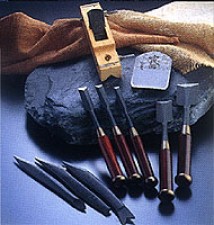
Main Products Chisels, planes, axes, adzes, carving tools, cutting tools, spear planes
Main manufacturing area Nagaoka City
Designated date March 12, 1986

contact address

■ Production area association

ECHIGO YOITA Uchihamono (Forged Blades) Association
940-2402
134-2 Yoita-ko, Yoita-machi, Nagaoka City, Niigata Prefecture
Yoita Town Chamber of Commerce
TEL: 0258-72-2303
FAX: 0258-72-3328

https://yoita-uchihamono.com/

Features

Yoita's forged blades are made using traditional fire-forging techniques and are renowned for their sharpness and ease of use.

How to make it

The steel and base metal are stretched to the specified dimensions, the steel is placed on top of the base metal, and after being carefully heated until red-hot, it is hammered to create a shape. Then, to improve the structure of the steel, it is annealed by being heated to soften it. Next, the surface is polished to make it beautiful, followed by hardening and tempering, which are considered the lifeblood of a blade. Finally, it is sharpened and fitted into the base or handle to become a finished product.

top