TAKAOKA Doki (Bronze Casting)

Toyama Prefecture

TAKAOKA Doki (Bronze Casting) originated in the early Edo period when the Maeda clan of Kaga Province invited seven metal casters with the skills of Kawachi Tannan, the birthplace of metal casting, to establish a foundry.
Its development stemmed from the creation of "karakane imono," a type of metalwork where intricate metal engraving is applied to cast metal items such as flower vases and Buddhist altar fittings. During the Meiji era, it became known worldwide after being exhibited at the Paris World's Fair, and eventually accounted for 90% of the national production.

  • Technology/techniques/raw materials

    Technology/techniques

    1. Mold making shall be carried out using the following techniques or methods:
    (1) It must be made from sand.
    (2) For the part of the casting sand that comes into contact with the molten metal, "paper clay" or "true clay" shall be used in double molds, sieve molds or wax molds, and "skin sand" shall be used in green sand molds.
    (3) The mold shall be made by "turning" or "filling" (including "wax casting").
    (4) In the case of double molds, cast molds, or wax molds, firing or drying the mold (including "surface firing").
    (5) In the case of raw material molding, the original shape should be removed using a "water brush".

    2. When engraving is done on the surface of a casting, it must be done by hand.

    3. The surface of the cast iron shall be colored by the "boiling method" or the "burning method," or by using lacquer or iron oxide.

     

    raw materials

    1. The material used for the casting shall be a copper alloy.

    2. The lacquer used as a coloring agent shall be natural lacquer.

  • Work scene

    Although it varies depending on the forging method and base metal material, the product is generally manufactured in the following order. Here, we will introduce the traditional method of mold forging.

    Process 1: Prototype production

    A prototype (made of plaster, wood, clay, etc.) is created based on the design drawings (design sketches) of the cast product to be made, and then a mold is created using that prototype.

    Step 2: Applying the clay

    After applying a release agent, the mold is shaped using paper clay and coarse clay, and then reinforced with rebar inside. Finally, it is allowed to dry.

    Step 3: Mold matching

    The mold is completed by setting the divided outer mold and core mold together. The gap between the outer mold and core mold determines the thickness of the product.

    Step 4: Completion of the outer mold

    The original model is removed from the mold, and the outer mold is completed.

    Process 5: Refining and Melting Process

    The refined metals used are mixed and melted to create a high-temperature molten metal.

    Process 6: Casting (molten alloy injection)

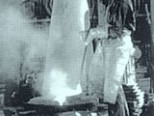
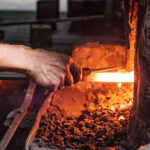
    The copper alloy, melted to around 1150°C to 1250°C, is poured into the mold.

    Step 7: Demolition and finishing process

    In the melting process, the molten metal is poured into a mold, solidified, and cooled before the mold is disassembled and the product is removed. Then, the finishing process begins.

    Process 8: Polishing, engraving, inlay, etc.

    We polish them, engrave them, and apply inlays.

    Step 9: Demolition and finishing process

    We use various chemicals and natural coloring materials to apply colors that take advantage of the properties of bronze, such as verdigris.
  • Close-up

    The beauty of TAKAOKA Doki (Bronze Casting), a blend of gold, silver, and copper alloys.

    TAKAOKA Doki (Bronze Casting) production area is highly specialized, with various fields such as prototyping, casting, finishing, polishing, coloring, engraving, and inlay working together to create the products. This time, we spoke with an inlay craftsman who skillfully brings out the beauty of the alloy.


    Helping my parents with their work

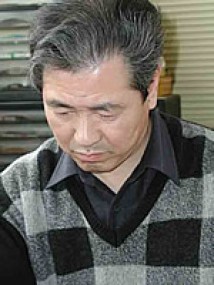
    Sogo Torita was born in 1940. Due to his father's work in TAKAOKA Doki (Bronze Casting) inlay (a technique of carving grooves into a base metal and then inlaying other metals to fit the shape), he helped out at copperware workshops from a young age. He began his apprenticeship with his father immediately after graduating from junior high school. Seeing his father use alloys in the inlay process, he became fascinated by the allure of alloys, and for the past 45 years, he has been involved in the production of TAKAOKA Doki (Bronze Casting). "Inlay is time-consuming, so nobody does it. But I do it," Torita says, and there's a reason for this. "Takaoka has the technology to create incredibly intricate work, and I think that kind of work is a characteristic of TAKAOKA Doki (Bronze Casting)." One can sense his pride in TAKAOKA Doki (Bronze Casting) and his sense of mission in carrying on the traditional techniques.
    Shogo Torita. Born in 1940. He has a history of receiving a special prize at the first Japan Traditional Craftsmen's Association Exhibition. His favorite sake is "Tateyama".

    Expressing colors solely through differences in metal tones

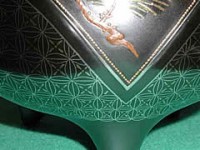
    Torita's specialty is inlay work, where grooves are carved into a copper base, and metals such as gold and silver are placed into them. "Unlike plating, once it's inlaid, it never comes out," Torita emphasizes. At first glance, it looks like thin lines of gold or silver are simply drawn on the surface, but when you realize that metal has been embedded through inlay, it's truly astonishing. Even more surprising is that all the drawings are beautifully colored, but those colors are expressed solely by the colors of the metals themselves. "Mixing silver with gold creates blue gold, gold with copper creates red gold, copper with gold creates red copper, and copper with silver creates quarter-silver, and so on; the color changes depending on the type of alloy. "There isn't much difference in color when you're making it. At the end, when you put it in chemicals and oxidize it, the color suddenly comes out. That's the most enjoyable part," Torita said with a smile.
    Surprisingly, all of these colors are the colors of metals.
    The idea came from observing nature.

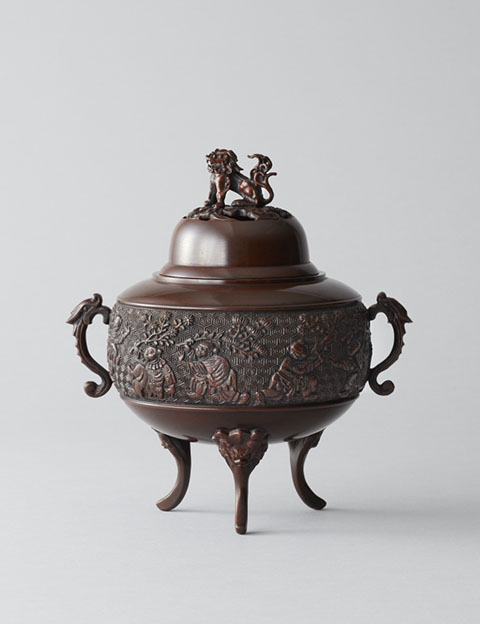
    Ms. Torita paints designs on decorative plates, vases, and incense burners, and then renders them using inlay. Her work begins with conceiving the designs. "Recently, I've painted several pieces with the saury fish as the subject. I came up with this design because I found it amusing to see them swarming around bait when I went fishing," she said, showing me her work. The painting vividly depicts a school of saury circling around. Looking at Ms. Torita's work, the stereotype that "metal = cold" is shattered. "Once the painting is done, it's almost finished. All that's left is to meticulously inlay the design," says Ms. Torita. The inlay work for TAKAOKA Doki (Bronze Casting) requires a high level of skill in painting as well.
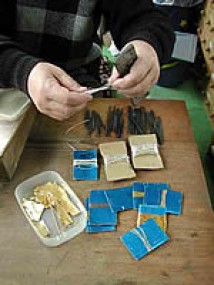
    Gold and silver threads and plates used as materials for inlay work
    You'll understand when you see the real thing.

    "Well, it takes about three to four months to make one." That's why each piece is expensive. However, he is confident in his work, saying, "If you see the actual piece, you'll understand its quality. It's not too expensive at all." Takaoka accounts for 90% of the national share of copperware production, and its technology is unmatched. The confidence he has gained from honing his skills in Takaoka is reassuring because it is backed by a proven track record. In particular, his alloy technology and the oxidation technology that brings out its color are said to be something that other production areas cannot imitate.
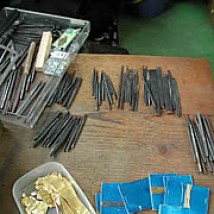
    These are chisels used for inlay work. I have about 500 of them, all handmade.
    Give yourself some peace of mind

    "The kind of things I make require a little peace of mind to even attempt. But I want anyone who's interested to come and see them anytime. There's a lot you can't understand without seeing it." Torita's current favorite color is "hikin" (crimson gold). Perhaps it can be described as a silvery color close to gold with a pale reddish tint. It has a mysteriously soft color. This is truly something that you "can't understand without seeing it." You should definitely make time in your mind and see this color with your own eyes.

    Anecdotes

    The secret of inlay work

    The inlay technique, which involves carving grooves into a copper base and embedding gold or silver metals into them, is extremely sophisticated. If you were to take a cross-section of an inlaid section, you would see that the bottom of the groove is wider and the opening is narrower, with the gold or silver embedded in that groove. It's easy to see why craftsmen say, "It will never come out." Furthermore, sometimes more metal is inlaid on top of the already embedded metal, a technique called "armor inlay." After the metal inlay is complete, the piece is immersed in chemicals to create an oxide film and add color, and grated radish plays a crucial role in this process. Apparently, washing the entire surface with grated radish before immersing it in chemicals brings out the metal's color beautifully. Who on earth discovered this? You can imagine the trial and error that went into it by our predecessors.

    • Every thin line and every dot is embedded.

overview

Craft item name TAKAOKA Doki (Bronze Casting)
Reading Takaoka Doki
Classification of crafts Metalwork
Main Products Vases, incense burners, bookends, paperweights, panels, clocks, wall reliefs, lighting fixtures
Main manufacturing area Takaoka City
Designated date February 17, 1975

contact address

■ Production area association

TAKAOKA Doki (Bronze Casting) Traditional Crafts Promotion Cooperative
〒933-0029
101 Otobiyamachi, Takaoka City, Toyama Prefecture
Otaya Serio 2nd Floor
TEL: 0766-24-8565
FAX: 0766-24-8566

https://douki-takaoka.jp/

Features

There are 13 different manufacturing methods depending on the type of product and the intended expression. Products cast and processed using these various methods range from tabletop ornaments to vases, incense burners, panels, bronze statues, and even large Buddha statues.

How to make it

The manufacturing process is divided into casting and processing. Casting is a method of shaping that utilizes the fact that metal melts and becomes liquid. Molten metal is poured into a mold at high temperature, cooled, removed from the mold, and then finished with processing such as engraving and coloring. In addition to the traditional craftsmanship methods such as burnt molds, double molds, and lost-wax casting, there are various other casting methods.

Please see here for information on traditional craftspeople.

Japanese traditional craftsman
top