HIGO Zogan (Inlay)

Kumamoto Prefecture

It is said that the origin of this craft lies with Hayashi Matashichi, who served Lord Hosokawa Tadatoshi, who entered Higo Province as its ruler in 1632, and who inlaid firearms and sword guards.
During the Edo period, in addition to the Hayashi family, many masterpieces of Higo tsuba (sword guards) remain from the Hirata, Nishigaki, Shimizu, and Kanki families, among others. After the Sword Abolition Edict of 1876, the focus shifted to personal accessories and ornaments, with products being made to adapt to changes in daily life.

  • Technology/techniques/raw materials

    Technology/techniques

    1. The dough is shaped by hand by "cutting," "shaving," "hammering," "polishing," "piercing," or "soldering."

    2. The fabric shall be cut by hand in three or four directions (vertical, horizontal, and diagonal), as well as carved, fitted, or carved in relief.

    3. The metal plates and wires, which have been cut using a die, scissors, or chisel, shall be hammered in using a hammer and deer antler.

    4. To remove the texture of the fabric, use a metal spatula, texture-removing stick, scraper, and file to "crush" or "shave" the cuts on the surface of the fabric.

    5. Hair engraving shall be performed by "cutting" or "carving" using a cutting tool or hair engraving chisel.

    6. For surface polishing, use magnolia charcoal and magnolia board or paulownia board to "sharpen" or "level" the surface, and then use polishing powder or polishing rod to "polish".

    7. Rust removal is carried out by applying a unique "rust-removing liquid," which has been passed down as a tradition, to the surface.

    8. Rust prevention involves boiling tea leaves, applying vegetable oil or lacquer, and then firing.
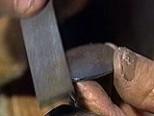
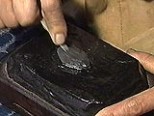
     

    raw materials

    1. The metal used for the fabric shall be iron, copper, brass, or red copper.

    2. The metal used for hammering shall be gold, silver, copper, blue gold, or ochre silver.

  • Work scene

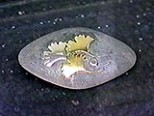
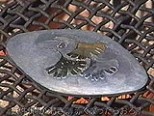
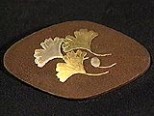
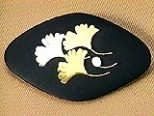
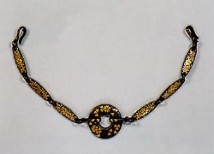
    HIGO Zogan (Inlay) is made by carving grooves into an iron base and then inlaying gold and silver plates or threads into them. There are several ways to create the grooves, but the basic technique for HIGO Zogan (Inlay) is called "nunomegiri" (cloth-pattern cutting). Here, we will show you how to make an inlaid brooch using the nunomegiri technique.

    Step 1: Making the dough

    We shape the iron plate by filing it down.

    Step 2: Polishing the fabric

    Use a file to thoroughly polish the surface of the iron. Start with a coarse file and gradually switch to finer grits, polishing the surface until there is no rust or dirt.

    Step 3: Preparing the dough

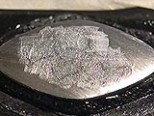
    The inlaid piece is placed on a workbench called a "resin stand" and secured in place. The resin stand is made by the inlaid artist themselves by applying a thick layer of a mixture of pine resin and polishing powder to a board. Since resin softens easily when heated and hardens at room temperature, the resin is heated with a burner to make the inlaid piece adhere tightly to the resin stand. Once it returns to room temperature, the inlaid piece is firmly fixed to the resin stand. The surface of the inlaid piece attached to the resin stand is then polished with a file or sandpaper to make it even smoother.

    Step 4: Sketching

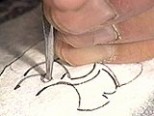
    1. Place thin paper over the fabric and trace its shape. Remove the paper from the stand and place the design within the fabric shape, drawing the outline with a brush. 2. Secure the completed outline to the resin stand and lightly trace the outline with a chisel over the paper, leaving a faint mark on the surface of the fabric. 3. Remove the thin paper and trace the chisel marks to draw the outline onto the fabric with a brush. Sometimes, the outline is drawn directly onto the fabric with a brush without using thin paper.

    Step 5: Cutting along the fabric grain

     
      画像をクリックすると動画が再生されます
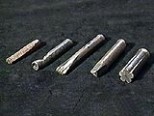
    Grooves are carved into the surface of the fabric using a chisel. Cuts are made in four directions: vertically, diagonally to the right, diagonally to the left, and horizontally. The narrower the spacing between the cuts, the better; 5 to 10 grooves should be carved within 1 millimeter. 1. Carve the vertical grain of the fabric. 2. Once all the vertical grains have been carved, rotate the resin stand and carve diagonally to the right. Adjust the angle of the cuts by rotating the resin stand, ensuring that your posture and the angle at which you swing the chisel remain constant. Similarly, carve diagonally to the left and horizontally. Adjust the pressure so that the depth of the grooves is deepest vertically, followed by diagonally to the right, diagonally to the left, and then horizontally.

    Step 6: Cutting out the shape

     
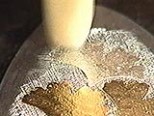
    Gold, silver, and blue gold (an alloy of gold and silver) are used for inlay work. The inlaid craftsman uses a roller to stretch the metal to be inlaid to a uniform thickness. This thickness is 0.08 mm, four times thicker than the metal sheets used in Kyoto inlay work. For this reason, HIGO Zogan (Inlay) is also called "high inlay." The metal sheet to be inlaid is punched out with a die to create the parts of the pattern. The die used at this time is made by the inlaid craftsman himself to match the shape of the pattern. The punched gold and silver pieces are placed on a plate and heated over a fire. This is called "annealing." Annealing improves the flexibility of the gold and silver pieces, allowing them to adhere firmly to the fabric weave and making them less likely to peel off the material.

    Step 7: Insertion

     
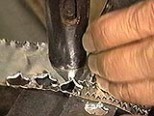
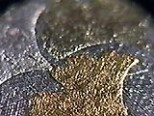
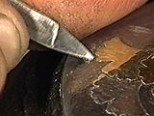
    The annealed gold and silver pieces or gold and silver wires are placed on the base metal and carefully hammered with a deer antler so that they bite into the grooves in the metal. Once the cloth pattern engraved on the metal becomes visible through the surface of the gold and silver pieces, the process moves on to the next step.

    Step 8: Tightening

    The visible weave of the gold and silver pieces embedded in the base metal is hammered away using a special hammer. This process smooths the surface of the gold and silver pieces and ensures that they interlock securely with the weave of the base metal.

    工程9: 磨き

    The surface is rubbed and polished with a stick. After polishing, it is hammered again with a deer antler to tighten it.

    Step 10: Removing the texture of the fabric

     
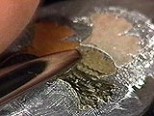
    1. Using the tip of the texture-removing tool, press and flatten the texture of the base metal along the edges of the inlaid gold and silver pieces. Once the texture on the edges is removed, lay the texture-removing tool flat and press and flatten the texture on the wider areas as well. 2. After flattening the texture, use a tool called a scraper to smooth the surface.

    工程11: 磨き

    Using several different polishing sticks, the surface of the fabric is polished to restore it to its smooth state before the weave was cut. After polishing with the polishing sticks, it is further polished with charcoal to a meticulous finish.

    Step 12: Engraving

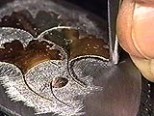
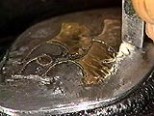
    The inlaid gold and silver pieces are then carved with a fine-tipped chisel to refine the pattern. After the carving is complete, polishing compound is applied to the leather and the surface is polished.

    Step 13: Preparation for rusting

     
    After polishing, the metal is removed from the resin stand and heated in a pot of water with caustic soda to remove any attached resin, grease, or other dirt. Once the dirt is removed, it is rinsed with water. Next, the surface of the metal is roughened by soaking it in nitric acid diluted with water. When the surface becomes slightly cloudy, it is removed from the solution, neutralized with ammonia, and finally rinsed with water. This process allows rust to adhere nicely to the surface of the metal.

    Step 14: Rust removal

     
    The base metal is rusted to create color and texture. This process is called "rusting." A liquid called rust solution is used for "rusting." Rusting solution is made by adding various components to nitric acid or hydrochloric acid, and its contents vary depending on the inlaid craftsman, so it is also called a secret recipe. a: Apply the rust solution evenly to both sides and place it on a preheated stove. b: When the base metal dries and turns slightly red, remove it from the stove. After a while, once the base metal has cooled, repeat the application and drying process once more. c: After the second drying is complete, remove the base metal from the stove and place it in a wooden box called a "muro" and let it rest for 2 hours. Take out the rested piece and repeat steps a to c three more times. The way rust forms varies depending on the temperature and humidity, so in seasons when rust is less likely to form, such as winter, repeat steps a to c five times. Finally, leave it overnight without placing it in the muro.

    Step 15: Rust prevention

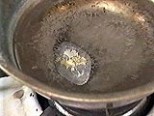
    1. Put water in a pot and heat it. Once it has warmed up, add the tea leaves. The tannins in the tea leaves neutralize the oxidation of the iron, stopping the rust from progressing and turning the rust black. After adding the tea leaves, place the dough on a sieve and submerge it in the pot and boil for 30 minutes. If it boils during this time, add more water and continue boiling. After 30 minutes, remove it and cool it while rinsing it with water. 2. Wipe off the moisture from the cooled dough and place it on a preheated stove. When white smoke rises from the dough and it is done, remove it from the stove.

    Step 16: Baking

    After removing the fabric from the stove, brush it with camellia oil mixed with soot, wipe it with a cotton cloth, and then place it back on the preheated stove. This baking process creates a protective film on the surface. After repeating the same process twice, wipe it with clear camellia oil (without soot) to complete the inlay.

    工程17: 組み立て

    We attach metal fittings and other components to the finished product to complete it into its final form.

    工程18: 完成

     
  • Close-up

    Expressing the aesthetics of the samurai class with a modern sensibility: HIGO Zogan (Inlay).

    HIGO Zogan (Inlay) is a craft in which gold and silver are embedded into grooves carved into the base metal to create patterns. Its origins can be traced back to the decoration of sword guards during the Hosokawa clan era. Because it is an ornamental art, far removed from practical use, HIGO Zogan (Inlay) embodies the aesthetics of samurai culture. Even as times change and the objects of inlay shift from swords to jewelry and other items, the underlying aesthetic sense remains unchanged. And the skills and spirit that create them have been passed down continuously to this day. We spoke with inlay craftsman Mitsutora Shiraki, who was born into a family of inlay craftsmen and grew up listening to the sound of chisels.


    Custom-made crafts

    The Shiraki family is a lineage of inlay artisans that has continued for 100 years. The art of inlay has been passed down through generations, from the third-generation Mitsutora to his son, Yoshiaki, who will become the fourth generation. However, the Shiraki family has not passed down anything that could be called a design. HIGO Zogan (Inlay) was originally a craft made to order, what we would now call a bespoke item. Until before the war, inlay artisans would work together with their clients to develop designs and use their skills to create works that fully expressed the client's tastes and individuality. Mr. Shiraki speculates that this is why no records remain. Bespoke HIGO Zogan (Inlay) symbols. HIGO Zogan (Inlay) is an extremely laborious job. For example, it takes about two months to complete a single paperweight. Such labor is reflected in the price. The custom-made HIGO Zogan (Inlay) reflected not only the patron's sensibilities but also their financial resources.
    Cherry blossom arabesque pattern haori cord - Men's, made by Shiraki Jushichi
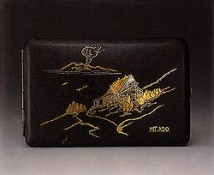
    I want people to experience the joy of creating something they like.

    "People in the past trusted their own eyes and valued their own preferences and individuality. But nowadays, people think, 'It must be good because a celebrity has it,' and they no longer try to discern things for themselves." Rather than blindly chasing after brand names, Shiraki wanted people to know the value of custom-made items, so he implemented a project. He set up an "Original HIGO Zogan (Inlay) Creation Corner" at the exhibition he held with his son, Yoshiaki. Shiraki thought that by creating a place where visitors could create their own inlay designs with their own hands, people would feel the joy of seeing their own designs take shape. Furthermore, he also hoped that by actually experiencing the process, people would gain a deeper understanding of HIGO Zogan (Inlay) techniques.
    Hotel illustration cigarette case, made by Shigeharu Shiraki
    Sensitivity and Technology

    In the past, simply acquiring technical skills was enough. However, in modern times, no matter how excellent the technique, if the design is poor, it's useless. Shiraki argues that it's crucial to think and acquire technical skills in parallel. In HIGO Zogan (Inlay), the iron base to be inlaid, except for jewelry, is created by the inlaid artist themselves by carving it from a piece of iron using a hacksaw and file. They also make the various shapes and sizes of chisels used in the work by hand using files. HIGO Zogan (Inlay) is a job where one person does everything from start to finish. That's why the artist's sensibility, skill, and design ability are so clearly reflected. Shiraki asserts that "the better the sensibility, the better the work," and in order to hone his own sensibility, he spends his days looking at various works, not just inlay. His interests are wide-ranging, including painting, calligraphy, dyeing, and weaving. He says that with good works, you start to feel "somehow good" after looking at them for a while. "I think that being able to intuitively understand what's good about something means that you've already built up a foundation of sensitivity," Shiraki emphasizes. He stresses that the first step in refining one's sensibilities is to be interested in a variety of things and to see good things.

    Nurtured by the climate and culture of Kumamoto

    The jet-black color of the base metal in HIGO Zogan (Inlay) is created by the rusting of the metal. This rust-based processing is a finishing technique in HIGO Zogan (Inlay), and its texture has a significant impact on the finished work. In families of inlay artisans, the method of making the rust-inducing solution has been carefully passed down for generations. Appropriate humidity and temperature are essential for rust to occur. Rust will not occur in dry areas, nor at low temperatures. HIGO Zogan (Inlay) brings out its maximum beauty by being made in the hot and humid climate of Kumamoto. "It's not that it can't be done in other places, but we've come this far with know-how based on the land of Kumamoto. It's inseparable from the land. I think that's what crafts are all about." The techniques of HIGO Zogan (Inlay) reflect the local climate, and its forms reflect an aesthetic sense backed by history. Shiraki believes that preserving HIGO Zogan (Inlay) is connected to the transmission of Kumamoto's culture.
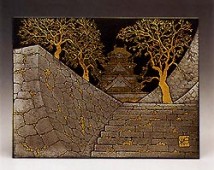
    Inlaid plaque "Kumamoto Castle" by Mitsutora Shiraki

    Craftsman Profile

    Mitsutora Shiraki

    Born in 1938. Inherited the third generation of the Shiraki family in 1967. In 1974, his work was selected for the first time at the Japan Traditional Crafts Exhibition Western Japan Crafts Exhibition. Since then, he has received numerous awards at the same exhibition, including the Bronze Prize in 1975, the Gold Prize in 1976, and the Regular Member Award in 1990. He actively holds solo exhibitions in various prefectures of Kyushu, as well as in Tokyo and Osaka. He is a regular member of the Japan Crafts Association and a secretary of the Western Japan Branch of the Japan Crafts Association. He is also a member of the Kumamoto Prefectural Art Association.

    Anecdotes

    HIGO Zogan (Inlay) Course

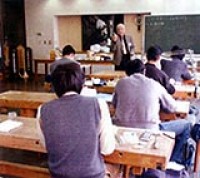
    The Kumamoto Prefectural Traditional Crafts Center has been offering the "HIGO Zogan (Inlay) Course" since 2000. In this course, leading inlay artisans teach their techniques to students who have applied through an open call. The course is held twice a month, from 10 a.m. to 4 p.m. The content is so dense that students must review and prepare at home to keep up, making it quite different from a trial class or hobby course. Behind this demanding course is a sense of urgency that "reviving a technique once lost is no easy task." The center wants even amateurs to inherit the proper techniques of HIGO Zogan (Inlay). In response to this passionate desire, the students are producing impressive works. Their works are displayed at local craft exhibitions and play a role in promoting "HIGO Zogan (Inlay)."

overview

Craft item name HIGO Zogan (Inlay)
Reading Higozogan
Classification of crafts Metalwork
Main Products
Main manufacturing area Kumamoto City
Designated date March 17, 2003

contact address

■ Production area association

HIGO Zogan (Inlay) Cresting Promotion Association
861-5344
1844-241 Take, Kawachi-machi, Nishi-ku, Kumamoto City, Kumamoto Prefecture
TEL: 090-7380-3862
FAX: 096-200-3654

Features

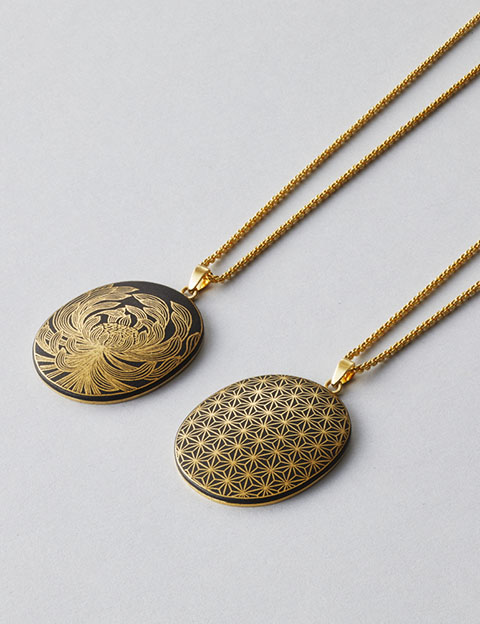
HIGO Zogan (Inlay) is characterized by its "substantial" and "refined" aesthetic. It involves techniques such as cloth-pattern inlay, where incisions are made in a base material like iron with a chisel and then gold and silver are hammered in to finish the piece, as well as carved inlay, set inlay, and cut-and-fill techniques. The products are crafted with dignity, with gold and silver standing out beautifully against a black background.

How to make it

Various patterns are drawn on a base material such as iron, and fine, cloth-like cuts are made. Gold and silver plates are hammered in with a deer antler, and intricate hair-like engraving is applied to the gold and silver. A secret rust-inducing liquid is applied to the surface to create a uniform rust, and then it is blackened by simmering in tea to prevent further rusting.

Please see here for information on traditional craftspeople.

Japanese traditional craftsman
top