NIIGATA SHIRONE Butsudan (Household Buddhist Altars)

In the mid-Edo period, a specialist in building temples, known as a garanshi, adopted techniques and methods from Kyoto to create Kyoto-style Buddhist altars. He then further refined them by adding simple carvings himself, resulting in the creation of the "shiraki-butsudan" (plain wood Buddhist altar).
In the latter half of the 18th century, unique techniques and methods specific to this region were developed, and a production system was established based on the division of labor among different departments.

  • Technology/techniques/raw materials

    Technology/techniques

    1. The structure of the "wooden base" is assembled using "mortise and tenon joints".

    2. The lintels shall be of the following types: "straight-line lintels," "bow-shaped lintels," and "bracken-shaped lintels."

    3. Palace construction shall be carried out using either the "masu-gumi" or "hijiki-masu-gumi" method.

    4. The painting shall be done by hand using refined lacquer.

    5. Apply maki-e (lacquerware with gold or silver powder) and gold leaf.
     

    raw materials

    1. The wood used shall be Japanese white pine, cypress, zelkova, magnolia, or cherry, or timber of equivalent quality.

    2. The metal fittings shall be made of copper, a copper alloy, or a metal of equivalent material.

    3 漆は、天然漆とすること。

  • Work scene

    The manufacturing process is broadly divided into six stages, from wood preparation to final assembly. Of course, each of these stages is further complicated by a series of more complex steps.

    Step 1: Wood base

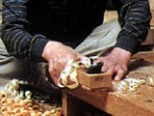
    The wood used for the base is Japanese white pine, magnolia, zelkova, cypress, Japanese cedar, and cherry. First, the logs are sawn, preserving the grain of the wood. After drying, the wood is measured and cut using a long measuring stick called a "kane-bakari." The woodworker measures the dimensions based on the various numbers and letters marked on this "kane-bakari." The wood cut to these dimensions is then processed with planes and chisels, and finally finished with mortise and tenon joints. Simultaneously, the construction of the palace (kuden) takes place.

    工程2: 彫刻

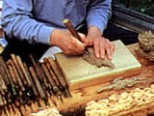
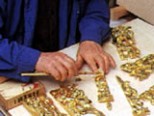
    In carving, various techniques are used to create a sense of three-dimensionality, such as "round carving," where a thick plate is carved through from both sides; "layered carving," where thin plates are carved one by one and stacked; and "flat carving," where thin plates are carved to appear as if they were made of thick material. In this way, figures, flowers, birds, and other subjects are all carved by hand.

    Step 3: Hardware

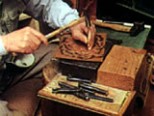
    The process involves hammering copper and brass plates, followed by coloring.

    Process 4: Painting

    The Buddhist altar, which is assembled using mortise and tenon joints during the woodworking process, is disassembled and lacquered. It is then dried in a humid environment, the surface is sanded, and another layer of lacquer is applied. This series of processes is repeated for at least three months. There are various types of lacquering, including "wood grain lacquering" which vividly brings out the wood grain, "roiro lacquering" which has a subdued sheen, "nashiji lacquering" which is finished by sprinkling gold, silver, or tin pear-skin powder, "aogai lacquering" which is inlaid with pieces of abalone shell, and "sunako lacquering" which is finished with a rough surface by sprinkling sand. The deep luster inherent in lacquer is utilized, and the use of various lacquering techniques creates a sense of luxury and elegance.

    工程5: 蒔絵

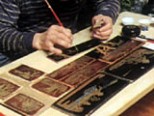
    Flowers, birds, and figures are depicted. Techniques include "hiramakie" (flat lacquerware) and "urushimori makie" (raised lacquerware). In particular, "urushimori makie," which involves applying lacquer multiple times to create a raised design, is an effective technique not only for creating a three-dimensional effect but also for creating a more majestic atmosphere.

    Step 6: Gold leaf application

    Pure gold leaf is applied to the finished lacquered pieces. Each piece is carefully worked on. There are three types of gold leaf application: "glossy application," "matte application," and "gold powder sprinkling," and the appropriate use of each creates a balance of elegance and refined luxury.


  • Close-up

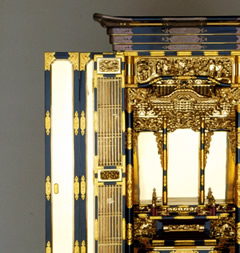
    NIIGATA SHIRONE Butsudan (Household Buddhist Altars) exude a majestic style nurtured by deep faith.

    Crafted with unique techniques, these palaces feature timeless gold lacquerwork and genuine lacquer. Nurtured by 300 years of tradition and constantly refined, NIIGATA SHIRONE Butsudan (Household Buddhist Altars) possess a majestic and elegant dignity.


    NIIGATA SHIRONE Butsudan (Household Buddhist Altars) were born from deep faith.

    Echigo is the land where Shinran, the founder of Jodo Shinshu Buddhism, and Nichiren, the founder of Nichiren Buddhism, were exiled, and due to their missionary activities, there were many believers, and Buddhist faith has flourished there since ancient times. In the Genroku era of the mid-Edo period, NIIGATA SHIRONE Butsudan (Household Buddhist Altars) were created by making improvements to the Kyoto-style altars. Furthermore, the fact that Shirone's hot and humid climate was suitable for drying lacquer, and that all the conditions necessary for making Buddhist altars were in place, is also cited as a reason why Shirone became a major production center for Buddhist altars. Subsequently, Shirone's unique techniques were developed, and the production area was completely established by dividing the work into five stages: woodworking, carving, metalwork, maki-e (gold lacquer), and painting. This time, we visited Mitsuo Furukawa, a craftsman who specializes in woodworking, the first stage of making Buddhist altars.
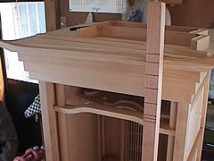
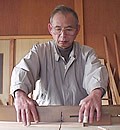
    Mr. Furukawa is a traditional craftsman who has honed his woodworking skills for 50 years. "The characteristics of NIIGATA SHIRONE Butsudan (Household Buddhist Altars) are the curved roof and the three-tiered roof of the palace (kuden) inside the altar. The raw materials mainly used are Japanese cypress and Russian cypress." The curved roof stands out as a particularly gorgeous accent within the overall dignified and majestic feel of the altar. In addition, a unique technique called "hiramasugata" is used for the palace, and even the smallest parts of the masu-gumi (square-frame) are all constructed using mortise and tenon joints.

    Drying the materials is fundamental to woodworking.

    The woodworking process begins with cutting the logs at the sawmill. Cutting the wood used for Buddhist altars requires dozens of precise size specifications. The cut wood cannot be used directly for carving or other purposes. It must undergo at least six months of outdoor drying. "We stack it outdoors, but we keep it out of the rain. This is how we create durable wood." Once the moisture content reaches about 16%, the drying is complete, and the wood is finally transported to Mr. Furukawa's workshop for processing.

    The key to creating an exquisite Buddhist altar: the metal weight

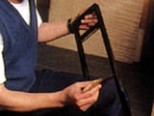
    When cutting the wood using a circular saw, the tool used at that time is called a "kane-bakari." In NIIGATA SHIRONE Butsudan (Household Buddhist Altars) there are no blueprints; the woodworkers determine the size of the altar based on the dimensions marked on this "kane-bakari." "Blueprints are not necessary for making Buddhist altars. Everything is in my head. In other words, the 'kane-bakari' is a tool that retrieves the blueprint from my head." Apparently, skilled craftsmen can tell the size of the altar they are about to make just by looking at this stick.

    Lined up in front of the mortise and tenon-jointed Buddhist altar are the blueprints for the altar, called "kanebakari".

    The masterful skills of craftsmen who breathe life into wood.

    The lumber, cut to precise dimensions, is planed smooth using hand and automatic planers, and the shape of the Buddhist altar begins to emerge through mortise and tenon joinery. However, no nails are used, as the altar will be disassembled for the next step, "painting." Then, the pillars and palace inside the altar are shaped through intricate carving using planes, chisels, knives, and various other tools. This process, in which simple lumber is imbued with a majestic and elegant life with each touch of the craftsman's hands, is truly a showcase of skilled craftsmanship.

    A single piece of wood is transformed by the hands of a craftsman into a sacred part of a Buddhist altar.

    Pride in the Buddhist altar to which we pray morning and evening

    "A Buddhist altar is a place to honor one's ancestors. Although there may be differences in sects, every Japanese home has a Buddhist altar. It is also an object to which one can express gratitude, acknowledging that one's current life and upbringing are thanks to one's ancestors. The only things we pray to morning and evening are the Buddhist altar and the Shinto altar. When I make something like this, I approach my work with the thought that I want to create something that can be used for generations to come," Furukawa said, passionately expressing his pride in making Buddhist altars.

    By cleaning the Buddhist altar, we ensure that traditions are passed down to future generations.

    These NIIGATA SHIRONE Butsudan (Household Buddhist Altars) are easy to disassemble, not only the main body but all parts, allowing for a complete restoration through disassembly, cleaning, and washing—a process known as "washing the altar"—to address tarnish and dirt accumulated over long periods of use. As a result, they can be restored to like-new condition even after 100 or 200 years. NIIGATA SHIRONE Butsudan (Household Buddhist Altars), embodying techniques cultivated over 300 years of tradition, are beloved for their solemnity and elegant dignity.

    Craftsman Profile

    Mitsuo Furukawa

    Born in 1933 in Shirone City, Niigata Prefecture. He is the second generation to make Buddhist altars. He expressed his enthusiasm to work on new designs of Buddhist altars by bringing together the strengths of each craftsman in the future.

    Anecdotes

    Tools that create the solemn world of Buddhist altars

    NIIGATA SHIRONE Butsudan (Household Buddhist Altars) are completed through a variety of processes. This requires not only skilled craftsmanship but also essential tools. This time, let's introduce some of the tools used in the first stage of altar making: "woodworking."
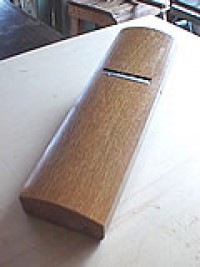
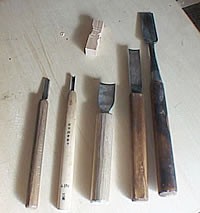
    First, there are the planes. Depending on the intended use, the most suitable one is selected from dozens of different types. There are many varieties, including arched outer planes, U-shaped inner planes, small planes for carving fine details (also known as craft planes), ginkgo leaf planes for creating unique shaved surfaces, and chamfering planes. In addition, chisels, knives, and woodworking sewing machines are used to create each part of the Buddhist altar.
    And what could be called the blueprint for the Buddhist altar is a long stick called a "kane-bakari." The surface of this stick is marked with various numbers and letters, and to the untrained eye, it is unclear what they are used for. When the woodworker cuts the wood, he uses this kane-bakari as a guide to determine the size of the Buddhist altar.
    In addition to those mentioned above, a wide variety of tools are needed at each stage of the process to complete a single NIIGATA SHIRONE Butsudan (Household Buddhist Altars). Skilled craftsmen use these tools, imbued with the wisdom of their predecessors, to create the magnificent world of Buddhist altars.

    • The parts have been cut out using a woodworking sewing machine. The cut surfaces are then smoothed using a plane and sandpaper.

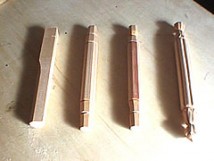
    • A variety of chisels. From left to right: a round chisel, a triangular chisel, and three types of flat chisels.


overview

Craft item name NIIGATA SHIRONE Butsudan (Household Buddhist Altars)
Reading Niigata Shirone Buddhist Altar
Classification of crafts Buddhist altars and Buddhist ritual objects
Main Products Buddhist altars and Buddhist ritual objects
Main manufacturing area Niigata City
Designated date October 16, 1980

contact address

■ Production area association

Shirane Buddhist Altar Cooperative Association
950-1217
1240-3 Shirone, Minami-ku, Niigata City, Niigata Prefecture
Niigata Minami Chamber of Commerce and Industry
TEL: 025-373-4181
FAX: 025-373-4199

Niigata Buddhist Altar Association
950-0324
547-3 Sakaya-cho, Konan-ku, Niigata City, Niigata Prefecture
Tomosaka Buddhist Altar Shop
TEL: 025-280-2236
FAX: 025-280-2236

Features

Durability and overall harmony are essential for a Buddhist altar. The balance of the pedestal (shumidan) and palace (kuden), the designs of the carvings and lacquer work, the quality of the lacquer application and gold leaf finish, and the attachment of the metal fittings are all important factors, as is whether the altar possesses a solemn and elegant dignity that comes from the overall finish.

How to make it

Using woods such as cypress, Japanese white pine, and zelkova, the wooden base and palace are created, and then carvings and metal fittings are made to match the dimensions. The completed carvings, wooden base, and palace are then coated with lacquer, decorated with maki-e (gold lacquer) and gold leaf, and assembled with metal fittings to finish the piece.

Please see here for information on traditional craftspeople.

Japanese traditional craftsman
top