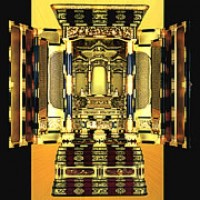
NAGAOKA Butsudan (Household Buddhist Altars)

It is said that the origins of NAGAOKA Butsudan (Household Buddhist Altars) date back to around the 17th century, when carpenters, Buddhist sculptors, carvers, and lacquerers who had gathered from all over Japan to build temples and shrines in the area centered around Nagaoka City took up the task of manufacturing Buddhist altars as a side job during the winter. By the first half of the 19th century, Buddhist altar production had become a thriving local industry.
This was a result of the Nagaoka Domain's policy of protecting Jodo Shinshu Buddhism, which led to the establishment of the custom of enshrining ancestral tablets in each household, an increase in the number of people seeking Buddhist altars, and the spread of Buddhist altars.

  • Technology/techniques/raw materials

    Technology/techniques

    1. The structure of the "wooden base" is assembled using "mortise and tenon joints".

    2. The lintels shall be either "bow-shaped lintels" or "bracken-shaped lintels."

    3. Palace construction is done using "plank joinery."

    4. The painting shall be done by hand using refined lacquer, and in the case of "wood grain painting," a "roiro finish" shall be applied.

    5. Apply maki-e (lacquerware with gold or silver powder) and gold leaf.
     

    raw materials

    1. The wood used shall be Japanese white pine, Japanese cypress, zelkova, magnolia, Japanese yew, or cypress, or timber of equivalent quality.

    2. The metal fittings shall be made of copper, a copper alloy, or a metal of equivalent material.

    3 漆は、天然漆とすること。

  • Work scene

    The manufacturing process is broadly divided into six stages, from wood preparation to final assembly. Of course, each of these stages is further complicated by a series of more complex steps.

    Step 1: Wood base

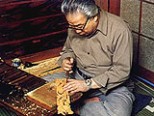
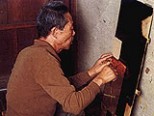
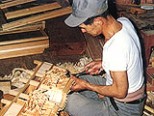
    The wood used for the base is Japanese white pine, magnolia, zelkova, cypress, Japanese cedar, and Japanese yew. First, the logs are sawn, preserving the grain of the wood. After drying, the wood is measured and cut using a long stick called a "shakujo." The woodworker measures the dimensions based on the various numbers and letters marked on this shakujo. The wood cut to these dimensions is then processed with planes and chisels, and finally finished with mortise and tenon joints. Simultaneously, the construction of the palace (kuden) takes place.

    工程2: 彫刻

    In carving, various techniques are used to create a sense of three-dimensionality, including "round carving," where a thick board is carved through from both sides; "layered carving," where thin boards are carved one by one and stacked; and "flat carving," where thin boards are carved to appear as if they were made of thick material. For round carving, boards at least 3 centimeters thick are used, and the carving is done with perspective in mind for the design.

    Step 3: Hardware

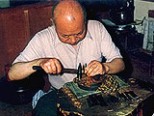
    The process involves hammering copper and brass plates, followed by coloring.

    Process 4: Painting

    The Buddhist altar, which is assembled using mortise and tenon joints during the woodworking process, is disassembled and lacquered. It is then dried in a humid environment, the surface is sanded, and another layer of lacquer is applied. This series of processes is repeated for at least three months.
    In the case of lacquering, there are various types, such as "wood grain lacquering" which vividly brings out the wood grain, "roiro lacquering" which has a subdued sheen, "nashiji lacquering" which is finished by sprinkling gold, silver, or tin pear-skin powder, "aogai lacquering" which is inlaid with pieces of abalone shell, and "sunako lacquering" which is finished with a rough surface by sprinkling sand. These techniques make the most of the deep luster inherent in lacquer, and the use of these unique lacquering methods creates a sense of luxury and elegance.

    工程5: 蒔絵

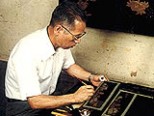
    Flowers, birds, and figures are hand-painted. Techniques include "hiramakie" (flat lacquerware) and "urushimorimakie" (raised lacquerware). In particular, "urushimorimakie," which involves applying lacquer multiple times to create a raised design, is an effective technique not only for creating a three-dimensional effect but also for creating a more majestic atmosphere.

    Step 6: Gold leaf application

    Pure gold leaf is applied to the finished lacquered pieces. Each piece is carefully worked on. There are three types of gold leaf application: "glossy application," "matte application," and "gold powder sprinkling," and the appropriate use of each creates a balance of elegance and refined luxury.


  • Close-up

    NAGAOKA Butsudan (Household Buddhist Altars) A culmination of techniques cultivated over a long and rich history.

    NAGAOKA Butsudan (Household Buddhist Altars) crafted with the tenacious craftsmanship of Echigo, have been refined through years of dedication. Their unique palace-like structure exudes a majestic and magnificent presence. And now, while preserving the traditional techniques cultivated over many years, NAGAOKA Butsudan (Household Buddhist Altars) are creating a new wave of innovation.


    The three-roofed palace is a characteristic feature of NAGAOKA Butsudan (Household Buddhist Altars)

    NAGAOKA Butsudan (Household Buddhist Altars) are said to have originated about 150 years ago in the area centered around Nagaoka City, when carpenters, Buddhist sculptors, carvers, and lacquerers who had gathered from all over the country to build temples and shrines took up the task of manufacturing Buddhist altars as a side job during the winter months.
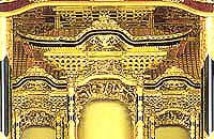
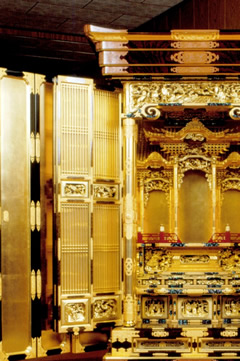
    Mr. Maruyama, who has been involved in the initial woodworking process for Buddhist altars for 54 years, says, "The distinctive features of these altars are the three-roofed palace inside and the extensive use of zelkova wood as a raw material." Generally, Higashi Honganji style altars have two-roofed palaces, and Nishi Honganji style altars have one-roofed palaces, but NAGAOKA Butsudan (Household Buddhist Altars) use a three-roofed palace as a compromise between the two.

    The "three-roofed palace" style is a distinctive feature of NAGAOKA Butsudan (Household Buddhist Altars). The craftsman's soul is embodied within this magnificent form.

    The most important thing is having an eye for judging wood.

    Mr. Maruyama says that the craftsman's skill lies in how beautifully they can showcase the grain of the zelkova wood. He says that the finer the grain, the more beautiful it is, and the more rounded the pattern called "tamame," the better the zelkova wood. "Having an eye for the material is the most important part of woodworking. In other words, you have to determine whether the wood will warp over time or not. That's where the process of making a Buddhist altar begins. After that, it's just a matter of working with a clear mind. I never compromise on the quality of my work."

    The essence of a Buddhist altar: "painting"

    Making a Buddhist altar is a laborious process. After the "woodworking" process, which involves creating the main body and palace, and the "carving" process, which involves sculpting figures and birds, comes the "painting" process using natural lacquer. The Nagaoka region originally had ideal conditions for Buddhist altar making, such as a hot and humid climate that was suitable for drying lacquer. This time, we spoke with three lacquer craftsmen: Junichi Takizawa, Shinji Kawakami, and Katsuhiko Hirokawa. "The painting is the most important part of a Buddhist altar. If the painting is poor, the surface will become uneven when the gold leaf is applied," says Takizawa, a lacquer craftsman from Ojiya City, Niigata Prefecture. Kawakami adds, "The composition of lacquer varies depending on the season and the weather on any given day. This composition relies on intuition cultivated over many years." Lacquer dries at a humidity of around 70%. The process involves applying lacquer, letting it dry, sanding the surface, and then applying it again. This series of steps takes about six months, or as little as three months, to complete. The Buddhist altars, meticulously finished in this way, are resistant to both salt and humidity, and exude a dignified presence. "We aim for a mirror-like finish," says Mr. Hirokawa. Each step of the process, through the dedicated and careful handiwork of the craftsmen, creates that magnificent and splendid style.

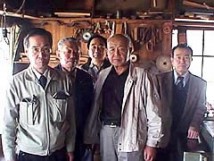
    The craftsmen who make NAGAOKA Butsudan (Household Buddhist Altars). From left: Katsuhiko Hirokawa, Eiichi Kurihara, Junichi Takizawa, Ryoichi Maruyama, and Shinji Kawakami (titles omitted).

    A challenge to create Buddhist altars that are in line with the times.

    The Nagaoka Regional Buddhist Altar Cooperative is also enthusiastic about creating new designs for Buddhist altars. In particular, their furniture-style Buddhist altars, which can be placed alongside furniture even in homes without a dedicated Buddhist room, have achieved remarkable success, including winning awards in national competitions, taking into account modern lifestyles. "We only know the traditional way of making Buddhist altars, so during the production process, we were worried about whether they would actually sell," says Eiichi Kurihara, the chairman of the cooperative. Kurihara himself is a craftsman who makes the woodwork and carves NAGAOKA Butsudan (Household Buddhist Altars). About 10 members of the cooperative's youth division divided the process among themselves to create this particular altar. They jointly conceived the design and it took them a year to complete. "Creating something new through collaborative production was very difficult, as it involved coordinating the opinions of each craftsman. Even though it's a new design, the original traditional techniques are utilized down to the smallest detail. Initially, there was little public interest, but the number of altars on store shelves is increasing year by year," says Kurihara. Amidst the flood of inexpensive Buddhist altars imported from overseas, NAGAOKA Butsudan (Household Buddhist Altars) continue to embrace new ideas while preserving the tradition of handcrafted work.

    Craftsman Profile

    Ryohei Maruyama

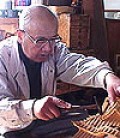
    He started working at the age of 15. He is proficient in using tools such as saws, planes, and chisels. He owns over 50 different types of planes, and says he has "never even counted them all."

    Anecdotes

    A proposal for a new design of Buddhist altar that harmonizes with modern times.

    In modern times, living environments have changed significantly from the past. With the increase in apartment dwellers and the trend towards smaller homes, there is a growing demand for Buddhist altars that differ from traditional designs.
    Amidst this trend, NAGAOKA Butsudan (Household Buddhist Altars) proposes a new type of Buddhist altar that is compact and features a fresh design that harmonizes with modern life, while still retaining the beauty and high quality of traditional craftsmanship.
    Within its modern form, the craftsmanship embodies the rich experience and advanced skills of the artisans, and above all, their burning passion to "create something better."
    At the National Traditional Craft Buddhist Altar and Buddhist Altarware Exhibition held in 1999, this new design of Buddhist altar was praised for being "compact yet refined," and was selected as the first-place winner in the new design category. Such a prestigious award can be seen as proof that the new style of NAGAOKA Butsudan (Household Buddhist Altars) is being embraced by the times.

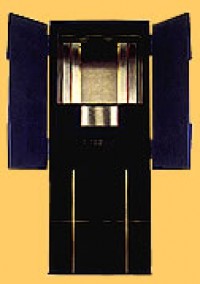
    • When the doors are closed, the design blends seamlessly with other interior furnishings.

    • The design ensures that the main image of Buddha is at eye level when you are seated in a chair.


overview

Craft item name NAGAOKA Butsudan (Household Buddhist Altars)
Reading Nagaoka Buddhist Altar
Classification of crafts Buddhist altars and Buddhist ritual objects
Main Products gold altar
Main manufacturing area Nagaoka City, Ojiya City, Tokamachi City
Designated date October 16, 1980

contact address

■ Production area association

Nagaoka Regional Buddhist Altar Cooperative
940-2035
5-5 Sekihara-cho, Nagaoka City, Niigata Prefecture
Hirokawa Buddhist Altar Store
TEL: 0258-46-2210
FAX: 0258-46-5730

Features

NAGAOKA Butsudan (Household Buddhist Altars) are assembled using a method where the base and main body are separate, allowing them to be repainted and restored even after 30 to 100 years. A distinctive feature is the three-roof structure of the palace-like structure. It is a traditional double roof combining a "karahafu" (curved gable) and a "chidorihafu" (gable with a curved roof), with side roofs of the "karahafu" on both sides.

How to make it

The process of making a Buddhist altar consists of five stages: woodworking, carving, metalwork, painting (such as lacquering or gold leaf application), and maki-e (gold lacquer decoration). Each stage is carried out by independent craftsmen with highly advanced skills.

Please see here for information on traditional craftspeople.

Japanese traditional craftsman
top