OSAKA Butsudan (Household Buddhist Altars)

It is said that when Prince Shotoku built Shitennoji Temple, he invited craftsmen from Baekje on the Korean Peninsula and had them settle in Osaka, which led to the formation of a production center for Buddhist altars and religious implements. Subsequently, as Buddhism spread, Osaka's unique and excellent manufacturing techniques and methods spread throughout the prefecture.
The original form of the Buddhist altar was devised by a Buddhist sculptor at Haraihashi in Nōninbashi. It was constructed using mortise and tenon joints, with doors and sliding screens, making it easy to move, and this design has been passed down to the present day.

  • Technology/techniques/raw materials

    Technology/techniques

    1. The structure of the "wooden base" is assembled using "mortise and tenon joints".

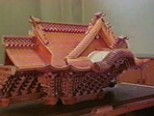
    2. The palace construction shall be based on the "hijiki-masugumi" (bracket and square bracket) method.

    3. The carvings on the transoms shall be made using the "cage carving," "notched carving," or "joined wood carving" techniques.

    4. The painting shall be done by hand using refined lacquer.

    5. Applying maki-e and gold leaf. In this case, for "tiered metal fittings" (excluding those for palace pillars), high maki-e shall be used.

    6. The metal fittings used in the 6th unit shall be colored using copper sulfate and copper acetate with a "Xuande finish".
     

    raw materials

    1. The wood used shall be cedar, pine, cypress, Japanese white pine, or red pine, or timber of equivalent quality.

    2. The metal fittings shall be made of copper, a copper alloy, or a metal of equivalent material.

    3 漆は、天然漆とすること。

  • Work scene

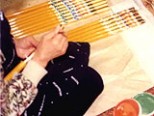
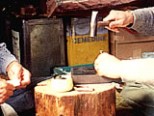
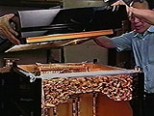
    The process of making a Buddhist altar is detailed and involves a division of labor. Let's take a look at the steps involved in making OSAKA Butsudan (Household Buddhist Altars).

    Step 1: Wood base

    Using carefully selected, thoroughly dried timber, skilled woodworkers begin crafting the Buddhist altar.

    Step 2: Roof

    We remove knots and other imperfections from the wood, and then meticulously cut and process it into various parts such as roofs, gables, rafters, brackets, corbels, finials, decorative gable boards, and flat beams.

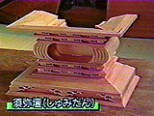
    Step 3: Shimidan

    Using small pieces of wood, we create carved ornaments for the rafters, shrimp-shaped brackets, and front table using a plane and carving tools, and then glue them together with animal glue and other adhesives.

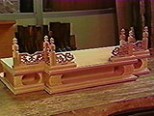
    Process 4: Front desk

    Using tools for the Buddhist altar stand, place the base, body, and top board in that order, secure them with wooden and bamboo pegs, and then place the brush rest on top.

    工程5: 彫刻

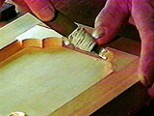
    The wood used for carving is from trees such as Japanese white pine and red pine, with knots, resin, and cracks removed. The carvings are then performed by skilled carvers.

    画像をクリックすると動画が再生されます

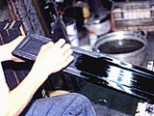
    Process 6: Lacquer coating

    The wood is prepared by applying polishing powder and other similar materials to create a base coat, and then the intermediate and top coats are applied repeatedly in a place with suitable humidity and no dust.

    Process 7: Roiroma

    The uneven surface created by the lacquer is carefully polished with charcoal, and then polished using horn powder, the palms and fingertips to create a beautiful, glossy finish.

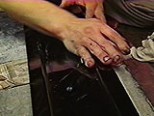
    工程8: 蒔絵

    In the case of OSAKA Butsudan (Household Buddhist Altars), the most distinctive feature is the raised lacquer work. This is a technique unique to Osaka, where metalwork is depicted without the use of stepped metal fittings.

    画像をクリックすると動画が再生されます

    Process 9: Gold leaf stamping

    This process requires the delicate and highly skilled hands of a master gold leaf craftsman, who carefully applies each sheet of the finest pure gold leaf using bamboo chopsticks.

    Step 10: Coloring

    There are two methods of coloring: wood coloring and foil coloring. The refined colors, combined with the exquisite artistry required to create a majestic and beautiful image, demand exceptional skill and artistry.

    Step 11: Decorative metal fittings

    Copper or brass sheets are cut to the required dimensions, punched out using a chisel, the distortion of the cut surface is corrected, the edges are smoothed using a file or scraper, and then engraved.

    工程12: 組立

    Finally, the assembly of each component takes place. The parts are assembled with meticulous care to avoid damage, and then undergo rigorous checks before completion.


  • Close-up

    Osaka's unique and excellent techniques, cherished alongside Buddhism.

    During the Asuka period, with the introduction of Buddhism, Buddhist sculptors and temple builders arrived in Naniwa Port from Baekje. From that place, OSAKA Butsudan (Household Buddhist Altars) began to be produced in two distinct styles: lacquered and gilded altars, and altars made from precious hardwoods. Even today, these altars, crafted using traditional methods, continue to bring peace and tranquility to people.


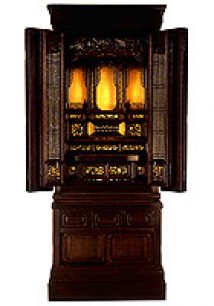
    A luxurious lacquered and gilded Buddhist altar that pursues solemnity.

    In 552 AD, six Buddhist sculptors and temple builders (carpenters and craftsmen) were sent from Baekje to Naniwa Port (present-day Osaka), a vital port for maritime traffic, along with Buddhist scriptures. Furthermore, in 593 AD, when Prince Shotoku built Shitennoji Temple, he summoned skilled craftsmen from Baekje and had them reside on the present-day Uemachi Plateau. Later, these craftsmen focused on the manufacture of Buddhist altars and religious implements, and the area around Tennoji in Osaka became a center for Buddhist altar production. Subsequently, as Buddhism spread, Osaka's unique and superior manufacturing techniques and methods spread throughout Osaka Prefecture.
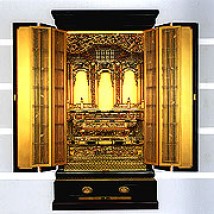
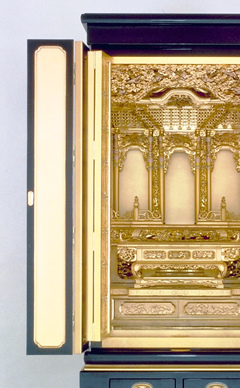
    A distinctive feature of this lacquered and gilded Buddhist altar is the application of the high-relief maki-e technique to the front of the upper section inside. This makes it look as if metal fittings have been attached. This technique prevents damage to the wood caused by the metal fittings.

    A lacquered Buddhist altar with the elegant sheen of gold leaf.

    A Buddhist altar made of precious karaki wood, boasting robustness and a heavy construction.

    From the early Edo period, the custom of placing Buddhist altars in each household became established, and in response to this, Buddhist altar adjustment shops in front of Senba Mido Temple and cabinetmakers living nearby began to create simple cupboard-style Buddhist altars using cedar, pine, and cypress.
    During the mid-Edo period, rosewood, ebony, and quince wood were called "Tang woods," and import volumes increased. Specialized craftsmen in Tang woodworking emerged, developing unique techniques.
    In the late Edo period, Buddhist altars with doors, modeled after temple styles and lacquered and gilded Buddhist altars, were produced in Osaka using materials such as karaki wood, mulberry, cherry, and knucklewood.

    A type of Buddhist altar made of precious woods originating in Osaka during the late Edo period.

    An interview with a female colorist whose use of rich colors is beautiful.

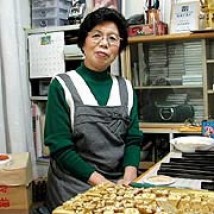
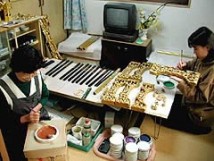
    Behind the Osaka Prefectural Gymnasium, where the colorful banners of sumo wrestlers for the Spring Grand Sumo Tournament flutter in the wind, lies the home and workshop of traditional craftswoman Sawako Imura. In a small, sunny room of about three tatami mats, fine brushes for coloring, pigments, and parts for Buddhist altars are lined up in abundance. "Initially, I entered this world by helping a colorist who lived nearby. Rather than formal training, I learned by watching and imitating at first. Thirty years have passed since then, and by working on many coloring projects, I've become able to apply a wide variety of colors. It's a very enjoyable feeling when a beautiful piece is completed." Every piece has a soft, feminine color scheme. The parts that are colored are even fitted into the back of the Buddhist altar, where they are not visible unless you look closely. No matter how hidden the part is, she never cuts corners.

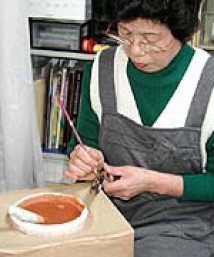
    • "I put my heart into coloring them for those who will pray to them," says Imura.

    • Use a fine brush to draw intricate patterns.

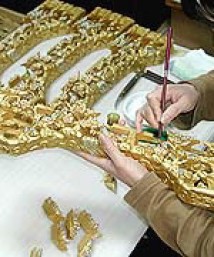
    • The decorative parts are divided into small pieces and assembled after painting.

    The traditional techniques and spirit have been passed down to the daughter...

    Every day, her married daughter comes to help with the coloring. The skills of coloring are passed down from mother to daughter. "For the past three years, I've been able to create the colors I want, and I've gradually started to enjoy it as a job. At first, I struggled to get the hang of dissolving the pigments," says her daughter, Mitsuko. She dissolves the pigments thicker for the transoms and thinner for the pillars. It's not a color that can be created with a chemical formula like how many grams of pigment to use for the color and how many grams of white powder to use to control the glue, so the "intuition" cultivated over many years is essential. "I tell my daughter that mistakes are inevitable at first. But these are things that people worship every day, so she should paint them with all her heart. Of course, I tell myself that too." The warm heart of the painter seems to be conveyed through the finished works.

    A workshop crammed with pigments and materials.

    Anecdotes

    equinox

    The word "Ohigan" originates from the translation of the ancient Indian word "Paramita" as "reaching the other shore." This refers to the Pure Land, the true ideal land and world of enlightenment. It is a word that refers to "the other," the ideal place beyond, in contrast to "this shore" (shigan), this world full of delusion and suffering. In Buddhism, it is believed that one can reach the other shore. For this reason, it can be said that Ohigan is the event that most closely reflects Buddhist thought among Buddhist events. However, the Ohigan rituals are unique to Japan and do not exist in India, the birthplace of Buddhism, or in China.

    Are you all honoring your ancestors? The "Think of Your Family and Ancestors" Executive Committee (sponsored by the All Japan Religious Goods Cooperative Association, the Osaka Religious Goods Commercial Cooperative Association, and the Buddhist Altar Culture Research Institute) will be performing a healing version of Yoshimoto Shinkigeki (a popular Japanese comedy troupe) to convey the importance of family and ancestors in a Yoshimoto style. This year marks the first time the event will be held on May 26th and 26th, 2001 at Namba Grand Kagetsu.


overview

Craft item name OSAKA Butsudan (Household Buddhist Altars)
Reading Osaka Buddhist Altar
Classification of crafts Buddhist altars and Buddhist ritual objects
Main Products Buddhist altar
Main manufacturing area Osaka City, Yao City, Higashi-Osaka City, Sakai City, Kishiwada City, and others
Designated date November 1, 1982

contact address

■ Production area association

Osaka Religious Goods Manufacturers' Cooperative Association
587-0062
355 Ooi, Mihara-ku, Sakai City, Osaka Prefecture
Fudodo Co., Ltd.
TEL: 072-363-2160
FAX: 072-363-2170

http://www.osakabutsudan.com/

Features

OSAKA Butsudan (Household Buddhist Altars) manufactures different types of altars for each Buddhist sect. Furthermore, the front of the upper section of the interior features a technique called takamakie (high lacquer work) to create the appearance of metal fittings, preventing damage to the wood from the metalwork. The pillars and carvings, which are covered in gold leaf, are adorned with elegant coloring. Another distinctive feature is the use of hassō (a type of decorative metal fitting) on the front of the doors, which reflects the differences between each sect.

How to make it

OSAKA Butsudan (Household Buddhist Altars) are made using wood such as pine, cedar, and cypress, and are finished with lacquer and gold leaf. They are produced through 11 separate processes. The differences between each Buddhist sect are reflected in the woodwork, the shrine (kuden), the platform (shumidan), and the decorative metal fittings.

Please see here for information on traditional craftspeople.

Japanese traditional craftsman
top