KAWANABE Butsudan (Household Buddhist Altars)

In the Kawabe region, which has strong ties to Buddhism, the Kawabe clan, who held power in the southern part of present-day Kagoshima Prefecture at the beginning of the Kamakura period, and the remnants of the Taira clan who were defeated at Dan-no-ura, were busy with memorial services and spreading Buddhism, mainly in the Shimizu Valley of Kawabe Town.
Numerous towers, tombs, and structures inscribed with Sanskrit characters, said to have been created by them, remain along a 500-meter stretch of cliff face. In 1200, the Kawabe clan's ancestral temple was built, and Buddhism flourished even more.
From these observations, it appears that the techniques and methods of KAWANABE Butsudan (Household Buddhist Altars) though simple in nature, were established.

  • Technology/techniques/raw materials

    Technology/techniques

    1. The structure of the "wooden base" is assembled using "mortise and tenon joints" and "cloth rubbing."

    2. The palace construction shall be carried out using the "traditional joinery technique."

    3. The painting should be done by hand using refined lacquer.

    4. Apply gold leaf.


    raw materials

    1. The wood used shall be cedar, cypress, magnolia, or pine, or timber of equivalent quality.

    2. The metal fittings shall be made of copper, a copper alloy, or a metal of equivalent material.

    3 漆は、天然漆とすること。

  • Work scene

    How KAWANABE Butsudan (Household Buddhist Altars) are Made

    Step 1: Wood preparation

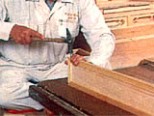
    The materials used are carefully selected woods such as cedar, cypress, and magnolia. The main body is easy to disassemble and assemble, and the lower part from the railing down is designed to be joined with a "rag-sliding board".

    <Woodworking Process>

    Sawmilling– This involves selecting and purchasing logs of timber such as cedar, milling them to the specified thickness and width, and then transporting them. The logs are typically 2 to 4 meters long, and are almost always milled using the quarter-sawn method.
    Natural drying – The lumber is sorted by thickness, placed on a natural drying base with railway ties, and stacked to dry. In this case, a location is chosen considering sunlight and wind, and the lumber is left for approximately 6 months. Once during this period, the stack is turned over to equalize the moisture content.

    Rough cutting– The lumber, with its moisture content reduced to 30%, is cut to length, width, and thickness according to the dimensions of the parts marked on a measuring stick. Shorter parts are cut to 2 to 5 times their original dimensions to facilitate machining. Drying after rough cutting is accelerated even indoors, and warping is reduced.

    Drying– Allow to dry for approximately two months.

    Cutting and Processing– After drying, the wood is cut and processed into the base material for the Buddhist altar and numerous other parts. Specifically, the outer parts of the Buddhist altar (gable walls, back panel, base frame, headband, canopy, doors, shoji screens) and the inner components (cat door, middle shelf, middle shelf base, sumi-dan, box holder, railing, pillars, ceiling, sill, storage compartment, base) are precisely cut to length and width using both machines and hand processing, and then work is performed such as miter cuts, handle attachment, drilling, notching, chamfering, grooving, etc.

    Finishing– After cutting, the parts are finished by planing (faces, ends, edges, mitered edges), and the parts necessary for painting, such as the front surface and holes, are finished. During this process, the parts are checked to meet the dimensions according to the specifications of the Buddhist altar before moving on to the next step.

    Assembly and Processing– Small Buddhist altars are assembled and firmly fastened from the beginning. Medium-sized altars are made so that the end walls, base, and headband can be assembled after painting. This makes the lacquering process easier and improves the quality. When assembling small altars, nails are carefully driven in while drilling on a level assembly table. The base is assembled and firmly fastened from the beginning. Adhesive is used at the joints. Nails are used that are at least three times the thickness of the wood, and the heads are flattened before driving them in. In particular, the inner components (cat door, middle shelf, middle base, sumi platform, box holder, railing) are attached to the baseboard (the board that supports the outer body and inner components), and then fastened to the outer body. The baseboard and the outer body are attached with a single nail, so by removing this nail, each part can be easily disassembled, making repairs and other maintenance easier.

    Step 2: Sculpture

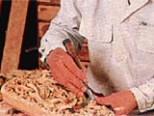
    The materials used include pine, cedar, cypress, and magnolia wood. A design is selected, and the piece is carved using chisels and knives. Adhesive is used to attach the piece to the base, and bamboo skewers are used to join the pieces together.

    Step 3: Palace

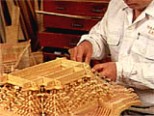
    The materials used include cedar, cypress, and magnolia wood, and the bamboo used for the bamboo skewers is thoroughly dried and treated to prevent insect infestation. The method of precisely holding the pillars and roof in a traditional joinery structure is a technique unique to KAWANABE Butsudan (Household Buddhist Altars).

    Step 4: Metal fittings

    The material used is copper plate or copper alloy, and the design is meticulously handcrafted using a chisel. The surface is colored, and the nails used for attaching the metal fittings also have the same surface treatment.


    画像をクリックすると動画が再生されます

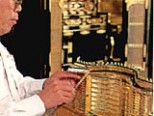
    Step 5: Makie (lacquerware decoration)

    The piece is first painted with lacquer, and then the underpainting is drawn using refined lacquer. Pure gold powder and natural mother-of-pearl are then applied, and the entire piece is finished by hand. There are two types of maki-e: flat maki-e and raised maki-e.
    Composition drawing – Stencil placement and powder application – Flat drawing (first drawing) – Powder application – Flat drawing (second drawing) – Powder application – Finishing drawing – Powder application – Black finish – Drying

    画像をクリックすると動画が再生されます

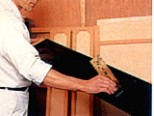
    Step 6: Painting (primer)

    A base coat of animal glue is used, and to prevent the wood from shrinking, white pigment is mixed in and applied repeatedly with a spatula.
    Painting is an extremely complex process. Here, we will go through the painting process step by step.
    Animal glue base preparation – Cutting the clay – Ground sanding (1st time) – Cloth application – Surface preparation – Drying – Cloth rubbing – Dry sanding (1st time) – Rough ground application – Rough sanding – Base coat application (1st time) – Ground sanding (2nd time) – Base coat application (2nd time) – Wet sanding and drying – Dry sanding (2nd time) – Ink application – Dry sanding (3rd time)

    Step 7: Painting (Topcoat)

    After the base coat has completely dried, an undercoat is applied, and the top coat is hand-painted with natural lacquer.
    Intermediate coat (1st coat) – Dry sanding (4th coat) – Intermediate coat (2nd coat) – Wet sanding – Top coat – Drying

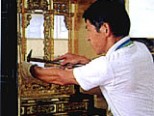
    Step 8: Gold leaf application

    After a certain period of drying in a lacquered finish, foil-stamping lacquer is rubbed into the parts, and then pure gold leaf is applied. There are two types: glossy and matte.

    Lacquer application– For areas where gold leaf will be applied (inside the gable walls of the main body, back panel, back of doors, palace, carvings), a gold leaf lacquer is prepared by diluting refined raw lacquer with alcohol in a ratio of 2:8, and lightly applying it with a brush or cotton. If a matte finish is desired for the gold leaf, the raw lacquer is applied by spreading it with a wooden spatula or cotton.

    Foil stamping– Each piece of gold leaf is carefully pressed down using foil tongs to create the foil stamping effect. This is an important and nerve-wracking process.

    Drying– Store in a humid bath (temperature 20-25 degrees Celsius, humidity 50-55%) and let it dry for about 24 hours.

    Step 9: Assembly

    After the paint and gold leaf application have completely dried, KAWANABE Butsudan (Household Buddhist Altars) is carefully and lovingly assembled, and then it is complete.

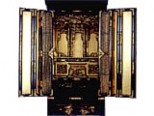
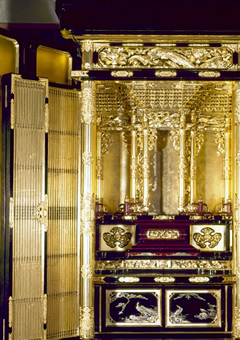
    Step 10: Finished product


  • Close-up

    Ancient techniques dyed in gold: KAWANABE Butsudan (Household Buddhist Altars)

    The Kawabe region has long been a center of Buddhism, and many Buddhist-related ruins remain. It is believed that the techniques and methods of KAWANABE Butsudan (Household Buddhist Altars) were established around 1200 AD. In 1597, Buddhist statues and altars were destroyed by fire during the Shimazu clan's suppression of the Ikkō-shū sect, but the faith remained strong, and the altars became smaller through what is known as "hidden nenbutsu" (a form of Buddhist chanting). In addition, altars were made that looked like chests of drawers, but when the doors were opened, a resplendent golden Buddhist altar was hidden inside.
    At the beginning of the Meiji era, when freedom of religion was permitted, a certain Ikeda, who had inherited the techniques and methods, openly began making Buddhist altars, laying the foundation for KAWANABE Butsudan (Household Buddhist Altars) today.


    Kawabe Town, a town with devout Buddhist faith

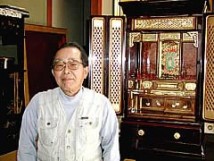
    A little over an hour's bus ride from the center of Kagoshima City takes you to Kawabe Town, famous for the Kiyomizu Magaibutsu (Kiyomizu Cliff Buddha), said to have been carved about 700 years ago by refugees from the Taira clan as a memorial for their ancestors. The Kawabe district has a long history of deep devotion to Buddhism, dating back to the Genpei War. What kind of history has the traditional craft of Buddhist altars been carved in Kawabe Town? We spoke with Masami Sakaguchi, a traditional craftsman of KAWANABE Butsudan (Household Buddhist Altars).
    "The fact that Buddhist altar manufacturing naturally arose in areas where Buddhism was prevalent is partly due to market principles. Also, it reflects the strong faith of the local people who endured all kinds of persecutions and strived to preserve their traditional techniques and methods," Sakaguchi began.
    "This region was originally a center of the Jodo Shinshu sect, and Buddhist altars developed primarily around the Jodo Shinshu's 'gold altars.' Previously, other sects commonly used karaki altars, but nowadays, people of all sects use gold altars. The gold leaf application is a skillful technique, but the distinguishing features of KAWANABE Butsudan (Household Buddhist Altars) are the tradition backed by its history, uncompromising material selection, and intricate carving techniques. Craftsmen divide the work at each stage, taking pride in their skills and utilizing them to the fullest."
    KAWANABE Butsudan (Household Buddhist Altars) exude a dignified presence that only genuine items, having withstood the test of time and the test of history, possess.

    A homemade Buddhist altar and Masami Sakaguchi

    "Painting is a competition against lacquer."

    In the world of Buddhist altar making, where division of labor is the norm, Mr. Sakaguchi is a master craftsman who can handle everything from the woodworking to the gold leaf application and assembly, but he is originally a craftsman in the finishing department. His passion for "lacquer painting" in particular is incredible. "Lacquer is a troublesome substance that cannot be controlled by human hands. It's strange, but lacquer won't dry unless the humidity is high. My day starts with checking the weather forecast. What will the weather be like today, and whether to do the lacquering work in the workshop on the first floor or the workshop on the third floor. It's truly a 'competition between the lacquer and the craftsman'."
    "If you cut corners, the lacquer will immediately mock you. The lacquer will laugh and say, 'See, redo this part,'" Sakaguchi says with a laugh.
    "That's why, for over 50 years, I've worked so hard to hone my lacquering skills so that I wouldn't be looked down upon by lacquerware," says Sakaguchi. However, even he once hit a wall. There was a level that he simply couldn't surpass with the traditional Kawabe lacquering techniques. He realized that his Buddhist altar making wouldn't progress unless he mastered the pinnacle of lacquerware. So, Sakaguchi went to Nagano Prefecture to seek instruction from a master of Kiso lacquerware. He traveled to Kiso again and again, in search of the ultimate lacquerware technique. His ambition is truly astonishing.
    And the craftsman of Kiso lacquerware, impressed by Sakaguchi's enthusiasm, went out of his way to travel all the way to Kawabe and taught Sakaguchi his lacquering techniques.
    I felt that the source of Mr. Sakaguchi's passion for lacquerware lies in the indomitable spirit of Kawabe Town, which never yielded to severe religious persecution and maintained a deep faith.

    What is the spirit of a craftsman?

    Mr. Sakaguchi said, "The reason I started this job wasn't so much out of religious faith, but rather because after graduating from school I went to Manchuria, but the war ended soon after, and I came back to Japan. I immediately went to live with my master and trained there." "Looking back now, I was really put through the wringer. I would start cleaning at 6 a.m. and finish work at 11 p.m. I couldn't run home and go back there to eat, so I had no choice but to work hard. Well, I suppose it was also because I've always loved making things. My master was also strict. No matter how much work I did, he would never praise me or teach me anything. I learned by secretly watching my master work and the Buddhist altars he made." "But I'm still in training. A craftsman's training is a lifelong process. Just once in my life, I would like to make a wonderful Buddhist altar that I can be truly satisfied with."
    "I think making Buddhist altars is the most difficult craft," Sakaguchi proudly states. Last year, a request to restore a famous Nio Buddha statue in Okayama was brought to Kawabe Town. It was so old and severely damaged that local craftspeople and architects hesitated to take on the job. The request finally came to Sakaguchi. It was a request from someone who knew of his high level of Buddhist altar-making skill.
    "If I can make a Buddhist altar, I can make anything. The only thing I can't make is a child," he said with a laugh, accepting the job and successfully restoring the Nio statue.
    This episode clearly demonstrates the high level of craftsmanship at KAWANABE Butsudan (Household Buddhist Altars).

    Craftsman Profile

    Masami Sakaguchi

    Born on May 10, 1930 (Showa 5).
    He is a veteran traditional craftsman with 54 years of experience making KAWANABE Butsudan (Household Buddhist Altars). His favorite saying is, "There is no end to our work; the learning continues until I finish."

    Anecdotes

    The history and origins of Buddhist altar making

    The Kawabe region has long been a land where Buddhism flourished, and many Buddhist-related ruins remain. It is said that the Kawabe clan, who possessed a Buddhist culture, and the remnants of the Taira clan, who were defeated in the Battle of Dan-no-ura, devoted themselves to missionary work, mainly in the Shimizu Valley of the town, carving numerous pagodas, tombs, and Sanskrit characters into the cliffs about 500 meters long, and living solely for the repose of the dead. Given this flourishing of Buddhism and the presence of these ruins, it is perhaps natural that Buddhist altars and implements were made here. For these reasons, the techniques and methods of KAWANABE Butsudan (Household Buddhist Altars), though simple, were established around this time. However, despite the presence of so many artifacts, why are there no Buddhist statues or altars remaining? This is because most of them were destroyed by fire due to the Shimazu clan's ban on the Ikkō-shū sect (1597) and the decree against Buddhism (1869). However, even with the ban and suppression of the Ikkō-shū sect, the faith remained strong, and so-called "hidden Nenbutsu" altars were created. This could be called Buddhist wisdom. Even today, KAWANABE Butsudan (Household Buddhist Altars) are made in the shape of a "gama" (meaning cave in Kagoshima), which is a remnant of the time when missionary work was carried out in caves and people chanted the Nembutsu single-mindedly.

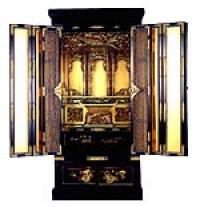
    • With round shoji screen

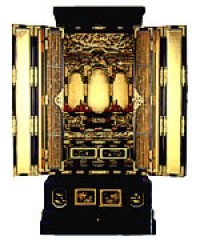
    • Open on three sides (temple-style architecture)


overview

Craft item name KAWANABE Butsudan (Household Buddhist Altars)
Reading Kawanabe Buddhist Altar
Classification of crafts Buddhist altars and Buddhist ritual objects
Main Products gold altar
Main manufacturing area Minamikyushu City
Designated date May 10, 1975

contact address

■ Production area association

Kagoshima Prefecture KAWANABE Butsudan (Household Buddhist Altars) Altar Cooperative
897-0215
6140-4 Hirayama, Kawabe-cho, Minamikyushu City, Kagoshima Prefecture
TEL: 0993-56-0240
FAX: 0993-56-5963

http://www.kawanabe-butudan.or.jp/

Features

KAWANABE Butsudan (Household Buddhist Altars) are comprehensive craft products produced through a seven-part division of labor. The altars are crafted by artisans in each department—woodworking, palace construction, carving, metalwork, lacquering, painting, and finishing—bringing together the best of their skills. They are meticulously crafted, sturdy, and reasonably priced.

How to make it

Using cedar, pine, and other woods as the base material, the piece is finished with a natural black lacquer coating, followed by the application of pure gold leaf and pure gold powder. The production process involves various stages, including woodworking, palace construction, carving, undercoating, lacquering, maki-e (gold lacquer) application, gold leaf application, decorative metal fittings, and final assembly.

Please see here for information on traditional craftspeople.

Japanese traditional craftsman
top