UCHIYAMA Washi (Papers)➡UCHIYAMA Gami (Papers)

Nagano Prefecture

It is said that UCHIYAMA Washi (Papers)➡UCHIYAMA Gami (Papers) originated in the early Edo period when a craftsman who learned the papermaking techniques in Mino began making paper in his own home.
The name UCHIYAMA Washi (Papers)➡UCHIYAMA Gami (Papers) comes from the place name. They have developed unique techniques such as "frozen skin," which involves bleaching the paper mulberry fibers with large amounts of snow to make them white, and snow bleaching.

  • Technology/techniques/raw materials

    Technology/techniques

    1. The raw hides should be subjected to "freezing" and "snow exposure."

    2. Papermaking shall be carried out using the following techniques or methods:
    (1) Using the "flow-casting" method.
    (2) The mats used should be made of bamboo.
    (3) For the "neri" (fermented paste), use tororo aoi (a type of okra).

    3. Drying shall be done by "board drying" or "iron plate drying".
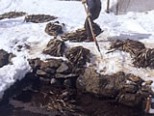
     

    raw materials

    The raw material should be paper mulberry.

  • Work scene

    UCHIYAMA Washi (Papers)➡UCHIYAMA Gami (Papers), which took root in the Iiyama region as a source of winter income for farmers surrounded by snow, has developed a manufacturing method that cleverly utilizes local natural resources, using paper mulberry that grows wild beside the fields and bleaching it with snow. The fibers of the paper mulberry are extracted, bleached with snow, then softened by boiling in an alkaline solution, and the fibers are further loosened before being made into paper.
    Known for its durability, UCHIYAMA Washi (Papers)➡UCHIYAMA Gami (Papers) is widely used for shoji screens and is also highly regarded as paper for calligraphy and ink. UCHIYAMA Washi (Papers)➡UCHIYAMA Gami (Papers) accounts for the majority of the paper used for preserving documents by local governments throughout Japan.

    Step 1: Cultivation of paper mulberry

    Paper mulberry (Kozo) was once a common plant in the mulberry family found along the edges of fields. Compared to other plants used as raw materials for Japanese paper, paper mulberry has long, strong fibers, and was cultivated by local farmers. In the autumn, it was harvested and sold to papermakers. Around November or December, when the leaves fall from the paper mulberry tree, it is cut down at the base.

    Step 2: Peeling the bark and drying the black bark.

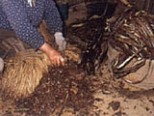
    The harvested paper mulberry stalks are bundled into lengths of 80 centimeters to 1 meter, steamed in a pot, and while still hot and soft, the bark, which is used as a raw material for Japanese paper, is peeled off. This bark is called "kurokawa" (black bark).
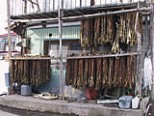
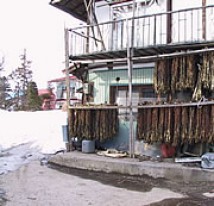
    The bark is bundled together and hung up. The sight of paper mulberry branches hanging in front of houses has become a winter tradition in Iiyama.

    Step 3: Freeze-skinning and peeling.

    After soaking the black skin in water, leave it on the snow overnight to freeze. Repeating this process about three times makes the skin easier to peel off, and any remaining skin or blemishes on the surface are scraped off using a tool called an "okaki." This is called "skin scraping."

    Step 4: Snow bleaching

    It will be bleached by being exposed to snow.
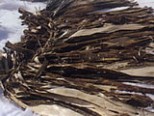
    The black bark is laid out on top of the snow, and then fresh snow is sprinkled on top. The day after it snows, the whole family pitches in to do this work. It is left in this state for about a week. The ozone produced when the snow melts bleaches the bark of the paper mulberry tree white. This state of the bark is called white bark.
    The bleached hides are then left to dry in the sun.

    Step 5: Boiling

    To soften the fibers, the white bark is boiled in a pot containing alkaline agents (caustic soda and sodium carbonate). Originally, straw ash was used as the alkaline agent. Straw ash is the least damaging to the fibers.
    After boiling, rinse off the alkali with water.

    Step 6: Bleaching

    This process didn't exist in the past. Nowadays, with whiteness being a requirement for washi paper, bleaching is done using bleaching powder or sodium hypochlorite. Any debris mixed in with the bleached fibers is then removed.

    Step 7: Thawing

    The white bark is placed in a beating machine, caustic starch is added, and it is beaten for about an hour to separate the fibers one by one.
    We refer to all of the steps up to this point as "raw material preparation work."

    Step 8: Shape the ball, small size

    The pulverized paper mulberry bark is bundled into balls weighing approximately 1 kilogram. This bundling is done to measure the raw material to be placed in the papermaking water tank called a "sukibune."
    Four balls are placed in a straining vat with 600 liters of water, and then 15 liters of mucilage from the hibiscus plant (commonly known as tororo aoi), which helps to evenly disperse the fibers in the water, are added and mixed well. This process is called "cobbling".

    Step 9: Skiving

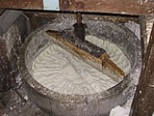
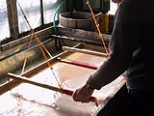
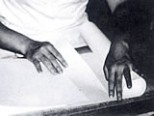
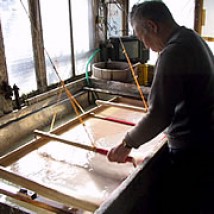
    Now, finally, we begin the papermaking process. The paper fibers are scooped up from the water using a screen. Years of experience are needed to ensure that the entire surface of the screen is of uniform thickness, and that every sheet of paper is of the same thickness. The screen is shaken vigorously vertically and horizontally to remove excess water, and the paper is then stacked.
    After applying pressure to the freshly made paper to squeeze out the moisture, each sheet is placed on a heated iron plate and dried.

    Step 10: Cutting and paper splicing

    Cut the paper into pieces measuring 28.1 cm vertically and 40.6 cm horizontally using a paper cutter. For shoji screens, 48 of these pieces of paper are glued together to make one 19-meter length.
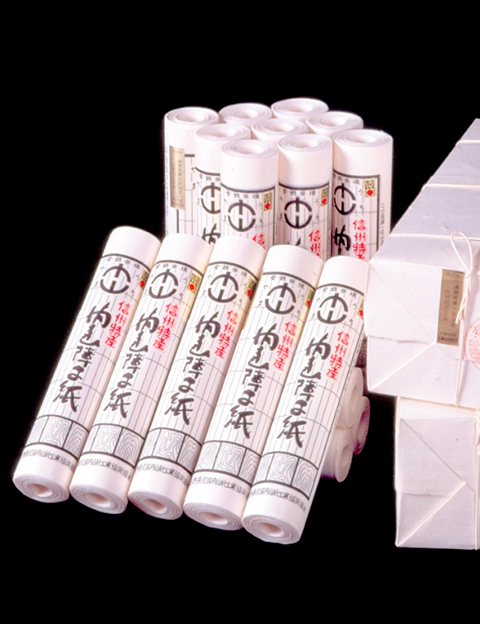
    UCHIYAMA Washi (Papers)➡UCHIYAMA Gami (Papers) is now complete after being wrapped.


  • Close-up

    Traditional UCHIYAMA Washi (Papers)➡UCHIYAMA Gami (Papers) created during the harsh winter season.

    In winter, UCHIYAMA Washi (Papers)➡UCHIYAMA Gami (Papers) papermaking is a famous symbol of snowy Iiyama. Washi paper has been a vital everyday item since the time of Prince Shotoku, preserving the Japanese spirit of harmony and providing comfort as shoji screen paper.


    Exploring the history of washi paper

    According to the "Nihon Shoki," a historical record of Japan during the Ritsuryo period, washi (Japanese paper) production in Japan began around 610 AD, during the reign of Prince Shotoku. The papermaking technology, invented in China at the end of the Han dynasty, reached Japan via the Korean Peninsula and became established as washi. One might wonder why it's called washi when it was invented in China, but it must have been something that suited Japan very well.
    Washi paper, made from kozo, mitsumata, and ganpi plants that grow naturally in the land, has preserved the spirit of the Japanese people. Used as shoji screen paper, washi paper was indispensable to our lives. UCHIYAMA Washi (Papers)➡UCHIYAMA Gami (Papers) Paper is the company that carries on the art of handmade washi paper to this day.

    As a side job during the snowy season

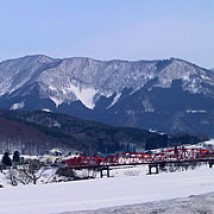
    "We're the only ones who do this full-time, year-round," said Mr. Abe, chairman of the Hokushin UCHIYAMA Washi (Papers)➡UCHIYAMA Gami (Papers) Industry Cooperative. I wondered if there were really that few artisans in the area, but it seems that's not the case. "UCHIYAMA Washi (Papers)➡UCHIYAMA Gami (Papers) originally developed as a winter job in this area surrounded by snow." In Iiyama, a heavy snowfall region, farm work is impossible in winter, leaving no source of income. Papermaking was well-suited to such an environment. "We bleach the mulberry fibers with snow. The melting snow has a bleaching effect." The sight of mulberry fibers lined up on the snow, with the whole family working together to cover them with fresh snow when it fell, was a common sight in winter in Iiyama. "We only bleach them with snow here and in Niigata. Other places mostly bleach them in rivers." UCHIYAMA Washi (Papers)➡UCHIYAMA Gami (Papers) was originally a seasonal job that could only be done in winter.

    The harsh winter snow nurtured the papermaking techniques of UCHIYAMA Washi (Papers)➡UCHIYAMA Gami (Papers).

    For handmade paper, Iiyama mulberry is the best.

    Nowadays, they not only make washi paper by hand, but also by machine. Because the supply of raw materials is limited, imported mulberry is often used in the machines. Apparently, the difference in raw materials is very clear when you make it by hand. "We import a lot of mulberry from Thailand these days. But mulberry grown in warmer regions is not suitable for handmade washi paper." The difference in climate changes the quality of the fibers.
    "UCHIYAMA Washi (Papers)➡UCHIYAMA Gami (Papers) is characterized by its durability. It has been used as shoji paper for a long time because of its strength." Kozo has the longest fibers of all washi paper raw materials, and this makes a difference when it is used for shoji paper. Uchiyama washi paper has been loved by people who seek durability.

    The sight of paper mulberry branches drying in front of a papermaker's house.

    Advanced technique to thin the paper to the same thickness from beginning to end.

    "If you're looking for handmade paper, this is the person to go to," Mr. Abe said, leading me to the workshop of traditional craftsman Kinichi Kobayashi. UCHIYAMA Washi (Papers)➡UCHIYAMA Gami (Papers), which was once a side business for farmers, has been passed down to the eldest sons of farming families, like Mr. Kobayashi, who have continued the traditional techniques. We were immediately shown the handmade papermaking technique. "We call this vat a 'boat.' We make 20 sheets of paper with one boat." A slatted tray is placed in the boat, and the fibers are evenly layered throughout by shaking it. The density of the mulberry fibers in the boat is completely different between the first sheet and the last. It's dense at the beginning but thin at the end. Yet, the skill of the craftsman lies in making the paper the same thickness each time.
    "Good paper can only be made in winter." The hibiscus (commonly known as tororo aoi) dissolved in the water prevents the fibers from sinking, and also helps when separating the washi paper sheet by sheet after it has been made. Because it is made from natural ingredients, it spoils easily in the summer, and its quality changes quickly. The high quality of UCHIYAMA Washi (Papers)➡UCHIYAMA Gami (Papers) has been maintained by the harsh work of handling snow and water in the bitter cold.

    High-quality washi paper is made precisely because it is produced during the cold season.

    Life with shoji screens

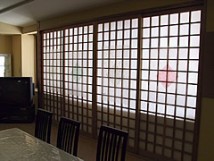
    With the increase in Western-style houses, many people now live in homes without shoji screens. Shoji screens were once a common sight in every home. Replacing the shoji paper while doing a thorough cleaning on New Year's Eve was a quintessential winter scene in Japan. "In the old days, there were no shutters, and shoji paper was used to separate the inside from the outside." Washi paper, which absorbs and releases moisture from inside the house, also lets in just the right amount of light, making it well suited to Japanese architecture. In recent times, with the renewed appreciation for building houses with natural materials, shoji paper deserves more recognition. Moreover, shoji screens somehow have a calming effect on our hearts. Sitting on a tatami mat and sipping tea in the light filtering through the shoji screens, UCHIYAMA Washi (Papers)➡UCHIYAMA Gami (Papers) evokes a nostalgic sense of Japanese tradition.

    It has a history of maintaining its reputation as shoji paper.

    Craftsman Profile

    Kinichi Kobayashi

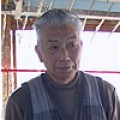
    A leading traditional craftsman representing UCHIYAMA Washi (Papers)➡UCHIYAMA Gami (Papers). His cheerful expression while talking suddenly transforms into a serious one when he begins making paper.

    Kazuyoshi Abe

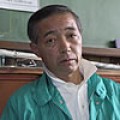
    He is the chairman of the Kitashin UCHIYAMA Washi (Papers)➡UCHIYAMA Gami (Papers) Industry Cooperative Association. In addition to handmade washi paper, he also manufactures washi paper using machines. Mr. Abe's washi paper is used for shoji screens and for preserving government ledgers, among other things.

    Anecdotes

    The Japanese spirit lies in cherishing the environment.

    Until modern times, Japan was perhaps the only developed country that coexisted with the environment. This is clearly evident in the tradition of washi paper making. It is made using locally sourced materials, produced in a way that does not pollute the environment, and returns properly to the soil after use.
    The wisdom of people from the past is especially evident in the making of washi paper. Bleaching is done by snow bleaching, which does not use harmful chlorine, the fibers of the paper mulberry are broken down by freezing them in the freezing cold air, lye is used to loosen the fibers, and non-woody materials that grow naturally are used instead of wood as raw material.
    If there had been no consideration for the environment, Japanese culture might have become much cruder. Perhaps the culture of washi paper wouldn't have developed, and we wouldn't have been able to capture the world of wabi-sabi. Reflecting on the feelings of people in the past when they picked up a brush is surely one of the unique pleasures of traditional crafts.

    • Hina dolls made of washi paper are popular with children.


overview

Craft item name UCHIYAMA Washi (Papers)➡UCHIYAMA Gami (Papers)
Reading Uchiyamagami
Classification of crafts Japanese paper
Main Products Shoji paper, long-lasting paper, processed calligraphy paper, paper products, single-strand paper
Main manufacturing area Iiyama City, Nozawa Onsen Village (Shimotakai District), Sakae Village (Shimominochi District)
Designated date June 2, 1976

contact address

■ Production area association

UCHIYAMA Washi (Papers)➡UCHIYAMA Gami (Papers) Cooperative
389-2322
6385 Mizuho, Iiyama City, Nagano Prefecture
TEL: 0269-65-2511
FAX: 0269-65-2601

http://www.uchiyama-gami.jp/

Features

The raw materials used are all from kozo, the strongest and most flexible of the raw materials for washi paper, and no pulp is used. Paper made from 100% kozo is tough, breathable, and has excellent moisture retention. It does not fade in sunlight, is tough and durable, making it ideal for shoji screens. It is also excellent as paper for long-term storage.

How to make it

There are about 20 to 25 steps involved in making UCHIYAMA Washi (Papers)➡UCHIYAMA Gami (Papers) from a mulberry tree. To produce high-quality UCHIYAMA Washi (Papers)➡UCHIYAMA Gami (Papers), the preparation of the raw materials, the papermaking process, and the drying process are all crucial. The papermaking process, in particular, is essential in determining the quality of the paper. In the "nagashi-zuki" method, the papermaker continuously moves the paper back and forth and side to side without stopping, working in extremely cold water that can cut your hands, to create the paper's texture. Preparing the water to facilitate the papermaking process is also essential.

Please see here for information on traditional craftspeople.

Japanese traditional craftsman
top