SEKISHU Washi (Papers)

Shimane Prefecture

The name of Sekishu appears in the "Engishiki," a document written during the Heian period.
According to the "Kamisuki Chohoki," a book published in the late Edo period, "during the Nara period, when Kakinomoto no Hitomaro was serving as a provincial governor in Iwami Province, he taught the people how to make paper." SEKISHU Washi (Papers) has been made continuously for approximately 1300 years. What started as a side business has now become almost a full-time occupation, and washi papermaking continues to be carried out using the same techniques and methods as in the past.

  • Technology/techniques/raw materials

    Technology/techniques

    1. Papermaking shall be carried out using the following techniques or methods:
    (1) By "flowing water" or "bottle water".
    (2) The mats used shall be made of bamboo or reeds.
    (3) For the "neri" (fermented paste), use tororo aoi (a type of okra).

    2. Drying shall be done by "board drying" or "iron plate drying".
     

    raw materials

    The main ingredients shall be paper mulberry, mitsumata, or ganpi.


  • Work scene

    Step 1: Steaming of raw materials

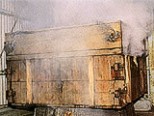
    The raw materials are paper mulberry (kozo), mitsumata (mitsumata), and ganpi (ganpi). These logs are cut to a length of about one meter and steamed using the "seiro-mushi" method to make the work easier for a small number of people. This makes it easier to separate the core from the outer bark.

    Step 2: Black bark trimming

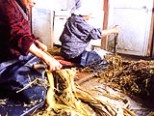
    After peeling off the black bark and letting it air dry, soak it in water for about half a day to soften it. Then, place it on a cutting board and carefully shave off the outer layer of each bark with a knife.

    Step 3: Boiling

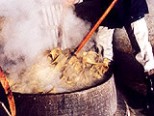
    After washing with water to remove impurities, put water in a boiling pot, add 12% soda ash relative to the water volume, and after it boils, add the raw materials while loosening them. Turn the pot over every 30 minutes to ensure even cooking, and boil for about 2 hours. Then let it steam.

    Step 4: Beating

    After boiling, the raw materials are carefully washed one by one in clean water, then placed on a hard wooden board and thoroughly beaten with an oak stick to break down the fibers. Here in Sekishu, the basic method is "six passes and six turns," which involves six back-and-forth movements from side to side and six up-and-down movements.

    画像をクリックすると動画が再生されます

    Step 5: Kazushi (a type of pickled roe)

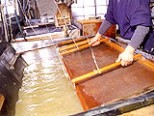
    Water, pulp, and hibiscus are added to the papermaking vat and mixed evenly. The pulp is quickly scooped up from the vat and used to form the surface of washi paper across the entire bamboo mat.

    Step 6: Condition

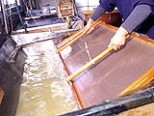
    The paper pulp is scooped up relatively deeply, and while adjusting the tension back and forth, the fibers are intertwined to create layers of washi paper. The thickness varies depending on the number of repetitions.

    画像をクリックすると動画が再生されます

    Step 7: Discarding water

    Once the desired thickness is reached, any excess water and paper pulp remaining on the bamboo mat are quickly sifted out.

    Step 8: Transferring to paper bed

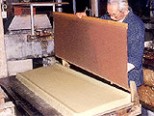
    After the washi paper has been made and placed on the bamboo mat to drain the water, it is moved to the paper-making table. The sheets are then stacked one by one on the paper-making table.

    Step 9: Drying

    After that, each sheet is peeled off, and the damp paper is used with a brush to stick onto a ginkgo drying board, which is then dried in the sun.

    Step 10: Sorting

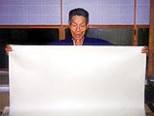
    Each sheet of dried washi paper is carefully selected by hand, removing any imperfections such as uneven thickness, tears, scratches, and dust.


overview

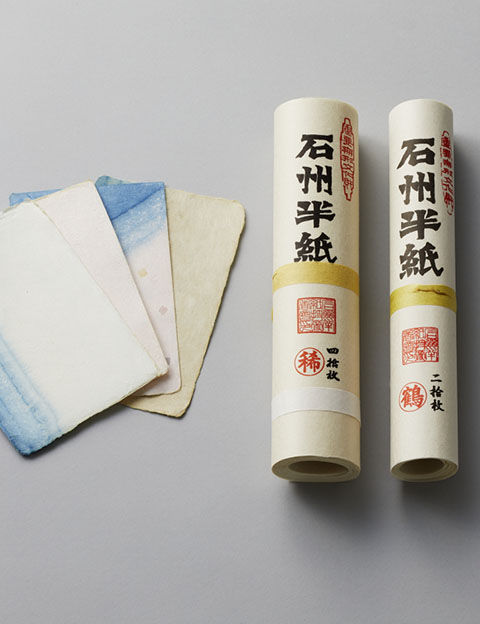
Craft item name SEKISHU Washi (Papers)
Reading Sekishuwashi
Classification of crafts Japanese paper
Main Products Shoji paper, Sekishu Hanshi paper, envelopes, letter paper, postcards, business cards
Main manufacturing area Gotsu City, Hamada City
Designated date April 11, 1989

contact address

■ Production area association

SEKISHU Washi (Papers) Cooperative
699-3225
683-3 Furushiba, Misumi-cho, Hamada City, Shimane Prefecture
Kawahira Workshop
TEL: 0855-32-1166
FAX: 0855-32-1166

https://sekishu.jp/

Features

Kozo paper has long fibers and is the strongest. Mitsumata paper is delicate, elastic, and has a soft sheen. Ganpi paper is the most delicate, glossy, and resistant to insect damage. Kozo paper, which is widely produced, was once used by merchants for their ledgers and was so durable that it could be thrown into wells to preserve it during fires.

How to make it

The raw materials used are the bast fibers of plants such as paper mulberry, mitsumata, and gampi, which are boiled with soda ash and other materials. The resulting water in which the fibers have been dissolved is then thickened with mucilage from the roots of the tororo aoi plant. A tool consisting of a bamboo or reed mat sandwiched between a frame is placed into the resulting liquid paper material, and papermaking is carried out using a technique called "nagashi-zuki" (flow-making). The finished paper is then dried in the sun or on an iron plate to complete the process.

Please see here for information on traditional craftspeople.

Japanese traditional craftsman
top