NARA Fude (Brushes)

Nara Prefecture

The history of brush making in Nara dates back about 1200 years, when Kukai traveled to Tang China, mastered the art of brush making, and then, upon returning to Japan, passed on that technique to the inhabitants of Yamato Province.
Since the Meiji era, it has been used throughout the country along with the establishment of the school education system, and continues to be used today.

  • Technology/techniques/raw materials

    Technology/techniques

    1. Using rice husk ashes to start a fire and rub the husks together.

    2. After "flattening" the fish, cut it into short pieces using a "dividing board".

    3. The hair blending should be done by "kneading and mixing".

    4. For the "ojime" (a type of kimono), use hemp thread.


    raw materials

    1. The material for the ear of grain shall be the hair of a goat, horse, raccoon dog, weasel, deer, cat, flying squirrel, squirrel, or marten, or animal hair of equivalent quality.

    2. The material of the shaft shall be bamboo or wood.

  • Work scene

    Process 1: Hair sorting/selection

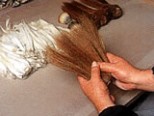
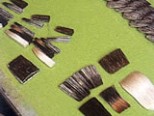
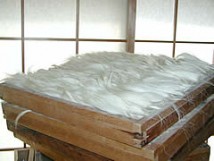
    The raw bristles are classified according to their intended use, such as thickness, flexibility, and length, and then the classified bristles are further sorted into parts such as the tip, throat, and body.
    The raw materials for the brushes are animal hairs selected from 10 different types, chosen for their ideal balance of softness and hardness, and their ability to hold ink well. However, the type of animal, the time of year the hair is collected, and the part of the body from which the hair is taken all subtly affect the final result. The brush-making technique, which involves skillfully combining hairs of varying elasticity, strength, and length, is the result of many years of experience and research by master brush makers.

    Step 2: Extraction

    Comb the raw wool to remove any downy fibers, then mix it thoroughly.

    Step 3: Hair massage / Nail removal

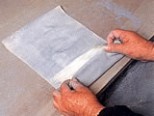
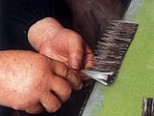
    The process involves sprinkling the deer hair with ashes from burnt rice husks, applying heat, wrapping the hair in deerskin, kneading it thoroughly to remove oil and straighten any curls, then carefully plucking out small amounts of the straightened hair with the fingertips, aligning the ends, and preparing the hair.

    Step 4: Trimming the ends / Removing backcombing

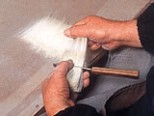
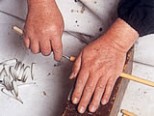
    Next, we use a metal tool and a wooden board to even out the ends of the hair. We then remove any unruly hairs with a blunt knife.

    画像をクリックすると動画が再生されます

    Step 5: Flounder

    Dip the trimmed hair in water and flatten it out.

    Step 6: Shaping

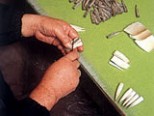
    The hairs from the mouth, throat, and waist are cut to the appropriate lengths, then assembled in stages, and the shape is refined. This is a crucial step that requires the delicate technique and skill necessary to create a good brush.

    Step 7: Mixing

    The overlapping hairs are thoroughly kneaded and mixed repeatedly to ensure an even distribution, removing any damaged hairs.

    Step 8: Core setting

    The mixed bristles (core hairs) are combined with glue, divided into sections of varying thickness, and then threaded through a tube called a "koma" to determine the desired thickness. Finally, they are allowed to air dry.

    Step 9: Applying the outer coat

    Thinly stretched, beautiful hairs, such as cosmetic hair, are wrapped around the core hair like a sushi roll.

    Step 10: Hemp fiber binding

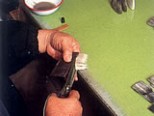
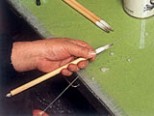
    The base of the dried ear of grain is tied with hemp thread, and the end is burned with a hot iron to tighten it firmly. This process creates the ear neck.

    画像をクリックすると動画が再生されます

    Step 11: Refilling

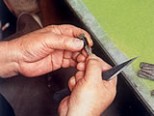
    The inside of the brush handle is carved out with a small knife, and the brush head is attached with adhesive.

    Step 12: Finishing

    The bristles, attached to the brush handle, are thoroughly soaked in seaweed paste (funori), wrapped with thread to squeeze out any excess paste, shaped, and then dried. A sheath is then placed over it, and the brush name or other details are engraved on the handle to complete the process.


  • Close-up

    Creating "good things." That's everything to a craftsman: NARA Fude (Brushes).

    Brush making in Japan began in the early Heian period when Kobo Daishi (Kukai) traveled to Tang China as part of a Japanese mission. It is said that Kukai himself taught the art of brush making to a resident of Yamato Province named Kiyokawa, which marked the beginning of NARA Fude (Brushes) making and, consequently, the beginning of brush making in Japan.


    A good brush is made from "skill" and "materials".

    Currently, dozens of types of animal hair are used for brushes, including sheep's wool, badger hair, rabbit hair, and cat hair. Furthermore, their elasticity and other properties vary greatly depending on the part of the body from which the hair grows, the time of year it is shorn, and the place of origin. Generally, Chinese brushes are made by mixing two to three types of raw hair, but Japanese brushes are often made by mixing around ten types of hair. This is because there are few animals inhabiting Japan that are suitable for brush hair, and the amount that can be harvested is also small, so the wisdom of brush makers from ancient times is still alive in the air, as various types of hair are mixed to bring out the characteristics of the brush.

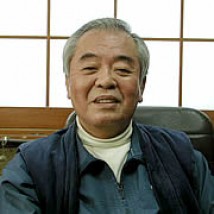
    Koichi Fujii, a traditional craftsman with 50 years of experience in brush making.

    Mr. Fujii was born in 1930 in Kumano-cho, Hiroshima Prefecture. Kumano-cho is still known as one of the leading brush-making centers in Japan in terms of quantity. His father was a brush craftsman there, and Mr. Fujii followed in his footsteps and entered the world of brush making in Kumano-cho. Although he was young, he quickly improved his skills with his inherent enthusiasm, and wanting to work at an even higher level, he moved to Nara at the age of 17 to create the best brush in Japan.
    Looking back on that time, Fujii said with a friendly smile, "First of all, the brushes themselves were completely different. The quality was different, and above all, I was surprised that there were hundreds of different types. In Nara, they make them to suit the preferences of the calligraphy teacher. I came to Nara thinking I was a full-fledged calligrapher in Kumano, but I realized that Nara is truly the best place in Japan for making brushes."
    "Even after coming to Nara, there was no master, and back then, nobody was kind enough to teach their skills to others. But I would make up all sorts of excuses and pretend to go visit the workshops of senior craftsmen in the neighborhood, and steal their techniques by 'watching' them." "Also, back then, brushes made in China were of the highest quality, so I spent all day and night researching and experimenting on my own. Hardship? I never thought of it as hardship at all. I was just always thinking about making the best brush in Japan, no, the best brush in the world. Before I knew it, I had been making brushes for over 50 years," he says with a carefree laugh.
    "For a craftsman, it all boils down to creating something 'good.' And if the people who use it praise it, that's the greatest reward."

    Koichi Fujii, who has been making brushes for 50 years.

    We will have His Majesty the Emperor and His Imperial Highness the Crown Prince review our technology.

    "My most memorable experience was when His Imperial Highness the Crown Prince (the current Emperor) saw my brush-making techniques in 1968, and then in 1969, His Imperial Highness Crown Prince Naruhito saw them. Of course, I was nervous to have god-like figures peer into the work of a mere brush maker, but I was also very happy and honored."
    "The current Crown Prince spent almost an hour looking around, even though his scheduled visit was only 20 minutes. He must have been really interested. I still remember how excited I was," Ms. Fujii said, showing me a commemorative photo from that time, her eyes sparkling as she spoke.

    The dream of "making the best brush in Japan"

    The dream Fujii set out to create "the best brush in Japan" when he was 17 years old seems to have been brilliantly fulfilled from the outside. However, Fujii says, "This world is incredibly complex. Even after more than 50 years, I still can't make a brush that I'm completely satisfied with. And it only gets more difficult as I get older."
    "I will continue working until I can create a brush that truly brings joy to the person who uses it. That is my dream, and my passion as a craftsman. And if I may say just one thing, I believe that the 'Way of Calligraphy' is at the heart of the Japanese people. I believe that learning the beauty of characters is very important. My other dream is for the 'Way of Calligraphy' to be revived as a part of Japanese culture."
    Finally, we received some profound words about the culture of the Japanese people.

    Brushes found in Mr. Fujii's workshop

    Anecdotes

    The origin of the brush in China

    Tracing the origins of the "brush," in ancient times, they were sharp, needle-like objects made of stone, without using bamboo for the shaft, or brushes made by beating plants and trees. Later, around 400 BC, during the reign of Qin Shi Huang, an ancient Chinese general who led 300,000 soldiers to conquer the Xiongnu and is said to have built the Great Wall of China is believed to have created a brush similar to the modern one.
    As time passed, a bamboo tube was discovered in a tomb from China's Warring States period, and inside was a brush with animal hair attached to a bamboo shaft. This is believed to be the oldest known brush of the same style as those used today.
    From the Warring States period into the Han dynasty, brushes similar to modern ones were created, made by attaching animal hair to bamboo. Unlike the earlier brushes that could only draw thin dotted lines, these brushes could hold plenty of ink, bringing about a major change and advancement in calligraphy itself, and enabling things like rapid sketching of cursive script.
    As time progressed from the Jin dynasty to the Sui and Tang dynasties, brush handles came to be made not only from bamboo but also from colored glass and ivory, and were made from various precious materials such as gold, silver, and lacquer. However, the most famous brush from that era that remains in Japan today is the "Tenpyo brush," which was used in the eye-opening ceremony of the first Great Buddha in 752, and is still preserved as an imperial treasure in the Shosoin.

overview

Craft item name NARA Fude (Brushes)
Reading Narafude
Classification of crafts stationery
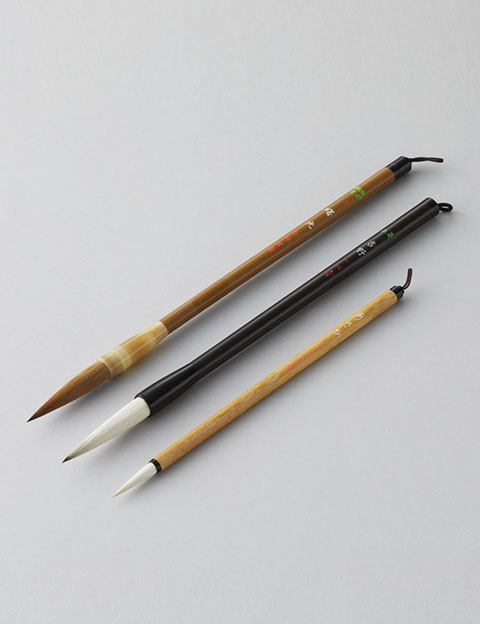
Main Products calligraphy brush
Main manufacturing area Nara City, Yamato-Koriyama City
Designated date October 14, 1977

contact address

■ Production area association

Nara Calligraphy Cooperative Association
630-8016
78-1 Minami-Shinmachi, Nara City, Nara Prefecture
Akashiya Co., Ltd.
TEL: 0742-33-1015
FAX: 0742-33-1015

Features

The hair of over a dozen different animals, including sheep, horses, deer, raccoons, weasels, martens, rabbits, and squirrels, is used as the raw material for the brushes. The brushes are made by skillfully combining hairs with a wide variety of textures, such as elasticity, strength, and length.

How to make it

Depending on the type of brush, the hair to be used as raw material is sorted, rubbed with ash, and gathered together. It is then soaked in water, shaped, mixed, and used to create the core, around which the outer hairs are wrapped. Once dry, the base is sealed with hemp thread to complete the brush head. It is then placed in the handle, adhesive is applied, and the brush's name is engraved to finish it.
Please see here for information on traditional craftspeople.

Japanese traditional craftsman
top