OKAZAKI Sekkohin (Stone Carving)

Aichi prefecture

Its origins can be traced back to the late Muromachi period. Later, during the Azuchi-Momoyama period, the lord of Okazaki Castle, located in what is now Aichi Prefecture, invited stonemasons from Kawachi and Izumi provinces to construct stone walls and moats in order to develop the castle town.
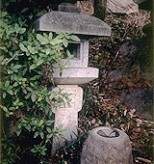
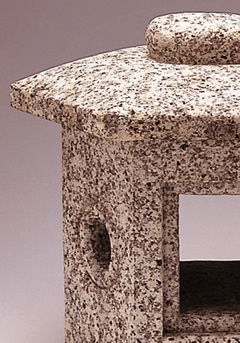
These stonemasons honed their skills and techniques, creating the prototypes for OKAZAKI Sekkohin (Stone Carving) such as Kasuga-style lanterns and hexagonal snow-viewing lanterns. At the beginning of the 19th century, there were 29 stonemasons, which increased to about 50 by the end of the 19th century, and before the war, at its peak, there were as many as 350, but recently the number has been declining.

  • Technology/techniques/raw materials

    Technology/techniques

    1. The stone materials used must be free from "bursting" or "corrosion."

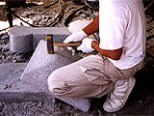
    2. For mold making, use a chisel, hammer, sledgehammer, and bishyan.

    3. The finial and roof of a multi-tiered pagoda shall be joined using mortise and tenon joints.

    4. The carving shall be in the form of relief, line carving, or openwork using a chisel, spatula, or openwork tool.

    5. The finishing process shall be one of the following: "scraper finish," "poking finish," "beating finish," "bishyan finish," or "pluck finish."
     

    raw materials

    The raw material shall be Okazaki granite or stone of equivalent quality.

  • Work scene

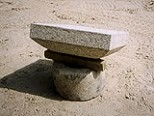
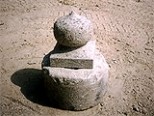
    Stone lanterns come in various types, broadly categorized into "basic types" where the six constituent parts—the ball, cap, fire chamber, base, pillar, and base ring—are clearly identifiable, and "variations" where they are not. Here, we will introduce the process of making an Oribe-style lantern, which is a type of lantern that is installed in a vase. The Oribe-style lantern is composed of the ball, cap, fire chamber, base, and pillar from top to bottom.

    Step 1: Ball

    After the processes of "under-shaping," "centering," "square shaping," "rough shaping," and "rough finishing" (see the section on the cap for details on each process), the surface of the ball is finished using a "bishan (a hammer with a pyramidal protrusion)," a "tataki," and a "kobera."

    Step 2: Cap (1)

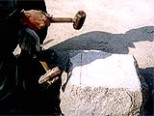
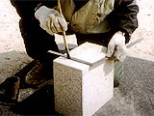
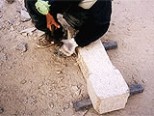
    After each of the following steps: "Creating the top and bottom of the stone," "Finding the center (using a square and ruler to find the center of the top of the rough stone)," "Setting the right angle (using a curved tool to cut and mark the dimensions of a rectangle on the bottom)," "Rough shaping (using the tools 'settou' and 'koyasuke' to roughly shape the marked rough stone)," and "Marking (Marking the rough stone to create the 'mukuri' (roof shape)"), the rough shaping is done on the marked rough stone using "settou" and "chisel" to create the eaves and bring out the curve.

    Step 3: Cap (2)

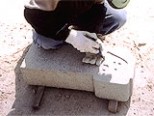
    The surface of the hat is finished using techniques such as "bishan" and "tataki".

    Process 4: Fire bag (1)

    "Top and bottom surface construction." The rough stone is cut flat into top and bottom surfaces using a cutting machine.

    Process 5: Fire bag (2)

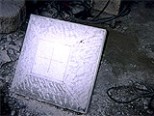
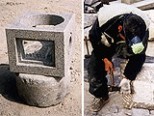
    After "centering," "square marking," and "rough shaping," the rough construction is completed to form a tetrahedron, and then "marking" is done for two sides with holes and two sides with windows.

    Process 6: Fire bag (3)

    The surface of the lantern shade is finished using tools such as a "bishan," a "kobera," and a "tataki."

    Process 7: Receiving

    After "creating the top and bottom framing," "centering," "rectification," "rough shaping," and "rough finishing," the surface is finished using "bishan" and "tataki."

    Process 8: Pillar (1)

    After "creating the top and bottom of the stone," "centering," and "setting the right angles," the rough stone that has been roughly cut is then roughly shaped using a chisel and a sledgehammer.

    Step 9: Pillar (2)

    sculpture
    A small wooden tool ("kobera") is used to carve characters into the upper part of the pillar (the bulging part). Sometimes a Buddha image is carved into the lower part (slightly above where it will be placed in the soil). After this, a small wooden tool ("bishan") is used to finish the entire surface of the pillar.

    工程10: 完成

    Assemble each component, and it's complete.

  • Close-up

    The emotionally rich beauty of the sculptures passed down in the "City of Stone"

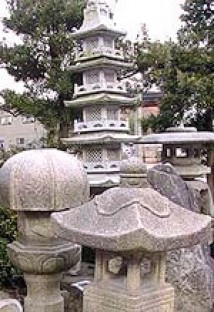
    Stone carvings flourished in Okazaki, a region known for its high-quality granite, during the Edo period. Originally created as lamps for shrines and temples, stone lanterns eventually became commonplace garden lanterns, expanding the world of garden decoration with their simple yet elegant texture.


    The joy of creating something with your own hands

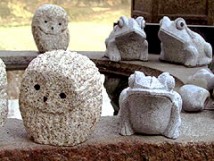
    Even though we refer to them simply as "stone lanterns," they can be divided into "standing lantern type," "snow-viewing type," and "flower-planting type," and these are further classified into more specific types. In front of the factory of Kazuo Ueno, who manufactures and sells stone products, various types of lanterns, including the representative Kasuga lantern, were lined up. Ueno entered the world of stone sculpture when he was 17 years old. While working in Osaka after leaving his hometown of Kumamoto, he visited a relative who ran a "stone shop" in Okazaki and tried making a frog figurine about 30 centimeters in size. "I was so engrossed in it for about three days that I lost track of time." Stone was the first material he touched as an experience of making something with his own hands. Attracted by its fascination, he began training to become a stonemason.

    Stone lanterns resonate with the Japanese people's love for nature and the beauty of the seasons.

    Because it's a natural thing, all we can do is subtract.

    "Stone is inherently hard, isn't it? It's easy to create a hard image from it. The challenge is how to give it a soft feel. It's like expressing the image of pottery using stone." There are things that can only be expressed with stone. "Normally, artificial things are made by adding things, a world of addition. In contrast, with stone, you only remove by carving. There is an aesthetic of subtraction." Just subtracting. That may lead to removing impure thoughts, or it may be about discerning the essence. A wabi-sabi unique to natural materials is born.

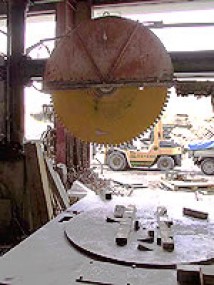
    The factory is also equipped with large machinery for processing.

    Producing spaces

    Of course, Ueno doesn't only create lanterns. With the changing architectural styles, he's recently been creating many stonework pieces that blend Japanese and Western styles, focusing more on "gardening" than just "gardens." He considers how to effectively incorporate stone into small spaces. He handles everything from design to production, but his focus remains on the creation process. "Design is a world of imagination in the mind. It's a two-dimensional thing drawn on paper. Actually creating is in the real world, and it requires a three-dimensional approach. Only after creating does one realize what worked well, or what didn't turn out as intended."

    Why not start enjoying stonework with small decorative items?

    As a craftsman, I am committed to the act of "making things."

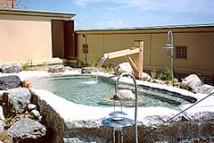
    In 2000, he created one of Japan's largest open-air stone baths. Because the granite stones, each weighing 75 tons, were difficult to transport, all the processing was done on-site in Toyota City. It was a massive undertaking, taking several people six months to create two baths, one for men and one for women. After processing, each bath weighed 43 tons. It measures 6 meters long and 3.5 meters wide. Filled with hot spring water from a local Mie Prefecture, the open-air bath is spacious enough to comfortably accommodate 30 people. "I'm happy if customers are satisfied and pleased with what I've created," says Ueno. "Stonework isn't something you make using a mold; everything is original. 'Creating' is the essence of being a stonemason."

    A stone open-air bath. It looks like it would be very relaxing.

    Bringing comfort and light to the lives of modern people

    Stone lanterns have evolved from religious objects offering light before gods and Buddhas to perpetual lamps illuminating dark paths, and further to stonework adorning gardens, but they have always remained a form of beauty that lights a flame in people's hearts. This is true not only of lanterns, but of all stonework imbued with quiet intention. It is a shame that with changing housing circumstances, gardens are being converted into parking lots, or stones are being removed because they are considered dangerous for children. "No matter how much times change, as people get older, they will surely want peace and tranquility," says Ueno. Stones will never decay and will be cherished forever, even as generations pass. Touching their unique texture, which marks a slow rhythm, will provide a moment to regain peace of mind in today's busy society.

    Craftsman Profile

    Kazuo Ueno

    Born in 1955.
    At the age of 17, I was drawn to the fascinating world of stonework and changed careers.
    "I want you to choose something that brings you peace of mind."

    Anecdotes

    Try incorporating stones into your everyday life.

    Many people dream of owning a house with a garden, but with today's housing situation, having a large garden has become difficult. While the bold use of stone in traditional Japanese gardens has become less common, it seems that more and more people are enjoying gardening by cleverly utilizing small spaces. Even with a Western-style house, why not try subtly placing stonework among the greenery to add a touch of ingenuity? If you're building a new house, you could make the gate an art object, lay stones in front of the entrance, or use stone in certain areas to create a unique look.
    Even those living in apartments without a garden can enjoy gardening in many ways, such as adding small stone ornaments to their balcony garden. When you place them close by, you'll notice that stones, which are supposed to be hard, have a moist, warm, and gentle appearance.

overview

Craft item name OKAZAKI Sekkohin (Stone Carving)
Reading Okazaki Sekkohin
Classification of crafts Stonework
Main Products Lanterns, multi-tiered pagodas, potted plants
Main manufacturing area Okazaki City
Designated date August 3, 1979

contact address

■ Production area association

Okazaki Stone Masonry Industrial Park Cooperative
444-0936
48 Umenoki, Kamisasaki-cho
Within the Okazaki Stone Masonry Industrial Park Cooperative
TEL: 0564-31-3823
FAX: 0564-31-1685

http://osd.tukai.jp/

Features

The main product, stone lanterns, feature simple yet beautiful straight and curved lines that intersect to form a variety of lines and surfaces. The intricate carvings, employing advanced techniques, imbue the stonework with delicacy and elegance.

How to make it

Standing lanterns are made from Okazaki granite. The "ink marking" process, where the boundaries of the carvings will vary are drawn on the raw stone, is done using a carpenter's square. The finishing is done using tools such as chisels, hammers, trowels, and small spatulas, and then the lanterns are assembled from the bottom up, with the base, pillars, base, fire chamber, cap, and finial being placed on top.

top