WAKASA Menou Zaiku (Agate Work)

Fukui Prefecture

Onyu, located in present-day Wakasa no Sato, Fukui Prefecture, is home to the largest shrine in Wakasa. It is said that during the Nara period, a seafaring people called the Wani clan, who worshipped jewels, came to this area, built the Wani Road in front of the shrine, and made jewels there as their occupation, which marked the beginning of the area.
During the mid-Edo period, a technique for firing agate raw stones to produce beautiful colors was established. In the 19th century, the techniques for craft carving were further developed, leading to the techniques used today.

  • Technology/techniques/raw materials

    Technology/techniques

    1. The raw stone shall be hardened using "namarashi" and "agebi" methods.


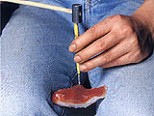
    2. The notching is done by using an iron arrow and a small mallet to make rough and fine notches.


    3. The carving shall be done in one of the following ways:
    (1) For vessels, the carving shall be done using a flat grate, as well as carving with an iron sesame seed, and flat carving.
    (2) For items other than vessels, the carving must be done using a combination of at least two of the following techniques: flat carving, flat carving, gouging, relief carving, openwork carving, and groove carving, using a flat grater and a spinning top.


    4. Polishing should be done using a paulownia wood spit, paulownia wood stick, etc., to ensure that no sand marks are left.
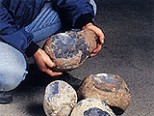
     

    raw materials

    The raw material will be processed into agate.

  • Work scene

    Agate is an extremely hard stone (hardness 7), which makes it very difficult and time-consuming to process.
    WAKASA Menou Zaiku (Agate Work) is unique in the world for its "quenching" process, which oxidizes the iron content to produce a beautiful red color. The entire process is broadly divided into stages: selecting the raw stone, quenching, cutting, and polishing, until the craftsmanship is complete. Please witness this precious technique, which can be considered the pinnacle of gemstone craftsmanship.

    Process 1: Raw stone

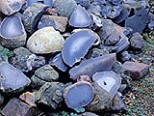
    High-quality raw materials were available in Hokkaido from the middle of the Meiji era, but they gradually began to be depleted, and currently high-quality stones from Brazil are used.

    Process 2: Stone inspection

    We examine the raw stones and determine what kind of craftsmanship they are suitable for based on their color and pattern. If the stone is clean all the way through, we use it for large sculptures; if it is hollow inside, we use the good quality parts for jewelry such as earrings and brooches.

    Step 3: Cutting into large pieces

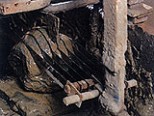
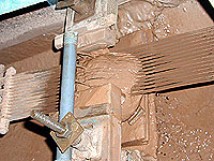
    In the process of cutting the raw stone to a size suitable for crafting, a "bow-type cutting machine" is used. The steel plate does not have a blade, and the work is carried out while constantly applying a muddy mixture of sand and water.

    Process 4: Exposure

    To enhance the vibrancy of the colors after "quenching," the raw stone is left to oxidize naturally throughout its interior.

    Step 5: Hardening

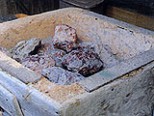
    Quenching is a method of heating raw stone to oxidize the iron, chromium, and other elements it contains, thereby enhancing the stone's vibrant colors. The process involves placing the raw stone in ash and then heating it with charcoal. This is repeated several times until the stone turns red. Overheating can cause the stone to crack, while underheating will result in an opaque color, making this a process that requires the skill and intuition of a craftsman. Nowadays, electric kilns are often used to perform quenching at a temperature of approximately 300 degrees Celsius over several days.

    Step 6: Cutting (with a saw)

    After examining the color, pattern, and imperfections of the heat-treated raw stone, we decide how to process it. We then draw a rough shape with graphite and cut off any excess with a diamond cutter.

    Step 7: Notching

    The process involves supporting the stone with the knees or feet, then placing a five-inch nail-like iron wedge against it and hammering it with a small mallet to shape it.

    Step 8: Shaving

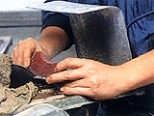
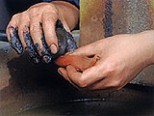
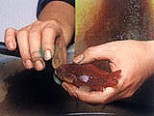
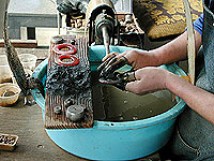
    Using a potter's wheel, an iron spinneret is attached, and water-soaked emery powder is continuously applied to the stone while it is being carved. The shape is completed by progressively using finer sand in the order of rough carving, medium sand, and finishing carving.

    工程9: 磨き

    Once the shape is formed, the surface is polished with mud to make it smooth. A wooden spit is attached to the potter's wheel, and the surface is polished using fine sand. Finally, a finishing polish is performed using wooden spits and a polishing powder called chromium oxide to bring out the deep transparency inherent in the agate.
    For relatively simple shapes, the process of cutting the agate after the initial large cut, then shaping, trimming, and notching takes about 12 hours; the rough shaping, medium sanding, and finishing shaping takes about 16 hours; and the mud polishing and final polishing takes about 8 hours to complete. Complex and intricate designs can take up to a month and a half.


  • Close-up

    WAKASA Menou Zaiku (Agate Work) flame sculptures created by heat treatment.

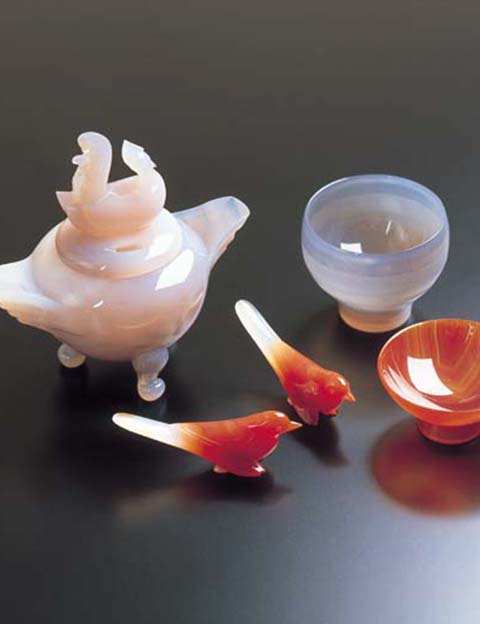
    Agate craftsmanship that exhibits a vivid red color. The extremely rare heat treatment and painstaking carving and polishing process create a masterpiece of gemstone craftsmanship.


    The beautiful red gradation brought out by the heat treatment process.

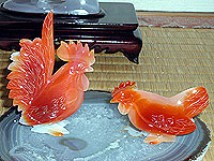
    In WAKASA Menou Zaiku (Agate Work), animals such as roosters, hens, and carp are frequently used as motifs. The fiery red color is created through a process called "quenching." By literally applying heat to the gray raw stone, the iron content oxidizes and turns red. This process, which is rare worldwide, is a major characteristic of WAKASA Menou Zaiku (Agate Work). It is not certain how the "quenching" technique was discovered, but it is said that someone must have noticed that some stones turned red when exposed to a bonfire or similar heat.

    Beautiful translucent agate work. Roosters and hens are traditional motifs.

    Carefully polishing hard materials

    Agate is a hard mineral with a hardness of 7. Even cutting the raw stone into slabs takes about 70 hours using a cutting machine. Finishing small, relatively simple shapes like curved beads takes three days. To achieve precise craftsmanship and a magnificent luster, a single piece can require 30 to 45 days of dedicated work by a craftsman.
    Many struggles that cannot be seen by simply looking at the finished product are etched into the beautiful craftsmanship. Carving hard stone and polishing it to a lustrous finish inevitably takes time and results in a high price, but understanding the difficulty of the process will help you appreciate its value.

    The raw ore is cut with an iron plate. This takes about 70 hours.

    Two historical craftsmen whose story is connected to the origin

    Around 270 to 280 years ago, during the Kyoho era, a man named Takayama Kihee appears as the origin of Wakasa agate. It is said that while working as an apprentice at an eyeglass shop in Naniwa, he learned the art of bead carving, and upon returning home, he began carving agate beads in Wakasa. Later, in the early Meiji era, a man named Nakagawa Seisuke, dissatisfied with bead carving, devised various carving techniques, and the carving techniques used today were passed down.

    Craftsmen who pass on their craftsmanship to the present day

    Junichi Takatori, whom we interviewed this time, is one of the craftsmen who carries on the craftsmanship of Seisuke Nakagawa. "Among agate craftsmen, there are those who make beads and those who craft them. I am a craftsman; I enjoy creating shapes, which is why I do this job."
    "Agate is very hard, making it an extremely unique material for carving. Shaping it by carving and trimming is enjoyable (though difficult), and I don't mind the detailed work. But the polishing afterward is truly challenging." The process involves applying emery, an abrasive, to an iron wheel attached to a potter's wheel and polishing the agate. The sand is gradually made finer and the abrasive is polished over and over again. After a long time, a beautiful luster finally emerges. This difficulty in polishing is a major difference from working with other materials. In particular, the abrasive does not easily penetrate the areas with intricate carvings, and the carving marks are difficult to erase.

    Grinding and polishing with emery powder (at Wakasa Agate Center)

    A fleeting moment that occurs when completion is near.

    When asked about the difficulties of this job, he said, "What often happens is that when the carving is finished and all that's left is polishing, the friction heat causes the agate to crack. Friction heat raises the temperature in an instant. It happens in the blink of an eye." Moreover, the closer you get to completion, the greater the risk becomes.
    "Also, after carving to a certain extent, you might come across scratches or holes that the raw stone originally had. It depends on the customer, but often, once a hole is found, it's no longer usable. In addition, sometimes the color doesn't turn out as expected after heat treatment, or it takes a year to find a suitable raw stone. There's no end to the failures and hardships. Even when you think you've finally finished, you start to notice more and more flaws as you look at it..." There is no compromise in the discerning eye of this craftsman when it comes to his own skills.

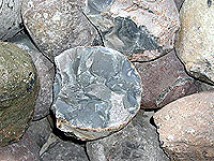
    The raw stone is gray before quenching.

    The joy of seeing the agate's unique characteristics come through.

    "Even so, I'm very happy when the agate has that translucent quality, where you can see through it. It's a unique beauty that agate possesses, different from glass," Takatori said, filling an agate cup with water and holding it up to the light to show how the water rippled. The subtle colors and transparency had a mysterious texture unlike anything I had ever experienced before. The cool, smooth feel of the stone's surface was also a major attraction. I hope you will take your time to appreciate, with your own eyes and hands, the art that is born from a true craftsman's unwavering dedication to the stone.

    "I'm happy when the agate's unique characteristics come through," says Takatori.

    Craftsman Profile

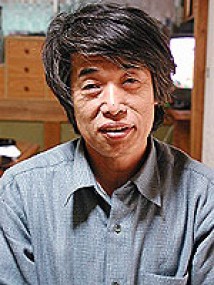
    Junichi Takatori

    Having started at the age of 25, he already has over 25 years of experience as a craftsman. With his frank and open manner, he speaks in detail about the history of agate, as well as local culture and temples and shrines, and his gentle smile leaves a lasting impression.

    Anecdotes

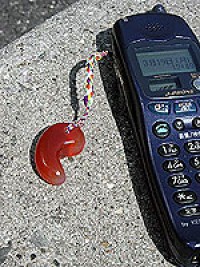
    Agate netsuke and mobile phone

    I love the smooth feel of this little curved bead netsuke (a small decorative toggle), and I often find myself taking it out. I attach it to my cell phone as a strap, and when I hold it up to the light, a beautiful gradation of colors vividly emerges. It has a wet-look sheen and a cool, smooth texture. Even when I don't intend to make a call, I find myself taking it out of my bag to admire its presence.
    "Netsuke" are essentially Edo-period accessories attached to items like inro (small decorative cases). Many feature humorous designs of animals and other motifs, reflecting a desire for unique and original pieces that stood out from the crowd. They're much like cell phone straps today, an accent that allows the owner to express their individuality on a phone of a similar design. Of course, there were no cell phones in the Edo period, but the desire to own a small, cherished treasure remains a timeless and refined pleasure.


overview

Craft item name WAKASA Menou Zaiku (Agate Work)
Reading Wakame no Uzai
Classification of crafts Gemstone craftsmanship
Main Products Personal accessories, ornaments, tea bowls, wind chimes
Main manufacturing area Kohaya City
Designated date June 2, 1976

contact address

■ Production area association

(WAKASA Menou Zaiku (Agate Work)) Obama City Commerce and Tourism Division
〒917-8585
6-3 Otemachi, Obama City, Fukui Prefecture
TEL: 0770-53-9705
FAX: 0770-52-1401

http://wakasa-koubou.com/

Features

Agate is a translucent, aesthetically pleasing quartz stone with a ring-like pattern. When this raw stone is heated to 200-300 degrees Celsius, people discovered that it develops beautiful colors, leading to the creation of a unique firing technique specific to Wakasa. The extremely hard raw stone is then carved and polished over time to create adorable animals, Buddhist statues, incense burners, cups, and various other ornaments.

How to make it

The process of agate carving is broadly divided into four stages: cutting the raw stone, heat treatment, carving and shaping, and polishing. The raw stones, cut to bring out the unique characteristics of each stone, are beautifully colored through heat treatment, and then meticulously carved and polished using techniques unique to precious stone carving, transforming them into delicate and exquisite works of art.

top