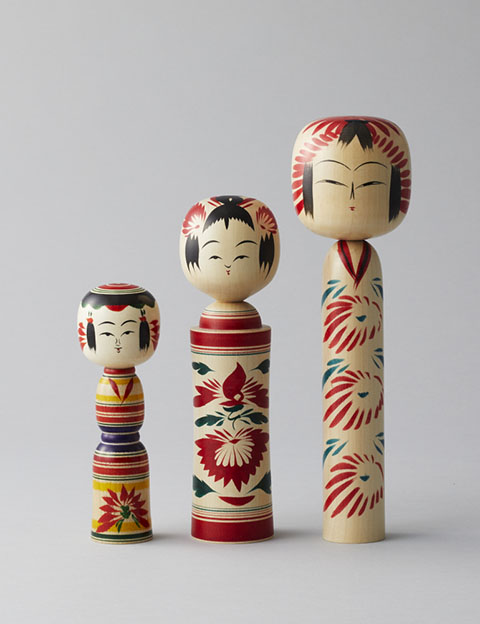
MIYAGI Dento Kokeshi (Wooden Dolls)

Miyagi Prefecture

It is said to have originated in the mid-Edo period as a souvenir from hot springs in the Tohoku region.
Miyagi Prefecture has five traditional kokeshi dolls: Naruko kokeshi, Sakunami kokeshi, Togatta kokeshi, Yajiro kokeshi, and Hijiori kokeshi.

  • Technology/techniques/raw materials

    Technology/techniques

    1. Drying should be done by natural drying.

    2. The woodworking shall be carried out in one of the following ways:
    (1) In the case of Naruko kokeshi dolls, the following techniques or methods shall be used:
    (i) For rough turning, use a horizontal lathe and a lathe plane.
    (b) The woodworking process involves finishing the wood using a lathe and a finishing plane, followed by polishing.
    H. The head should be "melon-shaped".
    2. The torso should have a stepped upper section, creating an "inverted torso."

     
    (2) In the case of Togatta kokeshi dolls, the following techniques or methods shall be used:
    (i) For rough turning, use a vertical potter's wheel and a potter's plane.
    (b) The woodworking process involves finishing the wood using a lathe and a finishing plane, followed by polishing.
    H. The head should be either "melon-shaped" or "under-sprouted."
    2. The torso should be a straight torso with sloping shoulders.

     
    (3) In the case of Yajiro kokeshi dolls, the following techniques or methods shall be used:
    (i) For rough turning, use a vertical potter's wheel and a potter's plane.
    (b) The woodworking process involves finishing the wood using a lathe and a finishing plane, followed by polishing.
    H. The hairstyle should be "melon-shaped," "Fukusuke-shaped," "under-strapped," "round," or "updo."
    2. The torso shall be a straight or constricted torso with sloping shoulders, or a straight or constricted torso with a step at the top.

     
    (4) In the case of Sakunami kokeshi dolls, the following techniques or methods shall be used:
    (i) For rough turning, use a vertical potter's wheel and a potter's plane.
    (b) The woodworking process involves finishing the wood using a lathe and a finishing plane, followed by polishing.
    H. The head should be "Fukusuke type," "melon seed type," or "round type."
    2. The torso shall be a straight torso with sloping shoulders and a tapered hem, or a straight torso with a stepped hem at the top, or a torso with a tapered waist.

     
    (5) In the case of Hijiori kokeshi dolls, the following techniques or methods shall be used:
    (i) For rough turning, use a potter's wheel and a potter's plane.
    (b) The woodworking process involves finishing the wood by planing it using a lathe and a finishing plane, followed by polishing.
    H. The head should be either a "Fukusuke type" or a "Shitahari type".
    2. The torso shall be a straight torso with sloping shoulders, a straight torso that flares out at the bottom, or a straight torso with a step at the top, or a straight torso that flares out at the bottom.


    3. When assembling the head and torso, the following techniques or methods shall be used.
    (1) In the case of Naruko kokeshi dolls, the dolls are made by "inserting".
    (2) In the case of Togatta kokeshi, Yajiro kokeshi, Sakunami kokeshi, and Hijiori kokeshi, the method shall be "insert" or "fit".


    4. The coloring should be done by hand using one of the following methods:
    (1) In the case of Naruko kokeshi dolls, the head shall be painted with "water-drawn hair and hair" or "topknot" and "facial features," and the body shall be painted with "chrysanthemum," "maple," "peony," "iris," "carnation" or "bellflower" and "lathe pattern."

    (2) In the case of Togatta kokeshi dolls, the head shall be painted with "radial hair, swaying hair and hair" or "bob haircut" and "facial details", and the body shall be painted with "chrysanthemum", "plum", "collar", "wood grain", "igata", "iris", "peony", "cherry blossom", or "lathe pattern".

    (3) In the case of Yajiro kokeshi dolls, the head shall be painted with a lathe pattern, a hair pattern or a topknot pattern and a facial drawing, and the body shall be painted with a lathe pattern, a chrysanthemum, a plum branch, a cherry blossom, a collar, a peony, a butterfly, a pine needle, a hem, an iris, or a knot.

    (4) In the case of Sakunami kokeshi dolls, the head shall be painted with either "a hair cord-like hair tie and a hair knot in the opposite direction", "a hair cord and hair in a radial pattern", or "a bob haircut" and "a facial drawing", and the body shall be painted with either "a chrysanthemum" and "a lathe pattern" or "a peony" and "a lathe pattern".

    (5) In the case of Hijiori kokeshi dolls, the head shall be painted with "ribbon-shaped hair and hair", "radial hair and hair", or "bob haircut" and "facial details", and the body shall be painted with "chrysanthemum" and "lathe patterns".


    5. The finishing touch is to apply a wax polish.
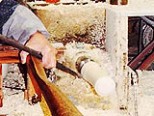
     

    raw materials

    1. The wood used shall be dogwood, Japanese maple, or timber of equivalent quality.

    2. Painting shall be done with ink or dye.

    3. The wax shall be made of Japanese wax, white wax, or a material of equivalent quality.

  • Work scene

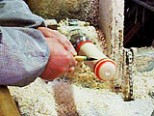
    Naruko kokeshi dolls are from the oldest woodturning region in Miyagi Prefecture. While there are five types of kokeshi dolls within Miyagi Prefecture, Naruko kokeshi dolls are characterized by the fact that the lathe is turned horizontally relative to the body when the wood is turned, and the neck is fitted in place, making a squeaking sound when turned.

    Step 1: Wood selection and rough cutting

    Kokeshi dolls are primarily made from dogwood. After cutting the wood, the bark is immediately removed, and the wood is naturally dried for 6 months to a year. Excess parts are cut off. Then, the general shape of each part is created using a lathe. In the case of Naruko dolls, a distinctive feature is that the lathe is oriented sideways relative to the body. (Sideways turning)

    Step 2: Head finishing and body finishing

    The head and body are finished separately. There are no markings made with lines; everything is carved directly with a chisel. The curves and thickness are checked with the fingertips and eyes as the carving is done. Once the shape is complete, it is polished with horsetail and sandpaper. After that, the lathe pattern is added to the upper and lower parts of the body.

    Step 3: Insert the head into the body.

    This is a major characteristic of Naruko kokeshi dolls. The body and head are fitted together while rotating on a lathe. During this process, a moment of smoke is produced due to the friction. When the fitted head is rotated by hand, it makes a squeaking sound, but as it dries, the fitted part subtly changes shape, so it will not come off.
    画像をクリックすると動画が再生されます

    Process 4: Painting

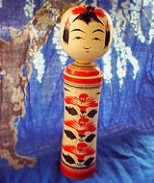
    The colors used are black for the face and hair, and red and blue (green) for the lathe patterns and kimono designs. Many Naruko kokeshi dolls feature chrysanthemum motifs on their kimonos, such as the layered chrysanthemum pattern and the carpet chrysanthemum pattern depicting a chrysanthemum viewed from above. In addition to chrysanthemums, there are also patterns of maple leaves, carnations, and peonies. Even within the Naruko style, the patterns vary slightly depending on the craftsman.
    画像をクリックすると動画が再生されます

    Step 5: Waxing

    Once the painting is finished, the doll is put back on the lathe and coated with wax. This makes the grain of the dogwood wood shine even more beautifully. The beauty of the wood grain and the simple face go together very well. The Naruko kokeshi doll is complete.
  • Close-up

    Naruko Kokeshi dolls, born from the kindness of the woodworker.

    It somehow reminds me of someone... A Naruko kokeshi doll with a simple face, a round nose, and a slightly smiling mouth. It is said that it originated when a woodworker made them as toys for his own child.


    It all started when a woodworker made one for his own child.

    Kokeshi dolls are said to have originated about 200 years ago during the Bunka and Bunsei eras, when woodworkers in the mountains made wooden dolls for their children to play with. These dolls became toys for children in mountain villages. The beautiful patterns on the dolls' bodies, that is, the patterns on their kimonos, and the way they are adorned with hairpins (kanzashi) in their hair, likely reflected the children's wish to one day wear such kimonos themselves. The role these cute dolls play remains the same, then and now. However, toys that were once handmade have been completely replaced by mass-produced items, and children rarely play with warm, handcrafted toys anymore. In this context, the role of kokeshi dolls has also shifted from being children's toys to being ornamental dolls, and this continues to this day.
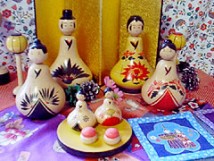
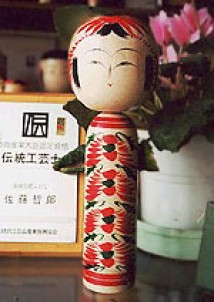
    This kokeshi doll was made by Naruko kokeshi craftsman Hideo Onuma for his granddaughter's Hina Matsuri (Girls' Day) celebration.
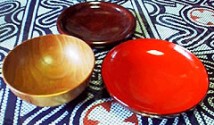
    The roots of kokeshi doll makers lie in woodworking.

    The roots of kokeshi doll makers lie in their origins as woodturners. Mr. Onuma, whom we interviewed this time, apparently also underwent training in woodturning.
    Naruko kokeshi dolls are crafted by woodworkers. The photo shows a vessel made by Mr. Onuma a few years ago.
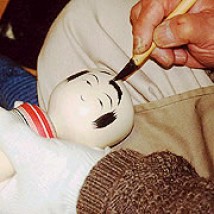
    Characteristics of Naruko Kokeshi dolls

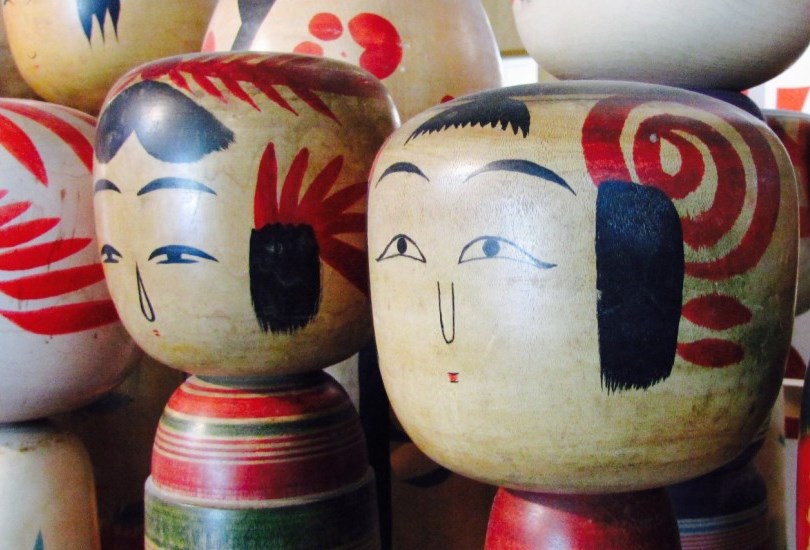
    The face is characterized by its tied-up bangs, sideburns, single eyelids, and round nose. The body is painted with various designs, including overlapping chrysanthemums viewed from the side, chrysanthemums resembling windmills, maple leaves, carnations, and peonies. Another distinctive feature of Naruko kokeshi dolls is that they make a squeaking sound when their heads are turned, allowing for playful interaction. Dressed in beautifully patterned kimonos and smiling elegantly, Naruko kokeshi dolls have a simple, endearing face.
    Doesn't this remind you of someone I know?!
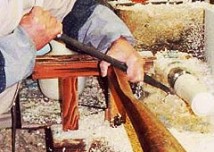
    I make the tools I use myself.

    As I watched the process of making kokeshi dolls, I saw many tools I had never seen before. When I asked, "Where do you buy these tools?", Mr. Onuma replied, "They're not sold. I make all the tools myself. I do blacksmithing." "It's like cooking. If you eat something and don't like it, you make it yourself. That's the basic principle." Even with commercially available tools, he always modifies them to his own liking before using them. He said that tools made by other people tend to chip with use. You know your own habits best. Because the quality of the finished product depends entirely on the craftsman's skill, artisans are particular about their tools. They carefully consider their own habits and the amount of force they use, and make tools while making adjustments. It's about confronting your own strength. That's where kokeshi doll making begins.
    • "If you want to use easy-to-use tools, make them yourself. That's the basic principle."
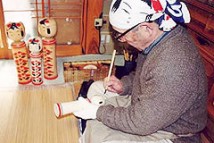
    • The towel wrapped around her head is from the National Kokeshi Festival, which is held every year in Naruko on the first Saturday and Sunday of September.
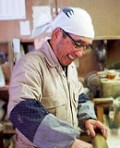
    Craftsman Profile

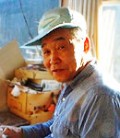
    Hideo Onuma

    He is the fourth generation of the Onuma Iwataro lineage of Naruko kokeshi dolls. The patterns on the kokeshi dolls have been passed down through generations.

    Anecdotes

    MIYAGI Dento Kokeshi (Wooden Dolls) doll, Naruko style

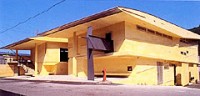
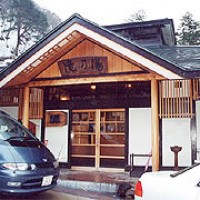
    Naruko kokeshi dolls, once beloved toys for children in mountain villages, evolved into souvenirs as Naruko developed into a hot spring resort town. "Kokeshi dolls and hot springs" have together shaped the history of this town. Onsen Shrine This Engishiki-listed shrine overlooks the Naruko hot spring town from a hilltop. The Shoku Nihongi (Continued Chronicles of Japan) states, "In the reign of Emperor Ninna, in April of the 4th year of Jōwa (837), Toriyagamori suddenly rumbled for several days, and finally erupted, spewing out hot water that flowed as a river. The villagers were astonished and reported it to the imperial court. The court enshrined the god of the hot springs, and on the 9th of October of that year, it was granted the rank of Junior Fifth Rank, Lower Grade." Every year on the first Saturday and Sunday of September, a festival is held where lion dances, portable shrines, and a procession of children parade through the hot spring town and are dedicated to the shrine. In the past, this hot spring was called Nakigo no Yu (Crying Hot Spring). This is said to be the origin of Naruko. Access: There is a stone staircase leading to the shrine next to Takinoyu (see below). Climbing up there will take you to the Onsen Shrine. Takinoyu, an ancient hot spring with a thousand-year history Descending the stone steps leading to the Onsen Shrine will take you to Takinoyu, the town's public bath. This hot spring has a thousand-year history as the sacred water of Naruko Onsen Shrine. It is effective for skin diseases, high blood pressure, etc. The water feels smooth and comfortable on the skin. As it is a public bath, it is very affordable, costing only 150 yen for adults and 100 yen for children. Inside, the bathtub, walls, and buckets are all made of wood, and the way the light enters creates a calm atmosphere. It is frequently used by locals, so it might be a good place to start gathering information about Naruko Town. Price: 150 yen for adults, 100 yen for children Hours: 7:30 - 22:00 Address: 84 Yumoto, Naruko-cho, Tamatsukuri-gun, Miyagi Prefecture 989-6823 (next to Yusaya Ryokan) Tel: None Access: 3-minute walk from Naruko Onsen Station on the JR Rikuu East Line Naruko Waseda Sajikiyu is also enjoyable as an architectural structure In the summer of 1948, shortly after the end of the war, students from Waseda University were conducting drilling practice in Naruko Town. The drilling work was extremely difficult due to their inexperience in working under the scorching sun. In September, when the work began to extend into the late night, one night at 3 a.m., boiling water suddenly gushed out of the ground like a mudslide. This was the birth of Waseda no Yu. Since then, it has been enjoyed by many people and continues to be so today. The current building was completely renovated in 1998, exactly 50 years after Waseda-yu's founding, based on a design by the Ishiyama Osamu Laboratory at Waseda University. It is a very unique building with a bright cream color. The interior is also a wonderful space with high ceilings and plenty of natural light. There is also an open-air bath where you can bathe while looking at the blue sky. This is for private use only, so you can relax with your family or friends. Price: Adults 500 yen, children 300 yen, private open-air bath 1,000 yen Hours: 7:30 - 22:00 Address: 124-1 Shin-yashiki, Naruko-cho, Tamatsukuri-gun, Miyagi Prefecture 989-6822 TEL: 0229-83-4751 FAX: 0229-83-4764 Access: 3-minute walk from Naruko Onsen Station on the JR Rikuu East Line

    Yajiro Kokeshi dolls were born in a small mountain valley amidst the majestic Zao mountain range.

    Yajiro kokeshi dolls have grown alongside the history of Kamasaki Onsen, a small hot spring resort nestled between the Zao Mountains. Their vibrant colors set them apart from other MIYAGI Dento Kokeshi (Wooden Dolls). The lathe-turned patterns of the Yajiro kokeshi dolls, which stand out beautifully against the lush greenery, have undoubtedly captivated the eyes of visitors to this hot spring town.


    Mizuki possesses strong vitality.

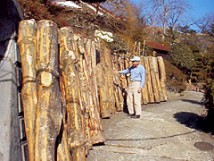
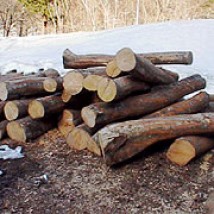
    Recently, cherry, camellia, and maple woods with slightly unusual colored grains are also used as materials for kokeshi dolls, but the main wood used for MIYAGI Dento Kokeshi (Wooden Dolls) is still the dogwood, with its beautiful white bark. This dogwood is harvested every year from the autumn equinox to the spring equinox. The bark is immediately peeled off, and the wood is stood upside down and dried for six months to a year. If it is not kept upside down, it will sprout in the spring even more than six months after being cut down. This demonstrates the strength of living things that can survive the harsh winters of Mutsu. Perhaps it is because they use this dogwood as their material that MIYAGI Dento Kokeshi (Wooden Dolls), while smiling quietly, somehow convey a sense of inner strength.
    After felling, the bark is immediately peeled off to facilitate drying. To prevent buds from sprouting in the spring, the branches are propped up upside down.
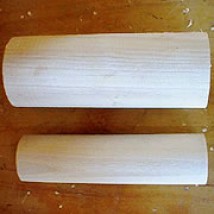
    The dogwood trees of this land, and the arms of this land

    I wanted to use the beautifully grained dogwood trees that grow in the harsh cold of this region. However, in recent years, the amount of dogwood trees that can be used as material in this region has decreased due to changing times, and the current situation is that we tend to rely on materials brought in from other areas. In this situation, Mr. Sakyo Niiyama, whom we interviewed this time, said that he has been planting dogwood trees on the mountains behind his house every year since 26 years ago, during the heyday of kokeshi dolls, and that from next year he will finally be able to use the grown dogwood as material for Yajiro kokeshi dolls. The Yajiro kokeshi dolls that will be made from now on will see the return of the traditional vibrant colors and cute lathe-turned patterns. The life of the dogwood trees unique to this region will be combined with the 26-year-long aspirations of kokeshi craftsman Sakyo.
    A piece of dogwood wood. From here, a kokeshi craftsman will create rich curves, lathe patterns, and paint faces to create a simple Yajiro kokeshi doll.
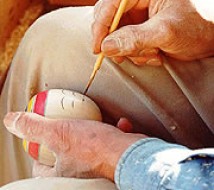
    An encounter that happens perhaps once a year.

    Many kokeshi doll makers divide their work by day; on some days, they focus solely on making the body, and on other days, they focus solely on painting the face and kimono patterns. Apparently, after the physically demanding work of turning wood, their hands tremble, making it difficult to paint as they wish. The most intense part of creating a kokeshi doll is painting the face. They start by painting the eyes, as if breathing life into each doll. "Even within a single day, the face of the first doll is different from the face of the tenth doll. The way the brush moves is different, after all. The tenth doll always has the best face," says Sakyo. Sakyo has been making kokeshi dolls for 55 years, but he says that out of the hundreds of kokeshi dolls he makes each year, there is only one, if any, that he can paint a face that he is truly happy with. Concentration does not guarantee that he will paint a good face. Sakyo faces each kokeshi doll every day in the hope of encountering as many of those perfect kokeshi dolls as possible.
    I took a deep breath and began drawing the face. The moment I drew the eyes, it was as if the kokeshi doll was brought to life.
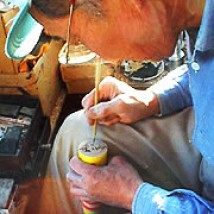
    For a craftsman, the workplace itself is a place of peace and tranquility.

    "This is definitely the best place for that," Sakyo said, leading me to a spot where a potter's wheel had been turning. However, the wheel was switched off, and a set of inkstone and brush sat in the quiet corner of the workbench. I was a little surprised, as I had imagined that the place where he worked with kokeshi dolls would be a quiet room with tatami mats or something similar. However, this workspace is the place where Sakyo can work most vigorously, and also a place where he can concentrate and find peace of mind. Having a space where one can pour their soul into their work is probably a necessary condition for any craftsman. For Sakyo, this place with the potter's wheel is an indispensable place to face each kokeshi doll and create something that he is satisfied with. From the moment he picks up a dogwood tree, or rather, from the moment he plants the seedling, Sakyo's time with kokeshi dolls begins.
    The final touch, the name inscription, is also written here. The inkstone used is OGATSU Suzuri (Inkstones), a traditional craft from Miyagi Prefecture.
    Craftsman Profile

    Niiyama Sakyo

    For 55 years, we have carried on the tradition of Yajiro kokeshi dolls, which has continued since the early Edo period. For the past 26 years, we have been planting dogwood trees, which are used as material for kokeshi dolls, in this village every year.

    Anecdotes

    Yajiro Kokeshi dolls developed alongside hot springs.

    Yajiro kokeshi dolls have developed as souvenirs of Kamasaki Onsen, a famous hot spring resort with a 600-year history located a short distance from the Yajiro village at the foot of Mount Zao. It is said that the tradition began when women from the Yajiro village would carry kokeshi dolls made in the Yajiro village and go around to the rooms of inns as souvenirs of Kamasaki Onsen. At the Kokeshi Shrine, officially called "Onomiya Korechika Shinno Shrine," the "First Kokeshi Doll Making Ceremony" is held every year on January 2nd. Every year, one Yajiro kokeshi craftsman makes a kokeshi doll on the spot and dedicates it to the shrine. All the kokeshi dolls that have been dedicated to the shrine so far are lined up inside, allowing visitors to see the history of Yajiro kokeshi dolls firsthand. On the day of the "First Kokeshi Doll Making Ceremony," the people of the Yajiro area serve ozoni (rice cake soup) and sacred sake. The traditional custom of local children carrying a portable shrine adorned with kokeshi dolls remains. Kamasaki Onsen, which is said to have been discovered by villagers with the tip of a sickle more than 600 years ago, is known as a medicinal hot spring and was once a famous hot spring bathed by the Date lords. It was extremely popular during the late Edo period. From that time, the woodworkers of Yajiro made kokeshi dolls as souvenirs, and women would go around to the rooms of the inns in Kamasaki Onsen with the wooden blanks and kokeshi dolls to sell them, thus establishing Yajiro kokeshi. This practice of going around Kamasaki Onsen selling kokeshi dolls was called "Kamasaki business," and this way of doing business continued until around 1959.

    MIYAGI Dento Kokeshi (Wooden Dolls) A new kokeshi culture unfolds with every mountain crossing.

    Miyagi Prefecture alone boasts four distinct traditions of kokeshi doll making. The dividing line between these traditions lies in the mountains of Mutsu, where harsh winters make traversing them even more difficult. Once these techniques have crossed the mountains, they have taken root in the region, creating unique and distinct cultures.


    Is the model for the Togatta Kokeshi doll a Kyoto beauty?!

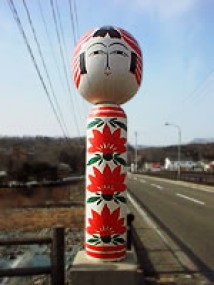
    The defining features of Togatta kokeshi dolls are their beautiful faces—big, double-lidded eyes, a straight nose, and a small mouth—and the red, radially arranged hair ornament on top of their heads. This is said to be inspired by the hair ornaments worn by geisha and oiran (high-ranking courtesans) in Kyoto. Why would a Kyoto beauty be the model for a kokeshi doll in Togatta, Miyagi Prefecture, so far from Kyoto? This is related to the fact that around the time the current form of Togatta kokeshi dolls was being established, KYO Ningyo (Dolls) dolls dressed in beautiful kimonos were introduced to this Mutsu region as dress-up dolls for children and as decorative items for adults. However, these KYO Ningyo (Dolls), often adorned with gold leaf and NISHIJIN Ori (Textiles), were apparently not something that ordinary people could afford. Eventually, the Sendai Tsutsumi dolls, which remain a tradition in Sendai today, were created based on these KYO Ningyo (Dolls). Perhaps you have seen these beautiful KYO Ningyo (Dolls) and Sendai Tsutsumi dolls somewhere before. The woodworkers of Togatta wanted to give the children of Togatta beautiful dolls like these. With that in mind, they created kokeshi dolls with clean facial features, like KYO Ningyo (Dolls), and adorned with the hair ornaments of courtesans. This is said to be the basis for the current style of painting on Togatta kokeshi dolls.
    The woodworker's desire to give many children beautiful dolls led to the creation of beautifully painted dolls in Togatta, inspired by KYO Ningyo (Dolls) dolls.
    Kokeshi doll culture found only in Tohoku

    There is a term called "onsen therapy." In Japan, where numerous hot springs gush forth, people have long relied on their therapeutic properties to heal their bodies. There are many old hot springs known as famous hot springs in the mountains of Tohoku. At the beginning of the Meiji era, when the oppression of the feudal era disappeared, farmers who had finished their arduous year's farming work began to cross the mountains and visit these hot springs in Mutsu. By soaking in the hot springs, the farmers who had worked so hard were able to rest both their minds and bodies. Hot springs were, even back then, a reward for one's hard work. Needless to say, kokeshi dolls were a welcome souvenir to commemorate visiting such a place. Kokeshi culture developed as a souvenir of hot spring areas. Japan, with its abundant water resources and volcanic terrain, has many hot spring areas, and this country, covered in many forests, had many woodworkers throughout the region. The combination of hot spring areas and woodworkers, which are the conditions for the development of kokeshi culture, existed all over Japan. However, kokeshi culture took root only in the Tohoku region. Why? It may be related to the harsh winter climate of Tohoku. During the harsh winter, the work available to farmers is limited. One of these is woodworking, and in hot spring resorts, kokeshi doll making flourished as souvenirs for visitors during the winter. It could be said that kokeshi culture was born precisely because of the harsh winters of Tohoku. The balance of supply and demand fostered the development of kokeshi culture, and kokeshi craftsmen established their skills.
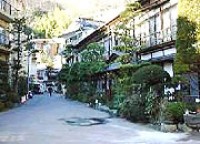
    The hot springs of Togatta. People crossed the mountains to reach Togatta, a therapeutic hot spring resort, in search of these springs. Kokeshi dolls were very popular as souvenirs, and kokeshi culture flourished as a result.

    Mountain ranges mark the boundary of kokeshi doll culture

    Just as different cultures exist across the sea, in the days before cars and tunnels, mountains also served as cultural boundaries. Traditional kokeshi dolls are divided into 11 styles, perhaps because crossing the mountains of Tohoku was a difficult task. These 11 styles are further divided into two main techniques, separated by the Ou Mountains. On the Pacific side, the lathe is turned vertically relative to the body when turning the wood, while on the Sea of Japan side, it is turned horizontally. Kokeshi-making techniques have been uniquely adopted and developed in each region. As a result, 11 styles and two different lathe-turning methods of traditional kokeshi dolls have been created. The joy of crossing the harsh mountains that separate cultures and arriving at a hot spring resort must have been exceptional. Finally reaching a land where different cultures flourish, and relaxing in a hot spring—people probably packed these travel memories into their kokeshi dolls and returned to their usual places.
    The Zao Mountains. The mountains have separated the flow of information, allowing each town to develop its own unique culture. Kokeshi dolls are one example, and currently there are 11 different styles of kokeshi doll culture in the Tohoku region.
    Craftsman Profile

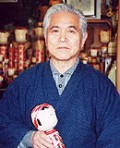
    Tetsuro Sato

    Born in 1932 (Showa 7). He began working with the potter's wheel at the age of 15. He is the 7th generation of the Yoshirohei Togatta lineage of kokeshi doll craftsmen. His work is characterized by the sharpness of his plane and the fluidity of his facial painting.

    Anecdotes

    MIYAGI Dento Kokeshi (Wooden Dolls) Togatta style

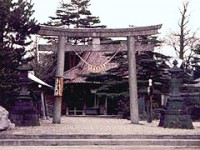
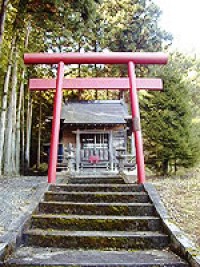
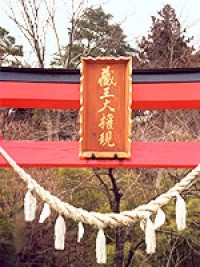
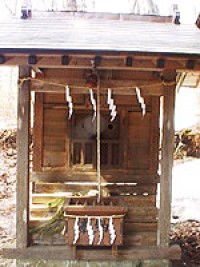
    Karita-mine Shrine This shrine is dedicated to the mountain god of Zao and was formerly called Zao-ji Temple. The god who protects the majestic Zao Mountains is said to be a female deity, and it has been said since ancient times that if a woman enters the mountains, the god will become jealous and displeased, so mountain work has been considered men's work. Following the abolition of the feudal system and the establishment of prefectures, it was established as Karita-mine Shrine in 1871. Located on a mountain overlooking the town of Togatta, the vermilion torii gate stands proudly against the mountain, evoking the image of the female god who protects the proud Zao Mountains. Koretake Shrine Prince Koretake is enshrined here as the god of woodturners. In the past, woodturners would enter the mountains, cut down trees, turn wood on a lathe in a mountain hut, create the wooden base, and then return to the village. In other words, once they entered the mountains, they would seclude themselves there for days to work. The work of a woodworker, which began with cutting down trees with only an axe in mountains where roads were not yet developed as they are today, was always dangerous. This Koretake Shrine is where these woodworkers prayed for safety before entering the mountains to ensure their work was safe.

    Sakunami kokeshi dolls watch over the growth of children in Sakunami.

    Sakunami kokeshi dolls have become an established souvenir for visitors to the Sakunami Onsen hot spring resort in Sendai, which boasts a history of 1200 years. Nowadays, they are also given to children in the area as graduation gifts for elementary school students. The kokeshi dolls are surely etched in the hearts of the people of Sakunami, along with their love for their hometown.


    Beautiful dogwood trees thrive in harsh cold.

    The Sakunami region of Sendai is located on the border between Miyagi and Yamagata prefectures, with Yamagata City just across the mountains. Much of the dogwood wood used as raw material for Sakunami kokeshi dolls comes from Yamagata. The trees on the Yamagata side grow slowly because they are exposed to the cold winds of the Sea of Japan, and many of them are thin for their age. "Trees that have grown over many years in a harsh environment are truly beautiful," says Kenichi Hiraga, a Sakunami kokeshi craftsman whom we interviewed. For the past decade or so, there has been a rapid shift in the use of wood for furniture and housing to cheaper, faster-growing wood imported from overseas. However, MIYAGI Dento Kokeshi (Wooden Dolls), where the beauty of the wood grain is paramount, are made from wood that has grown through the harsh winters of Mutsu, resulting in an elegant finish that embodies the beauty and harshness of Mutsu's nature and the culture that has developed in this land.
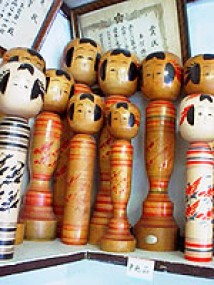
    The dogwood trees grown in the harsh Mutsu region, where snow remains until early April, have a beautiful, tightly grained wood.
    Children's play culture and kokeshi dolls

    Before becoming souvenirs from hot spring resorts, kokeshi dolls were originally children's toys. For example, Naruko kokeshi and Togatta kokeshi were played with by being carried on the back or dressed in kimonos. Therefore, their size and body shape were designed to be easy to carry on the back and easy to wrap cloth around, and this continues to this day. On the other hand, kokeshi dolls from Sakunami, located a few mountains beyond Naruko and Togatta, were played with by even younger children who were carried on their mothers' backs, holding the kokeshi doll in their small hands (like a rattle today). Therefore, although their sizes vary now, they were originally sized for small children to hold and play with. Originally, they were not meant to be admired, and Sakunami kokeshi in particular were unstable when standing upright and not suitable for display. However, as time passed, kokeshi dolls transformed from children's toys to objects of appreciation for adults, and Sakunami kokeshi dolls were also refined, resulting in the kokeshi dolls with stands, which are a distinctive feature of Sakunami kokeshi. It wasn't just about preserving tradition; Sakunami kokeshi dolls were established by incorporating the demands of the times and people. As time went on, the techniques were certainly passed down. However, the interpretation of each era was left to the individual craftsman.
    The Sakunami kokeshi doll with a stand was born from the changing times, the demand from people who wanted to take kokeshi dolls home as souvenirs from the hot springs, and the ingenuity of the craftsmen.
    Kokeshi dolls that watch over the growth of children in Sakunami

    Graduates of Sakunami Elementary School are presented with a Sakunami kokeshi doll bearing their name upon graduation. This tradition was proposed by Ms. Hiraga 14 years ago and continues to this day. Every year before graduation season, Ms. Hiraga begins making the kokeshi dolls to be given to the children graduating from Sakunami Elementary School. She carefully inscribes each child's name and finishes each doll. These graduating children will eventually grow up, take on the responsibility of this town, or leave town and make their mark in another city. Perhaps the kokeshi dolls made by Ms. Hiraga quietly watch over the growth of these children of Sakunami. And when they hold the kokeshi doll in their hands again, they will be reminded of the fun times they spent in Sakunami during their elementary school years.
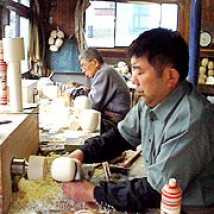
    The kokeshi doll-making techniques of Sakunami are passed down from father and mentor Kenjiro (pictured in the background) to Kenichi (pictured in the foreground), and then to his son and apprentice, Teruyuki.

    Craftsman Profile

    Kenichi Hiraga

    I started making kokeshi dolls as a graduation gift for Sakunami Elementary School, and it's been 14 years now.

    Even if they live far away, people from Sakunami will likely be reminded of this quiet hot spring town whenever they see a kokeshi doll.


    Anecdotes

    Sakunami Onsen and Sakunami Kokeshi dolls have developed as souvenirs of Sakunami Onsen. Sakunami Onsen is an ancient hot spring, said to have been opened 1200 years ago. There is a hot spring called "Taka-no-yu" (Hawk's Bath) where, according to legend, a hawk shot with an arrow during the time of the Minamoto clan came to heal its wounds, and the efficacy of the hot spring water (sodium chloride aromatic salt spring, effective for nerves, rheumatism, etc.) has been known since ancient times. Located in the mountains, the hot spring inns are situated along the valley. Most hotels and inns have open-air baths that take advantage of the beautiful valley scenery, offering spectacular views. In the open-air baths, you can soak in the warm water while listening to the sound of flowing water and enjoying the greenery, the autumn leaves, and the snowscape in winter. It is said that monkeys sometimes come to bathe in this hot spring surrounded by abundant nature.


overview

Craft item name MIYAGI Dento Kokeshi (Wooden Dolls)
Reading Miyagi Electric Kokeshi Dolls
Classification of crafts Dolls and Kokeshi dolls
Main Products Kokeshi doll
Main manufacturing area Sendai City, Shiroishi City, Osaki City, Zao Town and Shichikashuku Town in Katta District, Kawasaki Town in Shibata District, Matsushima Town in Miyagi District
Designated date June 22, 1981

contact address

■ Production area association

Naruko Wooden Toy Cooperative
〒989-6827
74-2 Naruko Onsen, Osaki City, Miyagi Prefecture
Inside the Japan Kokeshi Doll Museum
TEL: 0229-83-3600
FAX: 0229-82-2589

Japan Kokeshi Museum

http://www.kokesikan.com/

Yajiro Kokeshi Doll Cooperative
〒989-0733
72-1 Yajirokita, Fukuoka Hachimiya, Shiroishi City, Miyagi Prefecture
Yajiro Kokeshi Village
TEL: 0224-26-3993
FAX: 0224-26-3993

Sendai District Traditional Kokeshi Doll Craftsmen's Association
〒984-0831
3-8-32 Okino, Wakabayashi-ku, Sendai City, Miyagi Prefecture
TEL: 022-286-0564
090-9530-1028
FAX: 022-286-0564

http://www.sendaikiji-c.com/

Togatta Traditional Kokeshi Doll Craftsmen's Association
〒989-0916
36-135 Nishiyama, Shinchi, Togatta Onsen, Zao-machi, Katta-gun, Miyagi Prefecture
Inside Miyagi Zao Kokeshi Museum
TEL: 0224-34-2385
FAX: 0224-34-2300

■ Visits to production areas from overseas
image
MIYAGI Dento Kokeshi (Wooden Dolls)- A Visit to the Production Area

Features

In addition to the beauty of its extremely simplified form, consisting only of a head and torso, its pure and lovely appearance is a beauty born from the simple heart of a craftsman surrounded by the nature of a mountain village.

How to make it

After the bark is removed from the wood used to make the kokeshi dolls and it is air-dried for 6 months to a year, the wood is cut to size and any unnecessary parts are removed. The head and body are then shaped on a lathe and planed, and the faces and body designs are drawn on the polished wood using sandpaper or horsetail. The head is then hammered into the body.

Please see here for information on traditional craftspeople.

Japanese traditional craftsman
top