SURUGA Hinagu (Doll Decorations)

Shizuoka Prefecture

SURUGA Hinagu (Doll Decorations) were already being produced in the 16th century, during the time when the Imagawa clan were the daimyo of Suruga in what is now Shizuoka Prefecture. The warm, humid climate, combined with the advanced techniques introduced from across the country due to the construction of Kunozan Toshogu Shrine and Asama Shrine, allowed hina doll making to develop as a subgenre of lacquerware production that became established during the Edo period.
By dividing the processes into woodworking, lacquering, maki-e (gold lacquer) decoration, and metalwork, it was possible to produce large quantities of goods despite it being a handcrafted industry. Furthermore, it developed by taking advantage of its favorable location midway between major consumption centers such as Edo (Tokyo) and Kyoto.

  • Technology/techniques/raw materials

    Technology/techniques

    1. The wooden base shall be shaped using either a "joinery wood base" or a "chestnut wood base."

    2. The metal fittings are "carved in".

    3. The finishing touches should be as follows:
    (1) If decoration is to be added, it shall be done by "makie" or "gold leaf application".
    (2) When using mounting hardware, use hardware that is "recessed" or processed in a similar manner.
     

    raw materials

    1. The wood used for the joinery base shall be cypress, magnolia, alder, katsura, or wood of equivalent quality.

    2. The wood used for the chestnut wood base shall be birch or wood of equivalent quality.

    3. The metal fittings shall be made of copper, copper alloy, or a metal of equivalent material.

    4. For foil stamping, use gold foil or a material of equivalent quality.

  • Work scene

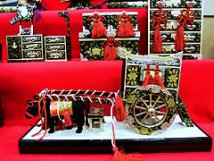
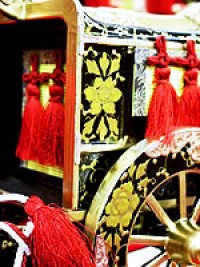
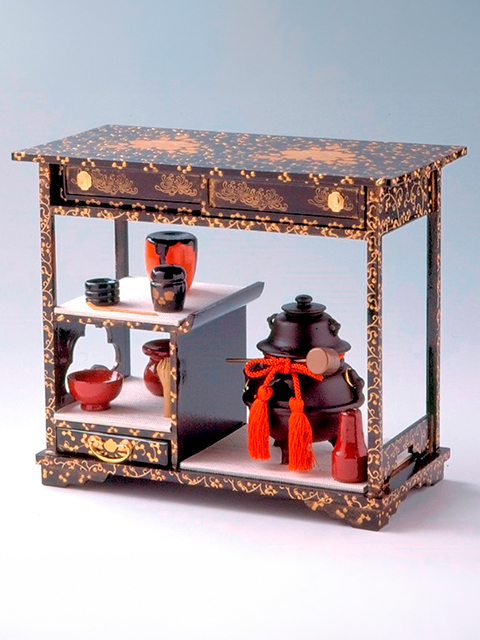
    Hina doll accessories include dozens of small items such as imperial carriages, chests of drawers, storage boxes, and dressing tables, and each one is made using the same processes as the real thing. Each task is carried out by a division of labor among craftsmen with specialized skills, and the finished product is the culmination of highly skilled craftsmanship.

    Step 1: Wood preparation

    They cut and plan the boards to create a box-shaped wooden base. Saws and planes are among the tools used (a joiner).

    画像をクリックすると動画が再生されます

    Step 2: Wood preparation

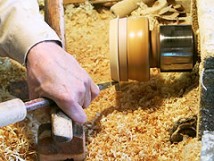
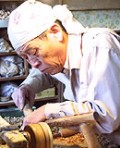
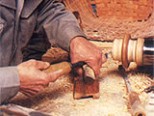
    A round wooden base is created. The roughly shaped base is placed on a horizontal lathe, and a cutting tool is used to carve it. The smaller the object, the more advanced the skill required (woodturner).

    Step 3: Painting

    After smoothing the surface with sandpaper, the lacquerware is repeatedly applied in stages: undercoat, intermediate coat, and topcoat, with drying and polishing between coats (lacquerware craftsman).

    工程4: 蒔絵

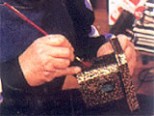
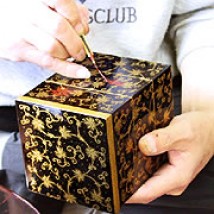
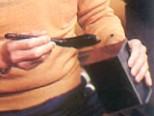
    The design is created by drawing an underpainting with lacquer and then sprinkling gold or silver powder onto it. After drying, the surface is polished with sheepskin to give it a shine. Common motifs include arabesque patterns and flowers, birds, and the moon, and it is also possible to use several colors to create variations (according to the maki-e artist).

    Step 5: Making the metal fittings

    After cutting the metal to a manageable size, it is heated over charcoal and then gradually cooled. The surface is polished clean, and then the metalwork pattern is drawn onto washi paper and cut out. A chisel is used to carve the pattern and shape (metalwork craftsman).

    画像をクリックすると動画が再生されます

    工程6: 仕上げ

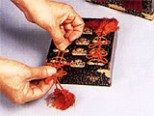
    Metal fittings are riveted to the doll's components and then fixed in place with adhesive. Using traditional techniques, the numerous parts are assembled together (by the finishing craftsman).


  • Close-up

    Splendid ornaments from the miniature world

    Since the Sengoku period (Warring States period), Shizuoka has been home to the Okiyashu, a group of artisans who produced lacquerware for use at Asama Shrine. The warm, humid climate, ideal for lacquerware, contributed to the development of highly advanced lacquerware production techniques. Shizuoka's hina doll accessories, utilizing these traditional techniques, now account for approximately 90 percent of the national production.


    Magnificent tools created through masterful skill and aesthetic sensibility.

    Miniature hina doll accessories such as chests of drawers, long chests, dressing tables, imperial carriages, high cups, and bowls are crafted using methods that closely resemble the real thing, and they shine as decorative works of art, making the hina doll display even more magnificent. What could be inside if you opened that drawer? This unique miniature world that sparks such imagination and inspires dreams. The production of hina doll accessories is carried out in a division of labor system centered on five crafts: woodworkers, turning artisans, lacquerers, maki-e (gold lacquer) artisans, and decorative metalworkers, and is, in a sense, the culmination of the artisans' skills. The advanced techniques unique to Shizuoka, a region that has long been thriving in wood and lacquer craftsmanship, are put to use.

    Highly crafted Hina doll accessories are born from the skill of experienced artisans.

    Precise manual work enhances the quality of the finished product.

    The road leading to the Hina Doll Craftsman's Industrial Park in the northwestern part of the city is dotted with tea plantations, and the scenery is rich with rivers and greenery. Stepping into the workshop of woodturner Kikuo Jinbo, you are first greeted by the scent of wood. The wooden bases for the Hina dolls are made by joiners for the box-shaped pieces and woodturners for the rounded pieces. The wood, cut to size, is set on a horizontal lathe, and when the cutting tool is applied, it is carved into a perfectly round shape as if measured. "There are no molds, so it's all determined by the feel of my hands." Small pieces are naturally difficult, but even large pieces like drums require the utmost care in handling, as they can crack when they dry. The finished wooden bases leave Jinbo's hands and move on to the painting and maki-e (gold lacquer) processes, but when he sees the finished Hina dolls on display, he can recognize what he made. "It makes me happy to see the things I've worked on become beautiful products."

    Round wooden pieces such as pedestaled cups and bowls are made using a potter's wheel.

    The art of maki-e (gold lacquer) supports the production of hina doll accessories.

    What enhances the decorative appeal of Hina dolls is undoubtedly the magnificent maki-e (gold lacquer) work. Gold powder is sprinkled over a design drawn with lacquer. Though miniature, the dignified splendor is truly breathtaking. The patterns are often arabesque or depictions of flowers, birds, and the moon. However, the arabesque patterns drawn by maki-e artist Fukuji Kenjo are something special. While it is a classic pattern, he expresses free creativity within its framework, and his style, which incorporates a new sensibility, has become popular. "It's not interesting if I only do what's in line with the norm," says Kenjo, but he still insists, "Arabesque is the most calming and beautiful." He apparently often goes on sketching trips to stimulate his creative drive. He has been in this field for over 50 years, but he says, "I'm interested in something all year round," and is always challenging himself with new endeavors.

    In addition to various patterns, colors other than gold are sometimes used to add variation.

    Challenges related to declining demand

    Although it accounts for about 90 percent of national production, the production of hina doll accessories has been steadily declining since 1973, the peak of the second baby boom, due to the declining birth rate and changes in housing conditions. The number of births, which was 2.09 million in 1973, fell to 1.18 million in 1999. Demand has nearly halved, and with no space to display hina dolls in urban apartments, miniaturization and simplification are progressing. If the seven-tiered display becomes three-tiered or even one-tiered, the amount of hina doll accessories needed will also decrease. In the local area, as a self-help effort to preserve the craftsmanship of hina doll accessories and lacquerware artisans, they are considering using lacquerware for school lunches at elementary schools. The idea is that after graduation, the items will be used at home, thus expanding demand from within family life. Another challenge for the future is to draw attention back to the traditions of seasonal festivals, which are losing interest. This will lead to the continuation of hina doll accessories, a unique form of Japanese beauty.

    Craftsman Profile

    Kikuo Jinbo

    Born in 1933.
    All the tools used to carve the wood are handmade.
    If the blade loses even a little bit of sharpness, I sharpen it hundreds of times a day.

    Born in 1933.
    After graduating from junior high school, I studied maki-e (lacquerware decoration) at a training school for crafts.
    His style, which incorporates a modern sensibility, is highly original.

    Anecdotes

    The maki-e technique that made lacquerware known as "Japan"

    In English, pottery is called "china," but lacquerware is called "japan." Lacquerware, which was also produced in China and Southeast Asia, came to be called "japan" because the unique Japanese maki-e technique was highly regarded as exceptional.
    In the past, Shizuoka lacquerware sometimes had a cheap image because inexpensive materials were used for the undercoat in order to mass-produce it. However, in the case of hina doll accessories, even without using expensive lacquer, the value as decorative items could be enhanced by applying gorgeous maki-e decorations. Perhaps the region's constitution was well-suited to the production of hina doll accessories. The maki-e technique that developed mainly in Shizuoka has come to be so highly regarded that it was said, "The lacquering is done in Kyoto, but the maki-e is done in Shizuoka."

    • Its elegant and delicate beauty makes you want to use it as a decorative item.


overview

Craft item name SURUGA Hinagu (Doll Decorations)
Reading Suruga Hinagu
Classification of crafts Dolls and Kokeshi dolls
Main Products Hina Matsuri and Tango no Sekku decorations, miniature products
Main manufacturing area Shizuoka City, Yaizu City, Kakegawa City
Designated date April 4, 1994

contact address

■ Production area association

Shizuoka Doll and Figurine Cooperative Association
422-8051
723 Nakano-Shinden, Suruga-ku, Shizuoka City, Shizuoka Prefecture
TEL: 054-281-8432
FAX: 054-284-5806

Features

The magnificent maki-e lacquer work, featuring arabesque patterns, flowers, birds, and landscapes, makes SURUGA Hinagu (Doll Decorations) stand out as decorations for the Hina Matsuri (Girls' Festival). The wooden bases, including joinery and turned wood pieces, are also meticulously crafted down to the smallest detail. For example, even a needle box that fits in the palm of your hand is characterized by its perfectly box-like construction, including the drawers.

How to make it

Each step of the process is handled by skilled craftsmen, and the manufacturer then brings these processes together and finishes the product. The workflow involves woodworking (such as joinery and carving), painting, maki-e (gold lacquer) decoration, metal fittings attachment, and finishing.

top