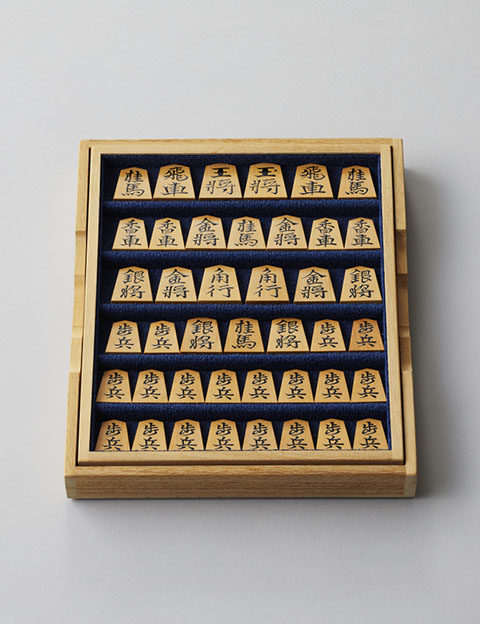
TENDO Shogi Koma (Japanese Chess Pieces)

Yamagata Prefecture

It all began in the late Edo period when the Oda clan, which ruled this region, was struggling financially. To alleviate this, they encouraged lower-ranking samurai to take up the side job of making shogi pieces.

  • Technology/techniques/raw materials

    Technology/techniques

    1. In preparing the wooden base for shogi pieces, the logs are cut into large pieces, small pieces, and then cut into individual pieces.

    2. In the case of written pieces, the writing shall be done directly on the wooden base of the piece using a brush and lacquer, in the style of calligraphy unique to shogi pieces.

    3. For carved chess pieces, the shading is traced from the character shape onto a letter template, the letter template with the shading is cut out, glued onto the chess piece base, carved with a carving knife, sealed, and then finished by applying lacquer, undercoat lacquer, or raised lacquer.
     

    raw materials

    1. For the base of the chess piece, the material shall be magnolia, Styrax japonica, Japanese maple, spindle tree, or boxwood, or a material of equivalent quality.

    2 漆は、天然漆とすること。

  • Work scene

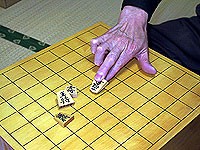
    Shogi pieces may seem simple at first glance, but in reality, there are various types, and the techniques used to play them differ accordingly.
    Here, we'll show you how carved chess pieces are made, including those with characters carved into them and filled with lacquer, raised chess pieces with characters that are raised on top of the piece, and traditional calligraphic chess pieces from Tendo.

    Step 1: Preparing the wooden base for the game pieces (drying and cutting).

    For the raw materials used to make shogi pieces, there are various types, such as boxwood (Hon-tsuge) for high-grade pieces and magnolia (Hon-no-ki) for standard and mid-grade pieces.
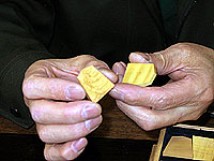
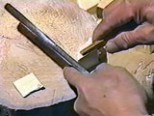
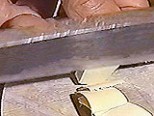
    After drying and ensuring the logs are no longer distorted in dimensions, they are processed into the shape of the game pieces. The logs are then cut into sections (or tubular pieces) to match the height of the game pieces. The tubular pieces are then split along the grain. This is called large-scale splitting. A hatchet is placed against the wood, and the top of the hatchet is struck once with a hammer, splitting the log with a satisfying sound.

    Step 2: Preparing the wooden base for the pieces (rough cutting to fine splitting)

    Using a slicing hatchet, the outer edge is shaved down to resemble stacked pieces, and then each piece is separated.
    After cutting off both ends of the wood, the sides are shaved to create the unique trapezoidal shape of the chess pieces. The bottom of the piece is shaved flat, and the top is also shaped into a mountain. Once this is done, the wood is split into individual pieces.

    Step 3: Pasting the lettering paper, carving, and sealing.

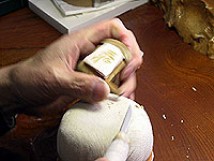
    After attaching paper with the characters written on it to the chess piece, the piece is fixed to a carving stand, and the characters are carved one by one using a carving knife. Skilled carvers use a technique called "openwork carving," where they carve directly into the piece without attaching the character template. There are various calligraphic styles for the characters that are carved, and a particular style created by an artist is specially called a "signature."
    The carved grooves are filled with a sealant such as animal glue or animal paste. Nowadays, glue is often used as a substitute.

    画像をクリックすると動画が再生されます

    Step 4: Applying lacquer, polishing, and finishing.

    Lacquer is applied to the grooves into which the characters are carved. Pieces with only the grooves coated with lacquer are called carved pieces, while pieces with the grooves completely filled are called carved and inlaid pieces.
    After applying the lacquer, the process of polishing the surface of the pieces is called "togidashi," which involves carefully grinding and polishing them using whetstones. Finally, the surface is polished using ceramics. This is called "setohiki."
    The carved and inlaid chess pieces are now complete.

    画像をクリックすると動画が再生されます

    Step 5: Raised slab

    To create raised chess pieces with letters that stand out, additional letters are layered on top of the letters already carved and inlaid on the pieces. Using a maki-e brush made from bundles of cat or mouse hair, the letters are gradually raised. Since it's not possible to apply a lot of lacquer at once, the process involves applying and drying the lacquer, applying and drying it, and gradually raising the letters.
    These raised chess pieces are used by professional shogi players in matches and are of the highest quality, difficult to manufacture. The feeling of the raised characters against your fingertips when you hold these pieces further sharpens the minds of shogi players who hold titles such as Meijin and Ryuo.

    Process 6: Calligraphy pieces

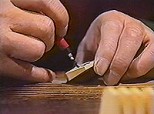
    The chess pieces traditionally made in Tendo are simply pieces on which characters are written. Even though they are simply written, writing characters on such small pieces with sticky lacquer requires highly skilled techniques.
    The calligraphic styles range from the common Kaisho (regular script) to the cursive script, which is comparable to that of a professional calligrapher. The art of calligraphy comes alive in these small pieces.


  • Close-up

    The craftsmanship embodied in these tiny shogi pieces TENDO Shogi Koma (Japanese Chess Pieces)

    You might think, "It's just a shogi piece," but in reality, TENDO Shogi Koma (Japanese Chess Pieces) are the result of masterful craftsmanship. The small works of art, woven from the wood grain and characters, stir the hearts of shogi players. The crisp sound of placing the pieces on the board is like a breath of fresh air that clears the mind.


    The whole town is filled with horses, horses, horses

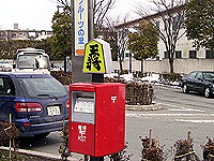
    Stepping off the train at Tendo station, you'll immediately notice shogi (Japanese chess) piece-shaped sculptures scattered throughout the town. Pieces on telephone poles, pieces on mailboxes, pieces on bridge railings. Even a first-time visitor will immediately realize that this town has a local industry of making shogi pieces.
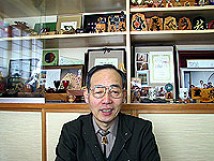
    In Tendo, the person who shared his story of shogi piece making was Tenryu Kunii, a craftsman who carves characters into the pieces. As his stage name, Tenryu, suggests, he is a leading traditional craftsman representing Tendo.

    The sculptures scattered throughout the town are advertising Tendo's chess pieces.

    Are craftsmen difficult and stubborn?

    "Hello, come on in. Come on in, come on in." I had been intimidated by the name, but as soon as I met him, all my tension instantly melted away. For those unfamiliar with traditional crafts, the world of artisans often conjures up an image of "difficult and stubborn people," but in reality, there are surprisingly many friendly people among them. Despite possessing skills of national treasure caliber, Mr. Tenryu Kunii spoke casually about the charm of making shogi pieces with a constant smile.
    "I started carving as a prank," says Kunii, who first put his knife into a chess piece when he was in junior high school. What began as a hobby at a nearby carver's house has now reached an unparalleled level of art.

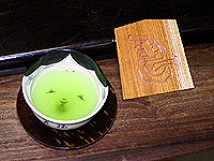
    I naturally find myself smiling when I drink tea.

    The beauty of the wood grain enhances the artistry of the pieces.

    "What do you think of this wood grain? Isn't it beautiful? This is called peacock grain. It's called that because it looks like a peacock spreading its feathers." There are many different types of wood grains, each with its own name. There's "straight grain" with its vertically straight lines, "tiger stripe" which resembles tiger's spots, and "root grain" which is cut from the root of the tree and has a beautiful marbled pattern, and so on. No two pieces of wood grain are the same; it's a work of art that only natural materials can offer. Just looking at them makes you happy.
    "The amount of force needed when carving varies considerably depending on the type of wood and the grain pattern." Through experience, his hands have memorized the appropriate amount of force to work with any type of wood. "I don't carve immediately after cutting it. The wood gradually shrinks." Being able to discern these characteristics of the wood and apply the techniques accordingly is something unique to natural materials.
    When the quality is good, the materials for just one set of chess pieces can fetch over 200,000 yen. "It's hard to get your hands on materials with good grain, so when I hear that a good one has become available, I buy it," he said.

    Finding a set with beautiful wood grain is difficult. That's something unique to natural materials.

    The peace of mind that wood grain brings

    I asked what kind of pieces professional shogi players use. "In matches, we always use 'akamasa' with a 'moriage' technique." Akamasa refers to pieces that are reddish in color and have vertical wood grain. Moriage is a technique where lacquer is filled into grooves where characters have been carved, and then layers of lacquer are carefully applied over the characters to make them stand out. While tiger stripe and rootwood may be visually beautiful, they might indeed feel distracting in a match where one's senses are heightened. Perhaps the slight raised texture of the characters that touches the fingertips can also give the shogi player intuition for their strategy. One is unknowingly drawn to its unfathomable depth.


    The carving technique is such that the carving knife seems to be drawn into the piece.

    "Shall we try carving a little?" As soon as Mr. Kunii said that, he began to hold the carving knife. "This technique is called 'openwork carving.' It's a technique where you carve directly into the piece without writing the characters on it first. There aren't many people who can do this." Before we knew it, characters were being carved into the blank piece of wood.
    The chess pieces carved by Mr. Kunii are then passed on to other craftsmen and transformed into raised-relief pieces. Then, he suddenly took out a piece and showed it to me. "What do you think of this piece? The lettering lacks power, doesn't it? This is machine-carved." Machine-carved pieces, in which the same font is engraved in the same position on every piece, become bland and lack individuality. It's hard to tell the difference unless you look closely, but there is definitely something different. Mr. Kunii's hand-carved pieces may look uniform to the untrained eye, but the slightest deviations convey the warmth of hand-carving. It is because he cherishes these differences that he is a craftsman.

    The depth and delicacy of the craftsmanship involved in making shogi pieces are far too profound to be dismissed as "just pieces." Experiencing the making of these pieces firsthand completely captivated me. And the clear, crisp "clack" sound when placing a piece on the board—this sound seems to purify even the soul. Perhaps what we need is the mental space and time to appreciate the pieces and enjoy playing shogi.

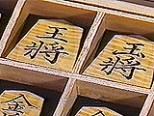
    Before I knew it, the characters for "King" were engraved in beautiful calligraphy.

    Craftsman Profile

    Tenryu Kunii

    A traditional craftsman, his numerous awards attest to his exceptional skill. He says he started carving "for fun and to earn some pocket money," but now his carving skills are among the best in Japan.

    Anecdotes

    The joy of wasting time playing shogi

    I hear that fewer people are playing shogi these days, due to the popularity of computer games that involve placing pieces on a shogi board. The sight of people playing shogi during their lunch breaks at work has practically disappeared. I wonder if office workers, especially those at high-tech companies, are less likely to play?
    Playing shogi takes time. I'm so busy I can't even find the time to play shogi. Before we know it, we're being controlled by machines designed to streamline our lives and free up time. The more technology advances, the busier we seem to get, for some reason.
    Perhaps the best way to calm down modern people is to "start by playing shogi." Is that too much to ask? Playing shogi requires not only time but also mental agility. You hold the pieces in your hands and think as you move them. It might be worth reconsidering shogi, as it could even help prevent early-onset dementia.
    "Now, now, take a break from your busy hands and how about a game?" If we start hearing voices like that, perhaps Japan will become a more peaceful place.

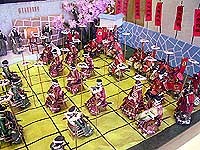
    "Human chess," where people are used as pieces. Surely this is taking up too much time?


overview

Craft item name TENDO Shogi Koma (Japanese Chess Pieces)
Reading Tendō Shōgi Koma
Classification of crafts Other crafts
Main Products Shogi pieces
Main manufacturing area Tendo City, Yamagata City, Murayama City
Designated date April 8, 1996

contact address

■ Production area association

Yamagata Prefecture Shogi Piece Cooperative Association
〒994-0013
1-3-28 Oinomori, Tendo City, Yamagata Prefecture
Inside the Tendo Chamber of Commerce and Industry
TEL: 0236-54-3511
FAX: 0236-54-7481

http://www.tendocci.com/koma/

Features

The characters are written on wooden bases such as Magnolia obovata, Styrax japonica, Japanese maple, Euonymus alatus, and Boxwood using natural lacquer. However, high-quality pieces are made by carving characters into genuine Boxwood and then applying lacquer in a raised layer. This company produces over 95% of the total Shogi pieces produced nationwide.

How to make it

The manufacturing process is divided into three stages: wood preparation, piece carving, and piece writing, and each piece is created through the combined efforts of skilled craftsmen.

Please see here for information on traditional craftspeople.

Japanese traditional craftsman
top