KOSHU Tebori Insho (Hand-carved Seals)

Yamanashi Prefecture

The "Koshu Shopping Guide," written in the late Edo period, contains a description indicating the existence of a woodblock printmaker in Kofu City who handled official seals, showing that craftsmen already existed and were engaged in the seal business at that time.
Other documents from the same period contain records of orders for premium hexagonal seals with grass inclusions (crystal mixed with grass and other materials, highly valued as seal material) and buffalo horn seal materials, indicating that seals made from various materials were being produced in Kofu City at that time.

  • Technology/techniques/raw materials

    Technology/techniques

    1. "Seal surface grinding" refers to flattening the seal surface using a whetstone.

    2. "Character insertion" means writing the characters in left-to-right letters within the frame after the print draft and character layout have been completed.

    3. If the seal material is boxwood or buffalo horn, the following techniques or methods shall be used:
    (1) Use a carving tool to create a rough carving while leaving the character portion intact.
    (2) Using a shaping knife, arrange the characters and finish them using the pushing-cutting method and the pulling-cutting method.

    4. If the seal material is crystal, the following techniques or methods shall be used:
    (1) Carving out the seal surface by striking it with a round chisel.
    (2) The process of finishing the characters by hammering a flat chisel made of metal.
    (3) Use a chisel to carve deeply and shape the concave surface.
     

    raw materials

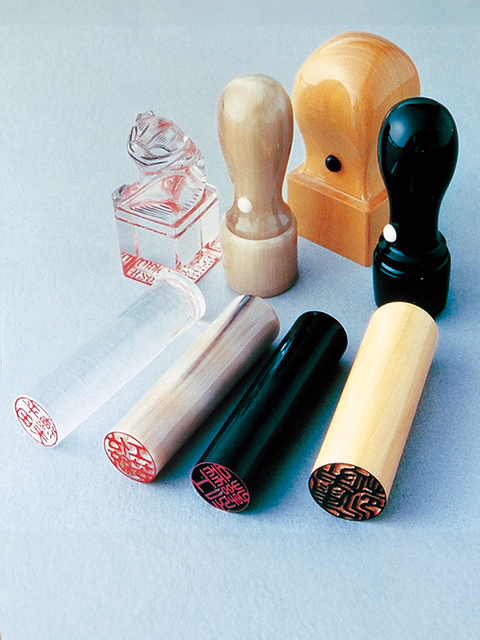
    The seal material should be boxwood, buffalo horn, or crystal.

  • Work scene

    Step 1: Printing the stamp surface

    The surface of the seal, made from materials such as boxwood, buffalo horn, or crystal, is flattened using a whetstone.

    Step 2: Lettering

    After preparing the design and layout, the left-hand characters (mirror images) are written within the frame of the seal.

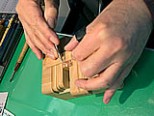
    Step 3: Carving (for boxwood and buffalo horn)

    (1) Using a carving knife called a kiteito, which is suitable for carving, rough carving is done, leaving the lettering intact.
    (2) Using a fine carving knife called a hansashito, the letters are shaped and finished. At this time, two carving methods are used: the oshikiri toho method, in which the knife is pressed while carving, and the hikikiri toho method, in which the carving is pulled while carving.

    Step 4: Carving (in the case of crystal)

    (1) To make the characters on the stamp face easier to read, paint the opposite side of the stamp face black with ink.
    (2) The seal surface is carved out by striking it with a round chisel made of metal (shaped like a large nail).
    (3) The letters are finished by hammering a flat chisel made of metal.
    (4) Use a chisel to carve deeply by hammering, and shape the concave surface.
  • Close-up

    One-of-a-kind seals in the world: KOSHU Tebori Insho (Hand-carved Seals)

    In an era where cheap seals are considered acceptable, machine-made seals are flooding the Japanese market. However, in Yamanashi Prefecture, there is a craftsman who has a deep affection for seals and continues to carve them by hand, contemplating their meaning. We spoke with Shozo Yokomori, who has been in this profession for 45 years.


    The history of "new" traditional crafts

    KOSHU Tebori Insho (Hand-carved Seals) are a "new" traditional craft, having only been certified in 2000 as the 194th such craft. "To receive certification, we had to prove that the seal-making technique has a history dating back to the Edo period," says Shozo Yokomori. The various documents he immediately showed me clearly showed the relationship between Koshu and hand-carved seals. "Crystal ore was discovered in Yamanashi. That's how crystal crafting began in the Edo period, and the seal materials were made at the same time as the crystal polishing techniques." Crystal, seals, and Inden (a type of leather craft). These three representative traditional crafts of Yamanashi have followed their own paths but have been closely intertwined. In the showcase of Mr. Yokomori's shop, Nisshin Insho, crystal seals are sold in Inden cases. Yamanashi now enjoys the title of "Kingdom of Seals." It is said that 90% of the seals given to junior high school graduates and other schools are produced in Yamanashi.

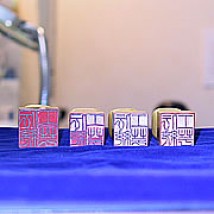
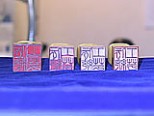
    Starting from left to right, the red areas are being carved.

    A seal has true meaning precisely because it is one of a kind.

    The craftsman affectionately calls the seals "hanko." "Hanko spread rapidly throughout Japan after the Meiji era. It was after a decree from the Grand Council of State that ordinary citizens and the people must use hanko. Before that, ordinary citizens didn't even have surnames." However, the history of hanko itself doesn't date back to the Kamakura or Heian periods, but surprisingly, to the time of the Mesopotamian civilization. Even in this traditional world of hanko, mechanization is progressing. So why does Mr. Yokomori insist on hand-carving? "A hanko only has true meaning if it is one of a kind. It's something that proves who you are. If you use characters that are read by a machine, no matter who carves it, the 'mountain' will always be the same 'mountain'. But with hand-carving, no matter how many times the same person carves it, no two will ever be exactly alike. It's only natural that no two hanko should be the same." That's why the difficult seal script is used, to make it difficult to create identical seals. A seal carries the weight of saying, "This one document protects all your assets."

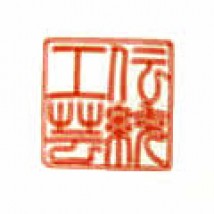
    The beauty of hand-carving can only be truly appreciated by imprinting the seal impression.

    The impression of the seal. I really want you to see the real thing at least once. Now, when you look at the impression of this hand-carved seal, you are simply amazed by the thinness of the characters and the beautiful lines. The characters, which are thinner than pencil, are clearly and beautifully imprinted in red. The delicate curves of the characters are something you wouldn't notice just by looking at the seal itself. What if this was my name? To have my name engraved in these characters, which I could never write myself. And to be able to use it however I like. Just looking at the impression pressed onto a piece of paper fills me with such excitement.
    Even so, to write such thin characters not with a pen, but with a brush, not only writing them left-to-right (mirror writing) from the beginning, and to carve these thin, beautiful characters without making even the slightest mistake—this is truly the work of a master craftsman.
    Yokomori says he is captivated by the artistry of expressing the beautiful lines of Japanese characters. "It's not my job, but I often enter the seal carving section of calligraphy exhibitions to hone my skills." Powerful, large-format works are displayed in his shop.

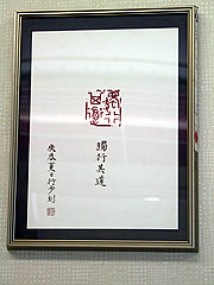
    • "Dokugō Sodō" (Living Alone on His Own Path), a work that won a special prize at the Yomiuri Calligraphy Exhibition.

    Reflecting on the Western spread of seals

    As the IT society and paperless trend continue, the culture of seals is also undergoing significant changes. The increase in electronic transactions and the elimination of paper contracts are leading to a decline in the use of seals. While some believe that "seals are deeply rooted in Japanese culture and will surely survive," others feel that "the Western expansion of seals might be a touchstone for exploring their appeal." When demonstrating seal making in Germany, the unexpected delight of the Germans gave a hint for expanding into the West. This traditional Japanese craft is steadily gaining attention overseas. "I dream that one day, young people in the West will use seals instead of signatures," he says.

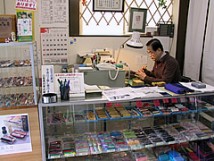
    Mr. Yokomori's shop, Nisshin Insho. It's both a shop and a factory.

    Craftsman Profile

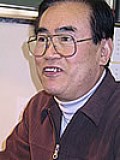
    Shozo Yokomori

    I've been doing this for 45 years.
    "Technical aspects are challenging, but expressing the beauty of the characters is the most difficult part, isn't it?"

    Anecdotes

    A hand-carved seal that reflects your personality and will last a lifetime.

    What kind of stamp do you use every day without giving it much thought? Do you feel any joy when you stamp it? When you stamp, it's like a single red dot on a white piece of paper. The weight of the red in the stamp, the beauty of the red in the stamp. By placing the final stamp on a sheet of white paper, balance is achieved, and meaning is created. The meaning of a stamp is proof of yourself. Sometimes you might stamp it casually as a hobby mark, and other times you might stamp it with the weight of responsibility as a guarantor. But no matter the situation, in this country, stamping a stamp is an expression of your own will.
    A seal that acts as a substitute for yourself. Why not create a lifelong piece that truly reflects your personality? The exquisite delicacy of the lines and the beauty of the curves. And what if your name is engraved on it...? A seal that makes you happy and joyful to use—that's a hand-carved seal.

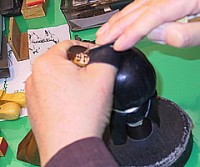
    • This is how the letters are hand-carved.

overview

Craft item name KOSHU Tebori Insho (Hand-carved Seals)
Reading Koshūteboriinshō
Classification of crafts Other crafts
Main Products stamp
Main manufacturing area Kofu City, Ichikawamisato Town (Nishiyatsushiro District), Minobu Town, Showa Town (Nakakoma District), and others.
Designated date July 31, 2000

contact address

■ Production area association

Yamanashi Prefecture Seal Shops Cooperative Association
406-0032
1569 Yokkaichiba, Isawa-cho, Fuefuki City, Yamanashi Prefecture
Inside Yamanashi Traditional Crafts Center
TEL: 055-263-7240
FAX: 055-263-7240


Features

The development of crystal polishing techniques, including the manufacture of crystal seal materials and the engraving of characters on the seal surface, has extended to materials such as boxwood and buffalo horn, forming an industrial structure not seen in other prefectures. All businesses involved in seal material manufacturing, seal engraving, and sales are concentrated in Yamanashi Prefecture, and this structure continues to this day.

How to make it

The main processes differ slightly depending on the raw material used (boxwood, buffalo horn, or crystal), but they encompass a wide range of steps, including adjusting the seal surface, drafting the design, laying out the characters, engraving, rough carving, adjusting the seal surface, straightening the characters, and finishing. Furthermore, each step is performed by hand using traditional tools such as a base carving knife, a stamping knife, a round chisel, a flat chisel, a scrubbing knife, a small mallet, a carving stand, and a carving rod stand. The impressions produced by seals that have undergone particularly skilled handiwork, such as character engraving and character correction, possess a unique and unparalleled charm.

Please see here for information on traditional craftspeople.

Japanese traditional craftsman
top