MARUGAME Uchiwa (Fans)

Kagawa Prefecture

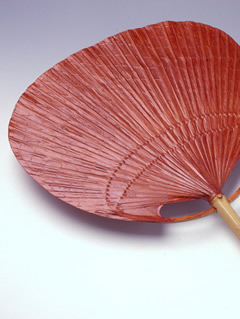
A traditional Japanese fan bearing a gold circle seal was created as a souvenir for pilgrims visiting Konpira Shrine in Shikoku.
In the mid-Edo period, the Marugame domain encouraged its samurai to make fans as a side job, laying the foundation for today's MARUGAME Uchiwa (Fans) making. It now accounts for approximately 90% of the total fan production in Japan.

  • Technology/techniques/raw materials

    Technology/techniques

    1. The frame preparation involves cutting, splitting, shaping the handle, shaping the sickle, weaving, and attaching the bamboo using a bamboo saw, hatchet, cutting machine, knife, striking rod, and measuring stick.

    2. The application shall be carried out using the following techniques or methods:
    (1) Use a brush, a brush, and a spatula for application.
    (2) For cutting out the shapes, use a pair of pruning shears or a sickle.
    (3) Use a brush and a small knife to trim the edges.

    3. Use a spatula or a grooving machine to make grooves.
     

    raw materials

    1. The bamboo used shall be Madake, Hachiku, Medake, or timber of equivalent quality.

    2. The yarn used for knitting should be cotton yarn.

    3. The base paper shall be Japanese paper (washi).

    4. When coloring the paper, use persimmon tannin, natural lacquer, pigments, dyes, or materials of equivalent quality.


  • Work scene

    Process 1: Tree removal

    The bamboo material is cut into tubes averaging 40-45 cm in length, and then split into a consistent width suitable for making fans. This technique takes advantage of the bamboo's property of splitting straight. Furthermore, the inner nodes are shaved off. This process creates the pleasant feel when holding the fan.

    Step 2: Splitting

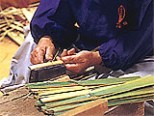
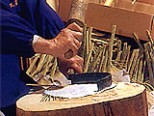
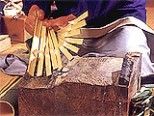
    Using a "cutting machine," an incision is made about 10 cm from the tip of the stalk. There are 35 to 45 stalks, but they are split at the same interval. It is an incredibly fast job, and skilled craftsmen can process 500 to 800 stalks a day.

    画像をクリックすると動画が再生されます

    Step 3: Drilling holes

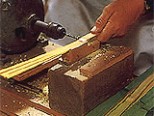
    Using a drill, holes are made in the nodes of the bamboo to pass the sickle (yumi-dake). The sickle itself is made using the skills of another craftsman.

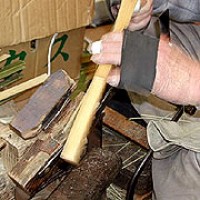
    Step 4: Handle shaping

    The handle is carved with a small knife, and various processing techniques are applied depending on the type of fan. This is the finishing process for the handle.

    Step 5: Knitting

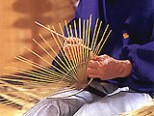
    The process involves weaving together the bowheads, which are threaded onto bamboo poles. This is primarily women's work, although in the past children also helped. With practiced hands, they skillfully weave, producing an average of 300 to 400 bows per day.

    画像をクリックすると動画が再生されます

    Step 6: Attachment

    The process involves shaping the bamboo ribs of the woven fan, correcting any irregularities in the weaving, and securing them with thread to ensure symmetry. This is a skilled and demanding task, and in the past, the craftsman was sometimes called a "attacher."

    Step 7: Application

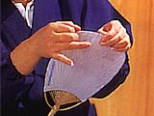
    Apply glue to the tip of the fan's frame and attach the paper base to it.

    Step 8: Cutting the shape

    Depending on the type of fan, the bristles are shaped into a full moon, an egg, or other shapes. This process, which involves striking the bristles with a sickle and a wooden mallet, is also called "tataki" (beating).

    Step 9: Edge trimming

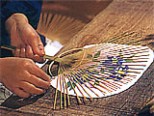
    A long, narrow strip of paper called "hemigami" is attached around the edge of the fan to make it safe. After this, "mimi" are attached to both ends of the fan, and it is pressed with a roller to create grooves, completing MARUGAME Uchiwa (Fans).


  • Close-up

    MARUGAME Uchiwa (Fans), nurtured in a castle town with a gentle breeze atmosphere.

    The production of Marugame fans, which flourished in the early Edo period, has continued to develop as a representative local industry, boasting approximately 90% of the national market share, and was designated a national traditional craft in 1997.
    Although the demand for fans is declining, these charming fans remain a beloved symbol of Japanese summer.


    A souvenir from a pilgrimage to Konpira Shrine, distributed throughout Japan.

    "Welcome to Marugame, the town of castles and fans," said Mr. Yano, chairman of the Kagawa Prefecture Fan Cooperative Association, cheerfully as he spoke about the tradition, history, and future prospects of MARUGAME Uchiwa (Fans). "The fact that all the materials could be sourced locally is the reason why fans have developed so much in Marugame. Also, in the past, pilgrims from all over the country bought these fans as souvenirs when visiting Konpira Shrine, which greatly contributed to our growth." But what about the practical aspects of fans as everyday items? "While it is a traditional local industry that boasts a 90% share of the national market, demand has decreased due to rapid changes in lifestyles, and we are going through a difficult time. However, in order to protect the fan industry, we are continuing our efforts as an industry, such as developing designer fans that can also be used as interior decorations and high-end fans as folk crafts." "Fortunately, along with the growing need for a more comfortable and prosperous lifestyle, there is a growing trend to re-recognize traditional culture, and we are seeing bright signs for the fan industry," Mr. Yano said passionately.
    "And above all, it's ecological," he added. "MARUGAME Uchiwa (Fans) are 'genuine practical items' nurtured by history. Genuine items are wonderful when they are made, and the more you use them, the more their wonderfulness comes out as a character. The makers talk to the natural materials as they put the tools into place. The feel of MARUGAME Uchiwa (Fans), how easy it is to fan yourself with—there is a value that only genuine items possess," he said emphatically until the end.

    Mr. Yano, Chairman of the Kagawa Prefecture Uchiwa Cooperative Association

    A skill honed over 50 years using only bamboo.

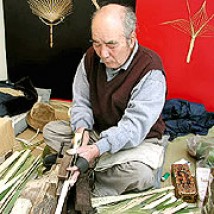
    Masayuki Takaide, a traditional craftsman, was born in 1928. He is still actively making traditional fans.
    "The most important thing for a fan is the material. That's right, bamboo. Three to five-year-old moso bamboo is the best. It has the most elasticity. It makes me happy when I see good bamboo. Bamboo from very fertile land is no good. It has too much moisture, and bamboo that is too shiny is also unsuitable for fans," Mr. Takade said, splitting the bamboo with a cutting machine, his face showing how much he cherishes bamboo.
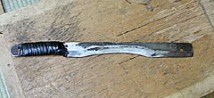
    "Next up are bladed tools. Look at this sword, it's in this state, but it's still in active use," he said, showing me a sword with a worn-down blade. "How long have you been using that sword?" I asked. "I don't know," Mr. Takade replied. "It might be since I started working. A craftsman's tools are his lovers, you can't do good work if you don't take good care of them." Mr. Takade undoubtedly possesses a spirit that the Japanese people have forgotten.

    Masayuki Takaide, a traditional craftsman

    My apprenticeship involved constantly splitting bamboo and learning by observation.

    When asked, "What was it like for apprentices to craftsmen in the old days?", Takade replied, "I got fed up after the first two months. I was splitting bamboo all day, and my hands ached. But I didn't have any other talents, so I just endured it and continued splitting bamboo for several years. My master didn't teach me anything. That's how it was back then. You could just say he was 'taciturn,' but it's not something you can teach. I learned everything by watching how my master moved his hands, how he held the blade, the angle. That's how everything was back then. And then I would look at the finished product." "All he would say was, 'Do it again.' It was a constant cycle of that. It was tough, but I had no choice. Eventually, I started to work in sync with the bamboo, and I was able to split it fairly well the way I wanted. That's when my master stopped telling me to 'do it again.' But even though I've been working with bamboo for almost 50 years now, I can't cut corners. The finished fan is everything. The real thing has a different grip on the handle, and you don't need any strength to blow air with it." I envied the smile on the face of Mr. Takade, the "craftsman" who splits bamboo with the lightning speed of a magician, as he recounted the life of the craftsman.

    A sword worn down in the middle

    Anecdotes

    Mr. Takade's prized machine is a cutting machine.

    "This cutting machine was invented in 1913 by someone from Marugame. It makes 36 cuts on this 1.5cm wide bamboo handle."
    The machine has just a tiny bit of "play" in the part that moves the blade, and it is this subtle gap that makes it possible to perform this seemingly miraculous 0.5mm wide cut.
    Mr. Takade, who explained the cutting machine over and over again, made a strong impression on me. And no matter how many times I saw it, I couldn't help but be impressed by his craftsmanship, which made me think, "Wow! That's amazing!" I couldn't help but feel a sense of respect for him.

    • My pride and joy, the "cutting machine"


overview

Craft item name MARUGAME Uchiwa (Fans)
Reading Marugame Uchiwa
Classification of crafts Other crafts
Main Products fan
Main manufacturing area Marugame City
Designated date May 14, 1997

contact address

■ Production area association

Kagawa Prefecture Uchiwa Cooperative Association Federation
763-0054
25-1 Nakatsu-cho, Marugame City, Kagawa Prefecture
Inside MARUGAME Uchiwa (Fans) Museum
TEL: 0877-24-7055
FAX: 0877-43-6966

https://marugameuchiwa.jp/cooperative


Features

A distinctive feature of MARUGAME Uchiwa (Fans) is that the handle and frame are often made from a single piece of bamboo. Both round and flat handles are available.

How to make it

The frame of a fan is made by carving bamboo such as Madake or Hachiku. Next, washi paper is carefully pasted onto the frame, and if color is to be added, persimmon tannin or natural lacquer is applied.

top