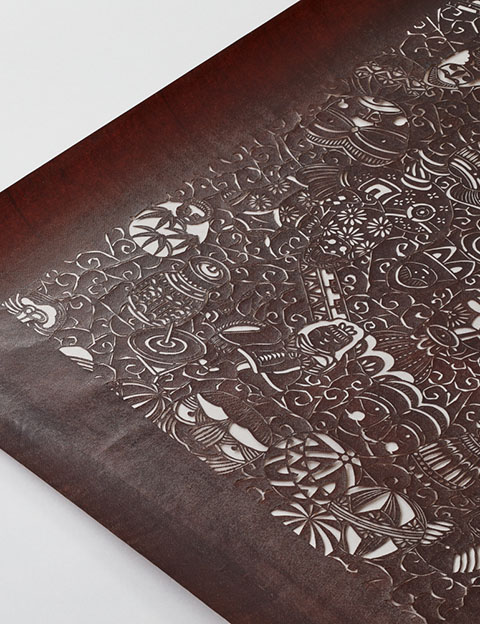
ISE Katagami (Paper Stencils)

Mie Prefecture

The history of ISE Katagami (Paper Stencils) is long, and there are various theories about its origins. However, since a painter from the Muromachi period depicted dyers using stencil paper in his "Shokunin Zukushie" (Illustrations of Craftsmen), it is thought that stencil paper existed as early as the end of the Muromachi period.
During the Edo period, the area received protection from the Kishu Domain, which controlled what is now Wakayama Prefecture and southern Mie Prefecture, and developed, centered around the villages of Shiroko and Jike.

Note: ISE Katagami (Paper Stencils)) are designated as a "traditional craft tool" by the Minister of Economy, Trade and Industry.

  • Technology/techniques/raw materials

    Technology/techniques

    1. For "making the frame," use a "paper cutting knife."

    2. For "papering," use persimmon tannin.

    3. "Drying" refers to either "natural drying" or "indoor drying."

    4. The carving shall be done by "drill carving," "tool carving," "protrusion carving," "pull carving," or "striped carving."

    5. When performing "thread insertion," use raw silk.
     

    raw materials

    1. The paper used for the pattern shall be handmade mulberry paper, mitsumata paper, or ganpi paper, or paper of equivalent quality.

    2. The persimmon tannin must be aged for at least four years.

  • Work scene

    The process of making ISE Katagami (Paper Stencils) is broadly divided into two stages: making the stencil paper and carving. The production of the stencil paper is carried out only here in the entire country.

    Process 1: Ridge construction

    200 to 500 sheets of MINO Washi (Papers) are stacked and cut to standard dimensions.

    Step 2: Papering

    Three sheets of washi paper are glued together in a plywood-like manner, alternating vertically, horizontally, and vertically along the grain of the paper, using persimmon tannin. Washi paper is strong in the horizontal direction but weak in the vertical direction. By gluing the three sheets together alternately, a strong paper is created that has no weak points no matter which direction it is cut. In addition, washi paper coated with persimmon tannin has water-resistant properties, as it was once used for Janome umbrellas.

    工程3: 乾燥

    After the paper has been coated, it is left to rest for 1-2 days to increase the adhesive strength of the persimmon tannin. Then, it is pasted onto a cypress board and dried in the sun. On a sunny summer day, it will dry in about an hour.

    Step 4: Drying indoors

    The dried paper is placed in a smoking chamber (the temperature inside is about 40 degrees Celsius) and smoked with cedar sawdust for about a week. It is then soaked in persimmon tannin, dried, and smoked a second time. This process hardens the persimmon tannin, which forms a film between the fibers of the laminated Japanese paper. This results in a dark brown paper (raw paper) that is water-resistant, suitable for carving, and does not shrink easily.

    Step 5: Completion of the stencil paper.

    The paper is then soaked in persimmon tannin once more, sun-dried, then air-dried indoors, and the surface is inspected before it becomes stencil paper. This process takes about 45 days. Before it is actually used as paper for carving stencils, it is left to mature for another 1-2 years.

    工程6: 彫刻

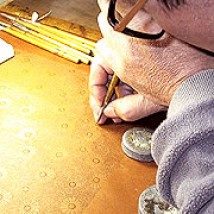
    There are four carving techniques: drill carving, tool carving, thrust carving, and pull carving. Drill carving involves holding a carving tool with a semicircular tip perpendicular to the stencil paper, firmly fixing both arms on the table, and rotating the drill to carve small holes. Patterns are created by a series of circles, and these are shipped out as stencils for Edo komon (a type of Edo-period patterned paper). For very intricate designs, as many as 900 circles may be carved into a 3cm square.
    In the case of thrust carving, 5 to 8 sheets of stencil paper are stacked and placed on a stand called an anata, and a small knife with a long blade is used to carve forward by thrusting it vertically.
    In tool carving, various patterns are carved using carving tools that are shaped like flowers, fans, diamonds, and other shapes. Some tool carvers own as many as 3,000 carving tools.
    One of the representative techniques of pull carving is striped carving. A steel ruler is used to guide the carving in one continuous motion. For finer details, it is possible to carve 11 stripes within a centimeter.

    画像をクリックすると動画が再生されます

    Step 7: Stretching the gauze and inserting the threads.

    Tool carving, thrust carving, and pull carving can result in large carved areas depending on the design, making them very weak and sometimes requiring reinforcement for dyeing. Gauze reinforcement is a method of attaching thin silk threads of gauze with lacquer, and is used for patterned designs.
    Currently, the thread insertion is only done on striped stencils. If used as is, the fine stripes might tear, making them unsuitable for dyeing, so silk thread is inserted between two sheets of paper for reinforcement. Even a slight misalignment would render the stencil unusable, requiring extreme concentration.

    画像をクリックすると動画が再生されます

  • Close-up

    The masterful techniques that carry on the beauty of Komon (small patterned fabric)

    ISE Katagami (Paper Stencils) are used when dyeing patterns and designs for Yuzen dyeing, komon (small-patterned kimono), and yukata (summer kimono). In particular, 99% of komon kimonos nationwide are dyed using stencils shipped from Ise. We spoke to an artisan who continues to dedicate himself to komon kimonos.


    I became a craftsman the day after graduating from junior high school.

    ISE Katagami (Paper Stencils), designated as a traditional craft tool, has four carving techniques depending on the pattern being expressed: kiribori (drill carving), dogubori (tool carving), tsukibori (point carving), and shimabori (striped carving). Among them, the second-generation Rokutani Baiken is a craftsman specializing in kiribori. His father, the first-generation Rokutani Baiken, was a Living National Treasure in kiribori. He started working the day after graduating from junior high school. "It was around the time my father was informally designated as a Living National Treasure, and it was desirable to have a successor. In my case, it was a special circumstance, but many people who ran the family business naturally took over, and I had a feeling that I would take over after watching my parents work since I was little."

    Carving steadily and calmly at a consistent rhythm.

    The carving of ISE Katagami (Paper Stencils) begins with the creation of tools.

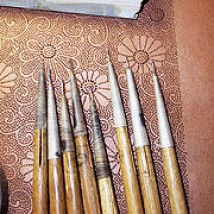
    "I've been helping out since elementary school, so I learned how to carve by watching and imitating. I don't remember ever having any particular difficulties with carving." However, he says he did have trouble making carving tools. For awl carving, he uses a semicircular carving tool, and he makes them himself by cutting and bending steel, ranging from those with a radius of less than 1 millimeter to larger ones. He has more than 200 carving tools, each with slightly different thicknesses. "I knew how to make and sharpen tools by looking at their shapes and how to make them, but with blades, you can't become a pro unless you experience the hardships yourself. It took me 20 years to finally understand the sharpness and how to sharpen them. Even now, sometimes when I think I've made the blade exactly as I wanted, I can't carve properly." So, "I think about a lot of things when I'm carving. Sometimes I just let the sound play in the background. But when I'm making tools, I'm desperate." Every New Year, he sharpens each and every blade of his carving tools. It takes him 10 days to sharpen more than 200 of them, but he says he does it as an annual event.

    The carving tools that Mr. Rokutani uses

    Things I learned from my predecessor

    "I worked with my predecessor for 20 years. You learn skills by watching, but you also learn passion and attitude towards work by watching. When I caught a cold, I would think about taking a day off, but my father continued working tirelessly day after day." I also asked him about the pressure. "Of course I felt it, but I tried my best not to think about it. Besides, I was able to work with my master for half of my (craftsman's) career. The only thing I can say is that I don't know if I'll ever surpass my master in the future, but I certainly didn't (in my lifetime). So I'm hoping to live at least one year longer."

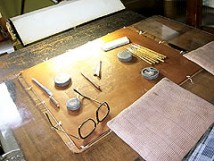
    A workbench. It measures 24 x 39 centimeters and will take about three weeks to complete.

    Kimono are Japan's national costume, so they will never disappear.

    As people stopped wearing kimonos as everyday wear, the demand for kimonos as luxury items also decreased after the bubble economy burst. Among his peers, the decline in kimono wear and the lack of successors are topics of conversation. Mr. Rokutani himself has no successors. "Even if I can pass on the techniques, I can't get them work. Even if they spend decades practicing and acquire the skills, what about their future? I can't take responsibility for that. If I'm going to pass on the skills, I want them to make it their main profession." Several people have wanted to become his apprentices in the past, but each time he has sent them away telling them to "go to school." However, Mr. Rokutani stated emphatically, "I hope that kimonos will never disappear because they are the national costume of Japan."

    I entrusted my hopes to a kimono with a small pattern.

    Rokutani, who said she wants to focus on komon kimonos, concluded by saying, "Until now, I've often been asked by kimono companies to design patterns like this. From now on, I want to design my own komon kimonos and create something that has never been seen before. Of course, it has to be something that not only I will like, but that everyone will be happy with. And I hope to meet people who understand the charm of ISE Katagami (Paper Stencils) and want to work with them. Those are my two hopes."

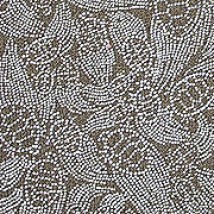
    Small patterned fabric dyed using a stencil by Mr. Rokutani

    Craftsman Profile

    Rokutani Baiken

    He has been engaged in ISE Katagami (Paper Stencils) dyeing) since 1953.
    A traditional craftsman who makes a living by creating small-patterned kimono fabrics.

    Anecdotes

    The Challenge of ISE Katagami (Paper Stencils) A First Step Towards a New Tradition


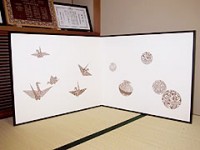
    • A charming sliding door made with ISE Katagami (Paper Stencils)

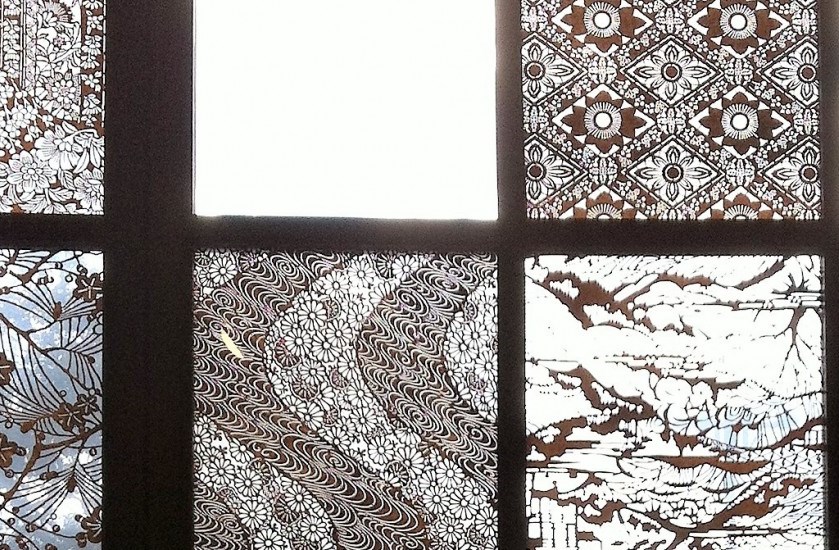
    • Art stencils come in a wide variety of patterns.

overview

Craft item name ISE Katagami (Paper Stencils)
Reading Isekatagami
Classification of crafts Craft materials and tools
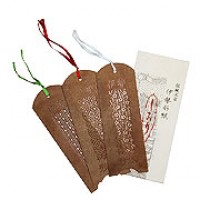
Main Products Dyeing tools, arts and crafts, interior decor
Main manufacturing area Suzuka City
Designated date April 27, 1983

contact address

■ Production area association

ISE Katagami (Paper Stencils) Cooperative Association
510-0254
3-10-1 Jike, Suzuka City, Mie Prefecture
Inside the Suzuka City Traditional Industries Hall
TEL: 059-386-0026
FAX: 059-386-7511

http://www.isekatagami.or.jp/

Features

ISE Katagami (Paper Stencils) is a traditional craft tool used to dye patterns and designs onto kimono fabrics, such as Yuzen, yukata, and komon.

How to make it

There are four carving techniques for ISE Katagami (Paper Stencils): ● Pull carving: The inner stripe carving ruler and carving knife are pulled towards the user to carve even stripes. ● Thrust carving: Five to eight stencil papers are placed on a stand called an anata (hole board), and the carving progresses by thrusting a small knife vertically into the surface. ● Tool carving: Carvings are made using carving knives whose blades are shaped like flowers, fans, diamonds, etc. ● Drill carving: This is a technique for carving small patterns, such as "same-komon" (sharkskin pattern), "gyogi-toshi" (gyogi-style pattern), and "arare" (hailstone pattern), using a carving knife with a semicircular tip.

Please see here for information on traditional craftspeople.

Japanese traditional craftsman
top