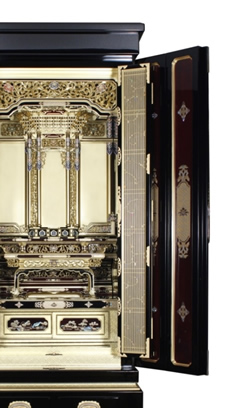
HIROSHIMA Butsudan (Household Buddhist Altars)

Hiroshima has long been a region where Jodo Shinshu Buddhism flourished. In the early Edo period, the techniques of metalworkers, cypress woodworkers, and lacquerers who had moved from Kishu were established, and later, a monk named Tonko traveled to Kyoto and Osaka to learn advanced manufacturing techniques for Buddhist altars and religious implements, which led to the establishment of HIROSHIMA Butsudan (Household Buddhist Altars).
During the Meiji era, the products were shipped nationwide using the convenient water transport routes of the Seto Inland Sea, but they suffered devastating damage during World War II. After the war, they were revived, carrying on the traditions of the past.

  • Technology/techniques/raw materials

    Technology/techniques

    1. The structure of the "wooden base" is assembled using "mortise and tenon joints".

    2. Palace construction should be based on the "masugumi" (square-frame) method.

    3. The painting shall be done by hand using refined lacquer.

    4. Apply maki-e (lacquerware with gold or silver powder) and gold leaf.
     

    raw materials

    1. The base wood shall be cedar, pine, cypress, or timber of equivalent quality.

    2. The metal fittings shall be made of copper, a copper alloy, or a metal of equivalent material.

    3 漆は、天然漆とすること。


  • Work scene

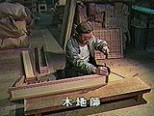
    Step 1: Wood base

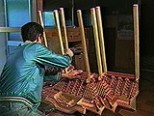
    First, a woodworker uses cypress or cedar wood to create the frame, ceiling, and pillars. After purchasing the wood, it is dried in the sun for over a year. HIROSHIMA Butsudan (Household Buddhist Altars) are made to order; each time an order is placed, a woodworker selects the appropriate wood and creates the altar. It is said that even a veteran woodworker can take 10 days to 2 weeks to make a single altar.

    Step 2: Building the Palace

    Next up is the palace craftsman. They assemble numerous small wooden carvings, from cylindrical pillars to roof tiles, and connect them with glue. The palace craftsman's work is the source of the entire process, as they bring together the various parts of the Buddhist altar according to their arrangement.

    Step 3: Wood carving

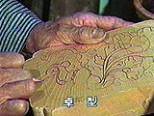
    Next comes the carver, or sculptor. They cut out the wood according to the design and carefully carve it. The creation process requires many tools, and how they use them appropriately is a testament to the craftsman's skill. Even for an experienced carver, it takes about a week to ten days to complete a piece.

    画像をクリックすると動画が再生されます

    Step 4: Tabletop type

    Next is the part called the tabletop, which requires extremely detailed work. The design is drawn on the partially carved piece, and then it is carved and hollowed out by hand. At this point, the base is completed.

    Step 5: Lacquering

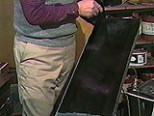
    The fifth step, the lacquerer's job, involves applying lacquer to the finished pieces. A base coat of wood is applied, and then refined lacquer is brushed on and allowed to dry. By repeating the process of undercoating, intermediate coating, and final coating, a deep, rich color and luster are created.

    Step 6: Decorative metal fittings

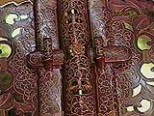
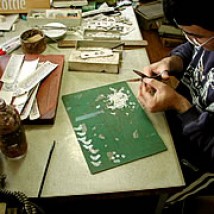
    Decorative metalworkers create hinges for commonly used parts such as doors, as well as many decorative metal fittings. These fittings are beautifully finished through metal engraving, accompanied by a pleasant sound. Copper and brass are the main materials used because they are easy to gold plate and process into intricate shapes. Decorative metalwork includes flat engraving (hair engraving), three-dimensional carving (ground carving), and relief carving, which is somewhere in between.

    工程7: 蒔絵

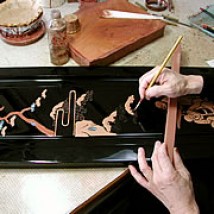
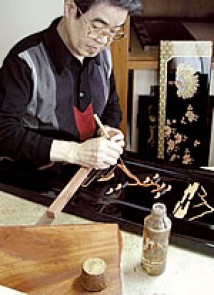
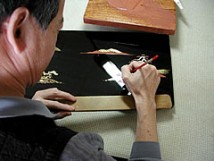
    The maki-e artist's job is to paint an underpainting with lacquer on the lower half of the Buddhist altar, which has already gone through the lacquering process, and then sprinkle pure gold powder on top to finish it off. After that, it is dried and the final touches are applied, and this is a crucial step in creating the luxuriousness and unique three-dimensionality of HIROSHIMA Butsudan (Household Buddhist Altars).

    画像をクリックすると動画が再生されます

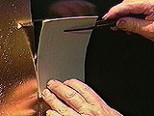
    Step 8: Foil stamping

    The eighth step is called gold leaf application. The interior decoration of HIROSHIMA Butsudan (Household Buddhist Altars) is created using this gold leaf application process. This involves pressing each approximately 12-centimeter square piece of gold leaf onto the gold leaf application lacquer, aligning the edges, and finishing the process. The success of this process depends on the condition of the lacquer application. The gold leaf is then left to dry in a special room for eight hours until it is completely adhered.

    工程9: 組み立て

    Finally, the process that brings together all the previous steps is called assembly. The parts that have gone through the eight stages are brought together, assembled, metal fittings are attached, gauze is stretched over the shoji screens, and the parts are polished. In this way, the magnificent HIROSHIMA Butsudan (Household Buddhist Altars) is finally completed.


  • Close-up

    Artworks nurtured by Jodo Shinshu Buddhism: HIROSHIMA Butsudan (Household Buddhist Altars)

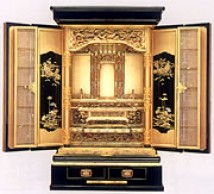
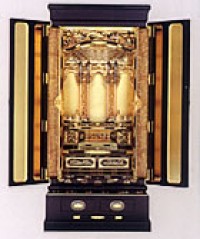
    Buddhist altars are not merely places to enshrine ancestors and the deceased; they can also be seen as places to represent and worship the invisible Pure Land and Amida Buddha. Shinshu Buddhist altars represent the Pure Land and are covered in gold leaf, which is central to HIROSHIMA Butsudan (Household Buddhist Altars).


    HIROSHIMA Butsudan (Household Buddhist Altars) that have walked alongside the Aki sect

    In Hiroshima, where Jodo Shinshu Buddhism is prevalent, the manufacture of Buddhist altars for followers has long been thriving. However, initially, the technology was still in its developmental stages. In 1619, when Asano Nagaakira was transferred from Kishu, he brought with him skilled lacquer craftsmen, which dramatically improved the manufacturing techniques for Buddhist altars. Later, in 1716, a monk named Atsutaka returned after studying Buddhist altar and ritual implement techniques in Kyoto and Osaka, establishing the advanced techniques of HIROSHIMA Butsudan (Household Buddhist Altars). In the Meiji era, when shipments began to be made outside the prefecture, Hiroshima's production became the largest in the nation by the end of the Taisho era, thanks in part to its advantageous location on the Seto Inland Sea, a key transportation route for transporting the bulky Buddhist altars.

    HIROSHIMA Butsudan (Household Buddhist Altars) are appealing for their luxuriousness and elegance.

    The atomic bomb caused devastating damage.

    When discussing Hiroshima, it's impossible to avoid mentioning the atomic bomb. Many Buddhist altar craftsmen lived near the hypocenter, and many lost their lives. After the war, the craftsmen who had been deployed and those who remained worked together to revive HIROSHIMA Butsudan (Household Buddhist Altars), and demand gradually increased. When the people of Hiroshima put their hands together in front of a Buddhist altar, they are not only honoring their ancestors, but also praying for true world peace, something that comes from their experience of being a victim of the atomic bomb.

    Work requires concentration

    The magnificent beauty unique to a gold Buddhist altar

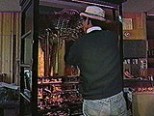
    The defining characteristic of HIROSHIMA Butsudan (Household Buddhist Altars) is their magnificent beauty, achieved through the use of gold leaf, the finest material. These gold altars are the mainstream of HIROSHIMA Butsudan (Household Buddhist Altars). Another characteristic is their similarity in form to the Osaka style. At each stage of the altar's creation, seven master craftsmen compete to showcase their skills. These are the woodworkers, carvers, palace builders, altar builders, decorative metalworkers, lacquerers, and makie (gold lacquer) artists. Masuda, a makie artist, is a veteran with 54 years of experience in this field. He describes the appeal of his work, which is both difficult and interesting, saying, "Makie on Buddhist altars lacks the durability of everyday lacquerware, but it demands luxury." "The most difficult part is making the lacquer; if it dries unevenly and not evenly, the gold powder that is sprinkled on next will also be uneven." The timing of sprinkling that gold powder is where the craftsman's years of experience and skill really come into play.

    Mashida-san at work

    Reliable work is supported by good tools and materials.

    While many tools are now mechanized, HIROSHIMA Butsudan (Household Buddhist Altars) still rely heavily on traditional, handcrafted techniques. "My biggest concern now is that we can no longer make good maki-e brushes. The materials must not be good. Brushes are very important; a good brush makes the work go much more smoothly," Mr. Mashida says, his usually gentle face clouding over for a moment. Good handiwork is also supported by good tools. The lifespan of a maki-e brush is about one month. Beyond that, the bristles become unusable, and it becomes impossible to draw delicate lines. "I'm very happy when I can draw something I like, but I always try to do consistent work, without any good or bad results," Mr. Mashida says, his expression truly warm. Perhaps it's because he always thinks of the people who quietly pray behind the altar as he paints. He sometimes demonstrates the production process at events so that more people can learn about the charm of HIROSHIMA Butsudan (Household Buddhist Altars). However, demonstrating the maki-e technique is difficult at the moment due to concerns about skin irritation in the audience. It seems that new chemical paints are being developed as an alternative to lacquer, but it will take many years to see results. Natural materials are gentler and the best, which is probably why they have been passed down unchanged for so long.

    • Finely chop the shells to be used as garnish.

    • For a maki-e artist, the brush is very important.

    Craftsman Profile

    Izuku Mashida

    Traditional craftsman, Yoshio Mashida, has been in this profession for 54 years, having started in 1947. He concentrates his mind on the intricate details of his work.

    Anecdotes

    The size and color of Buddhist altars reflect housing conditions.

    While the names for Buddhist altar sizes vary from region to region, HIROSHIMA Butsudan (Household Buddhist Altars) use a number (1 number is approximately 3 centimeters) to indicate the width of the inner board. Currently, the best-selling size is called No. 18, which accounts for about two-thirds of total shipments. Previously, the No. 24 size was the mainstream, so it has become about 20 centimeters smaller. Even smaller sizes are now available, and with the increasing number of homes without a Japanese-style room, designs that suit Western-style rooms are also being developed. In addition, while black and gold were previously the main colors, recently, colors such as colored lacquer, silver, and white are being used, and modern designs that match interiors are gaining popularity. HIROSHIMA Butsudan (Household Buddhist Altars) are flexibly embracing the times while preserving tradition. However, the feeling of respect for ancestors will surely remain unchanged.

    • A Buddhist altar room without a built-in storage compartment, size 21, long body.


overview

Craft item name HIROSHIMA Butsudan (Household Buddhist Altars)
Reading Hiroshima Buddhist Altar
Classification of crafts Buddhist altars and Buddhist ritual objects
Main Products gold altar
Main manufacturing area Hiroshima City, Mihara City, Fukuyama City, Fuchu City, Miyoshi City, and others
Designated date February 6, 1978

contact address

■ Production area association

Hiroshima Religious Goods Commercial and Industrial Cooperative Association
730-0033
2-16 Horikawa-cho, Naka-ku, Hiroshima City, Hiroshima Prefecture
Mimura Matsu Co., Ltd.
TEL: 082-243-5321
FAX: 082-246-0440

Features

HIROSHIMA Butsudan (Household Buddhist Altars) use gofun shitaji, a base coat made from finely crushed oyster shells, a specialty of Hiroshima, as their base material. They are renowned for their "tate-nuri" topcoat technique and also excel in gold leaf application. The style is similar to that of Osaka-style altars.

How to make it

The manufacturing process is divided into several departments: woodworking, palace construction, carving, metalwork, maki-e (gold lacquer) and lacquering. The woodworking department uses cedar, pine, cypress, or equivalent materials as raw materials and constructs the altars using mortise and tenon joints. The palace construction is done using box joints. The lacquering department is responsible for everything from the undercoat to the top coat and gold leaf application. The pieces made in each department are then assembled to create a single Buddhist altar.

Please see here for information on traditional craftspeople.

Japanese traditional craftsman
top