
Miyagi Kokeshi Dolls
Naruko kokeshi dolls, born of the gentle hearts of wood turners of old
They always look like someone you know, these charmingly simple Naruko kokeshi dolls with their round noses and sweet smiles. They say professional wood turners first made them as dolls for their children and that was the start of a beautiful craft tradition.
As toys
As much as 200 years ago there was a wood core turning trade in Naruko, deep in the mountains of Miyagi, and those wood craftsmen would occasionally turn their hands to making toys for their own children. Maybe the children of the mountain villages looked at the pretty kimonoes and lovely hair ornaments painted on the dolls and dreamed of seeing the real thing one day. Dolls, it seems, play the same role in any age. The difference today is that most of the toys children play with are mass-produced and not many children get the chance to handle handmade toys any more. This is also the case with the kokeshi doll, which has virtually changed from plaything to ornament in this modern age.
Mr Hideo Oonuma, Naruko kokeshi doll maker, made these kokeshi for his granddaughter to celebrate the Doll's Festival.
The first doll makers were wood turners
The first kokeshi doll makers were professional woodturners and the craftsman I interviewed for this article, Mr Hideo Oonuma, was also trained to turn wooden bowls and trays.
Bowls made by Mr Oonuma many years ago. He first trained as a wood turner of bowls.
Characteristics of Naruko kokeshi dolls
The Naruko kokeshi doll has its hair painted on as if it is tied up on top of the head but with some hair hanging by the side of the face. The eyes are single slits and the nose is round. The body decorations include double chrysanthemums shown side-on, "waterwheel" chrysanthemums, maple leaves, native carnations, and peonies. Another big characteristic of the Naruko kokeshi is that the neck squeaks when it is turned to the delight of children. Wearing its beautiful kimono and dignified smile, the Naruko kokeshi has a lovely countenance that seems somehow familiar.
The faces always remind you of someone.
Making his own tools
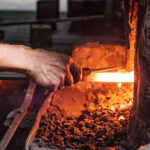
As Mr Oonuma showed me how the dolls are made. I spotted many tools that I had never seen before. "Where do you buy your tools?" I asked. "You can't buy these tools," he replied. "I make them all myself in my own forge." He reminded me that the making of tools is basic to the woodturner's trade. "It's the same as cooking -- if you eat something and don't enjoy it, it's better to make it yourself." He says even if he buys a tool he will always alter it in some way to suit himself. The craftsman is the only one who knows his own habits and his own strength, so it is best for him to make his tools while trying them out.
"If you want tools that are easy to use, make them yourself. That's fundamental to the craft."
Mr Oonuma is wearing a head towel advertising the all-Japan kokeshi festival held in Naruko, Miyagi Prefecture, every September.
Profile
Hideo Oonuma
He is the 4th generation of a family of doll makers making the Oonuma Iwataro type of Naruko kokeshi.
The designs he uses have been handed down in his family.
The Yajiro kokeshi, born in a valley of the towering Zao mountain range
The Yajiro kokeshi doll is part of the history of the Kamasaki hot spring which is wedged between tall mountains in the Zao mountain range. Their bright colors make them vastly different from the other Miyagi kokeshi dolls. These bright colors, which look so beautiful against the verdant mountain foliage here, must have charmed all who visited this hot spring town.
Dogwood with its great life force
Quite a variety of different woods are used now to make the Yajiro kokeshi doll, including cherry, camellia and maple, but the wood it is famous for is the lovely white dogwood. Dogwood trees are cut down every autumn to spring between the equinoxes. The bark is removed straight away and the trunks are stood upside down for six months to a year to dry out. If they are not turned upside down they are likely to sprout again in the coming spring, even after six months or more after having been cut. Such is the amazing life force of these trees that can survive in the harshest conditions of the cold north. Maybe because such a hardy wood is used to make them you can sense a hidden strength in the kokeshi dolls behind their quiet smiles.
After cutting the trees, he strips the bark so the wood will dry more quickly, and stands the trunks upside down so they will not sprout.
From the one region
Craftsman Mr Sakyo Niiyama, who I interviewed for this story, told me he wants to use dogwood that has been raised in the cold conditions of the north. But the amount of dogwood timber available has been dwindling every year and the local craftsmen have had to content themselves with wood brought in from elsewhere. However, Mr Niiyama has been planting dogwood saplings in the mountains behind his house for the past 26 years, ever since the peak of kokeshi doll production in this region, and he says that next year some of the trees will finally be big enough to use for his work.
So the lovely turned wood surface and bright colors of the original Yajiro kokeshi dolls will be revived again in the craft of Mr Niiyama as his hopes of the past 26 years bear fruit.
A piece of dogwood waiting for turning and painting to transform into a beautiful and simple Yajiro kokeshi doll
A once-in-a-year encounter
Many kokeshi doll makers turn the torsos one day, paint them another. One of the reasons for this is that it is hard to paint with a steady hand after doing the physically demanding job of turning for many hours.
The craftsmen need their greatest powers of concentration when they are painting the faces on the dolls. They put in the eyes first and this is like investing the dolls with life. "The expression on the face of the first doll of the day and the tenth can be quite different," Mr Niiyama tells me. "The tenth is always better." It seems the craftsman's hand moves more smoothly as he warms up. And Mr Niiyama says modestly that even though he has been making dolls for 55 years, in one year there is perhaps one in a hundred dolls with a really beautiful face, one which he immediately feels, "Yes, that's it!" And he believes it is not always the ones that he concentrates on the most that turn out the best. After all these years he is still giving all he has to make as many dolls that satisfy him as he can.
Composing himself, he begins to paint the face. As soon as the eyes are painted it is as if the doll comes to life.
His workplace is where he feels at home
"This is my favorite place," he proclaims, referring to his workroom containing his lathe. The switch has been turned off and the place is silent. He guides me to the place where his painting utensils.
I was a little surprised to find that he did his art work here as I had imagined a place with a more tranquil atmosphere, perhaps a tatami room. But this is where he throws his whole body behind the hard physical work of turning and also where he can feel most at ease to do the quieter tasks. I suppose every artisan needs a place where he can pour all his spirit into his craft. And for Mr Niiyama this place with his lathe is indispensable for him to do work in a way that he feels most comfortable. He first comes face to face with a doll when he picks up a piece of dogwood here in this workshop. Or is it when he first plants the saplings in the mountains.
He applies his signature to the doll. The ink stone he uses is a Miyagi prefectural traditional craft, Ogatsu ink stones.
Profile
Sakyo Niiyama
Has been making Yajiro kokeshi dolls for 55 years in the same tradition as when they started at the beginning of the Edo period (1600-1868).
He has been planting mizuki dogwood trees for the timber to make the dolls for 26 years.
Togatta dolls: a different kokeshi culture in every valley
There are four types of kokeshi dolls in the Miyagi kokeshi tradition and they exist in regions deep in snowy mountains, the skills having been passed from one valley to the next where they took on a new life of their own.
Togatta beauties
The characteristics of Togatta kokeshi dolls include the eyes depicted with two slits, a straight nose and a pert little mouth. But, above all, what makes them different are the red ray-like streaks on the top of their heads which are meant to represent hair ornaments -- not any hair ornaments but those used by the geisha of Kyoto. Why would a Kyoto geisha be the model for a doll developed so deep in these northern mountains and so far away from the ancient capital?
It appears that Kyoto dolls reached these deep mountains around the time that the kokeshi genre was being developed. They included toys whose clothes could be changed as well as dolls for display. These were dolls that could not have been made by any ordinary person -- they all wore splendid kimonoes made of Nishijin brocades and were decorated with precious pigments and gold leaf. Dolls based on these Kyoto models were also made in Sendai, as they still are today. But where had the people from the deep mountains first seen either the Sendai or the Kyoto dolls? No one really knows. But the fact is that a wood turner in the mountains somewhere decided he wanted to show the children of his village the beauty of such dolls. So he gave his kokeshi the refined nose and mouth of the Kyoto dolls and copied their hair ornaments. Togatta dolls have come down in this form today.
A wood turner's desire to show children the beauty of Kyoto dolls developed into the Togatta kokeshi doll.
Only in Tohoku
This part of northern Japan, which has many famous spas deep in the mountains. has been a Mecca for spa bathing for health and healing from ancient times. After the feudal age ended and the modern age began with the Meiji era (1868-1912), it became increasingly possible for the farmers in these deep mountains to travel to hot springs in neighboring valleys. They would go to heal themselves in the hot springs after the farm work was suspended with the onset of snow. Such a visit was like a reward for hard work, and many of the hot spring goers would take home kokeshi dolls as souvenirs.
The whole kokeshi culture in the north, in fact, grew up and thrived out of the Japanese gift-giving custom. There are many spas all throughout these volcanic islands of Japan and because of the abundance of trees, there were usually wood turners as well. This happy combination contributed greatly to the development of the kokeshi tradition. But only in the Tohoku region. Why?
It may have been because of the very harsh winters of this northern area. There were not many activities that farmers could engage in while it snowed, but one of them was woodturning. This was combined with the opportunity created by the fact that many people visited the hot springs during the winter and they all wanted souvenirs. So we can say the kokeshi culture owes its very existence to Tohoku's harsh winters. On top of that was a good balance between demand and supply. Under these favorable circumstances, the Tohoku wood turners were also able to improve their skills.
Togatta Hot Spring. Over the ages many people have crossed the mountains to come here to heal and relax. The kokeshi doll was a prized souvenir of the visit, and this led to the development of a kokeshi doll culture.
Mountain ranges the border lines of kokeshi culture
Just as different cultures exist over the seas, different cultures also developed in mountain valleys in the time before tunnels and trains. There are 11 different kokeshi types in Tohoku, all of which developed because of the deep snow in the mountains that divided the valleys from one another. These 11 can be broadly divided into two major categories according to the way that the lathe was used. Turners on the Pacific Ocean side of the Oou Mountain Range used the lathe upright while the Japan Sea side turners used the lathe on its side.
The many mountains of the Zao range. These mountains stopped the flow of information between valleys, so independent cultures developed. As a result there are 11 types of kokeshi dolls in Tohoku.
Profile
Tetsuro Sato
Born 1932
Started woodturning at age 15.
He is the 7th generation of a family specializing in the Togatta Kichiroubei type of kokeshi.
His turning work is especially clean-cut and smooth.
Watching over the children of Sakunami
Sakunami Hot Spring in Sendai has a history of 1,200 years. The kokeshi doll became a popular souvenir of a visit to the spa there. Elementary school children in the region now receive kokeshi as graduation souvenirs. A love for the kokeshi is undoubtedly engraved in the hearts of the people here along with their love for the spa.
Exquisite cold-climate dogwood
The Sendai Sakunami region is on the border between Miyagi and Yamagata. Just over the border is Yamagata City.
Dogwood trees from which the Sakunami kokeshi are made come mainly from Yamagata. These Yamagata trees grow in particularly harsh conditions whipped by the cold winds of the Japan Sea. As a result they are slow to grow and their grain is tight. Mr Kenichi Hiraga, who makes Sakunami kokeshi dolls, tells me that trees that have grown slowly certainly do have a more beautiful grain. But the timbers used for furniture and housing in recent years in Japan have changed dramatically from tight-grained domestic woods to fast-growing timbers and those brought in from overseas. The kokeshi made in Sakunami, however, rely on the beauty of the wood grain for their high-class finish, and traditionally local craftsmen have used only local timbers that have suffered through harsh winters. This hard-won timber seems to impart a special edge to the beauty of the Sakunami dolls.
The grain of the dogwood, which grows in places so cold that snow lingers on the ground till early April, is especially beautiful.
As children's toy
Of course, before they became hot spring souvenirs, kokeshi dolls were children's toys. In the case of Naruko and Togatta kokeshi, children used to carry the dolls around on their backs like babies or play with them by changing their clothes. And that is why they are shaped as they are. But in Sakunami, a couple of valleys away, the children played with kokeshi dolls like rattles while they were being carried round on their mothers' backs. For this reason they had to be small enough for a baby to hold. Today there are many sizes, large and small, but the originals were small.
Nor were Sakunami dolls made to be stood up and viewed as ornaments like they are today, so they were not necessarily steady on their pins. It was in the process of turning them into ornaments that stands were eventually attached to their bases.
Sakunami dolls have thus been adapted to suit new needs over the years and traditional techniques came to be established and passed on. But in whatever age they were made the way that different craftsmen handled the making of the dolls has always been an individual thing.
Over the years Sakunami craftsmen developed dolls with a heavy base so they would be more useful as souvenirs.
Watching over children
In Sakunami every child receives a personalized Sakunami kokeshi at the end of their six years of elementary school education. This was a tradition started by Mr Hiraga 14 years ago. His workshop makes the dolls just before graduation time every year and he paints on the children's names as a finishing touch.
When these children finally leave school and go out into the world they may not stay in Sakunami. But Mr Hiraga hopes that the dolls he makes will quietly watch over their progress wherever they may be and one day when they pick up the dolls again they will recall happy memories of their childhood in their home town.
The kokeshi making tradition was passed on from Kenichi's father Kenjiro (rear in photo) to him, and Kenichi will pass it on to his own son, Teruyuki
Profile
Kenichi Hiraga
He has been making kokeshi dolls for elementary school graduation presents for 14 years.
Even when they move away from Sakunami, youngsters from the town are bound to think of their home when they see their kokeshi dolls again.